
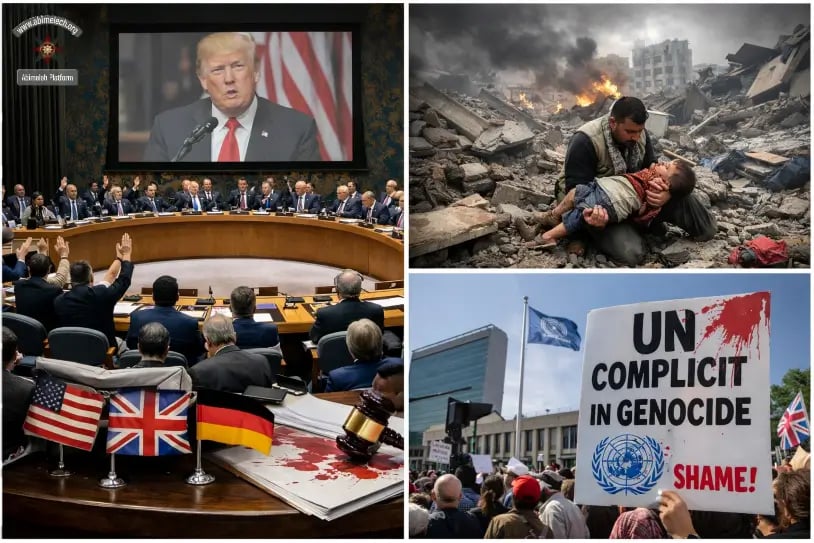
 UN Security Council Resolution 2803 rebrands genocide as ‘peace,’ shields the perpetrators, and imposes foreign guardianship over the survivors.
A Legal Report by the Tribe of Abimelech Platform
Published by: The Tribe of Abimelech | ʿAshīrat Ḥasanāt Abū Muʿailiq
Published through: Tribe of Abimelech Platform
Date of Submission: December 20th, 2025
Subject: UN Security Council Resolution 2803 (S/RES/2803) as a Criminal Instrument to Conceal Genocide, Shield Perpetrators, and Impose Foreign Guardianship Over Palestine in Violation of International Law
I. INTRODUCTION: A CRIME AND ITS COVER-UP
On 17 November 2025, the United Nations Security Council (UNSC) adopted Resolution 2803 (S/RES/2803), supporting a unilateral American colonial mandate denominated the "Trump Declaration for Enduring Peace and Prosperity," which the Security Council euphemistically described as a "Comprehensive Plan to End the Gaza Conflict." This Report demonstrates that Resolution 2803 constitutes not a genuine peace initiative but a juridical instrument for obstruction of justice under Article 70 of the Rome Statute. UNSC Resolution 2803 constitutes an unprecedented escalation of UN institutional complicity in ongoing Palestinian Genocide. The foundational mischaracterization requires immediate correction. Palestine is not experiencing "armed conflict" between symmetrical belligerents. Palestine is subjected to genocide as defined in Article II of the Convention on the Prevention and Punishment of the Crime of Genocide (1948). Characterizing systematic genocide and prolonged unlawful occupation of a UN member state as mere "conflict" constitutes discursive concealment that enables continuation of crimes against humanity by systematically obscuring the legal reality of ongoing genocidal operations, thereby facilitating perpetrator impunity.
This is a crime.
UNSC Resolution 2803 operates as a criminal mechanism designed to:
(a) conceal ongoing genocide through systematic omission of binding judicial findings;
(b) obstruct accountability for perpetrators and accomplice states potentially liable under Articles 25(3)(c) and 28 of the Rome Statute; and
(c) reward the states most complicit in facilitating mass atrocities, particularly the United States, United Kingdom, and Federal Republic of Germany, with formal juridical control over the surviving population.
The resolution systematically extinguishes the fundamental rights of the Palestinian people across all Occupied Palestinian Territory, Gaza, the "West Bank," and East Jerusalem, including the rights of Indigenous Palestinian tribal confederations such as the Tribe of Abimelech (ʿAshīrat Ḥasanāt Abū Muʿailiq) of Be'er es-Seba/Beersheba, the Tribe of Brahmiyya of Tel es-Safi/Gath, and the Tribe of Zamāʿirah of Halhoul, in systematic violation of Article 3 (self-determination), Article 10 (no forcible removal), Article 18 (participation in decision-making), Articles 25-26 (territorial rights), and Article 33 (Indigenous identity determination) of the United Nations Declaration on the Rights of Indigenous Peoples (UNDRIP).
Implementation of Resolution 2803 constitutes authorization for ongoing genocide and the transnational economy of genocide sustaining it, including arms manufacturing, military aid transfers, diplomatic protection rackets, and reconstruction profiteering to persist through coordinated actions of accomplice UN member states, including the State of Israel (perpetrator state), the United States of America (principal accomplice providing $17.9 billion in military aid), the United Kingdom, Federal Republic of Germany, French Republic (European arms suppliers), Persian Gulf states including Saudi Arabia, United Arab Emirates, and Qatar (normalization facilitators and Board of Peace participants), and permanent Security Council members including the People's Republic of China and Russian Federation (abstaining from accountability measures).
Resolution 2803 authorizes a UN member state against which genocide charges have been brought before the International Court of Justice, whose senior officials are subject to outstanding ICC arrest warrants for war crimes and crimes against humanity, to maintain military occupation and continue perpetrating systematic sexual violence (Article II(b) violations), physical assaults constituting torture under the Convention Against Torture, and administrative erasure of entire extended families from civil registries. Acts constituting "deliberately inflicting on the group conditions of life calculated to bring about its physical destruction" under Article II(c) of the Genocide Convention, as though genocide were a legitimate commercial transaction rather than the supreme international crime.
Absent immediate withdrawal, Resolution 2803 constitutes an unprecedented escalation of United Nations institutional complicity in the ongoing Palestinian Genocide, potentially rendering the UN system itself complicit under Article 25(3)(c) of the Rome Statute.
WITNESS TESTIMONY:
We have suffered over a century of oppression, military occupation, and genocide. Entire families, clans, and tribes have been targeted and erased from civil registries for being children of indigenous tribes of the 'Holy Land,' otherwise known by its indigenous name Canaan and Palestine. We are being killed in the streets, desecrated even after death, and body parts stolen from those murdered. Enough of this terror. The UN has not failed the Palestinian people; it has enabled and continues to enable their genocide." - Bajis Hasanat Abu Mu'ailiq, Tribe of Abimelech
This Report is submitted by the Tribe of Abimelech Platform, representing an Indigenous Palestinian tribal confederation possessing documented genealogical continuity, ancestral territorial claims, and juridical standing under the United Nations Declaration on the Rights of Indigenous Peoples. Our ancestral territories encompass the southern corridor of the land historically and biblically known as Canaan, identified in Indigenous Palestinian nomenclature for over 4,000 years as Palestine (Filasṭīn). Our tribal communities have maintained continuous habitation in the Gerar Basin (Wadi al-Sharīʿa), the Naqab/Negev/Beersheba region, Gaza and its littoral, the Hebron highlands, Jerusalem and Upper Lifta, and extending toward Wadi Musa and Karak in present-day western Jordan, as well as diasporic communities in Sudan and Hijaz.
Members of our extended families, clans, and tribal branches are among the 70,000+ Palestinians who have been killed, the 10,000+ forcibly disappeared, and the thousands subjected to sexual violence, torture, starvation, and systematic destruction during genocidal operations initiated in October 2023 and continuing through December 2025. We submit this Report in our capacity as direct victims, survivors, and witnesses to the crimes that Resolution 2803 systematically conceals, and as Indigenous peoples asserting our rights under UNDRIP to participate in all decision-making processes affecting our lands, lives, and political future.
By December 2025, documented minimum casualties exceeded 70,000 Palestinians killed in Gaza, constituting acts under Article II(a) of the Genocide Convention. Over 10,000 persons remain missing, presumed buried beneath systematically destroyed infrastructure, detained in undisclosed torture facilities, or subjected to enforced disappearance. Thousands of women, men, and children have been subjected to rape, sexual violence, and sexual torture, constituting Article II(b) violations. Thousands have been burned alive through the use of incendiary weapons targeting residential structures. Children died from engineered starvation including members of the Tribe of Abimelech, Article II(c) violations. Hospitals, maternity wards, and neonatal intensive care units were systematically destroyed. In vitro fertilization (IVF) clinics housing thousands of cryopreserved embryos were deliberately targeted and destroyed, Article II(d) violations (imposing measures intended to prevent births within the group).
Binding Judicial and Expert Determinations
The International Court of Justice determined (26 January 2024) that Palestinians possess "a plausible right to be protected from genocide" and issued binding provisional measures pursuant to Article 41 of the ICJ Statute ordering cessation of acts falling within Article II of the Genocide Convention. The UN Human Rights Council's Independent International Commission of Inquiry formally determined (September 2025) that the State of Israel is committing genocide against Palestinians in Gaza, documenting commission of four of the five prohibited acts enumerated in Article II of the Genocide Convention: (a) killing members of the group; (b) causing serious bodily or mental harm; (c) deliberately inflicting conditions calculated to bring about physical destruction; and (d) imposing measures intended to prevent births. Amnesty International published a comprehensive forensic report (December 2024) concluding that genocide has been and continues to be perpetrated. Pre-Trial Chamber I of the International Criminal Court issued arrest warrants (November 2024, Warrant Ref. ICC-01/18) for Israeli Prime Minister Benjamin Netanyahu and former Defense Minister Yoav Gallant for war crimes under Article 8 and crimes against humanity under Article 7 of the Rome Statute, finding reasonable grounds to believe both accused bear criminal responsibility for starvation as a method of warfare, murder, extermination, persecution, and intentionally directing attacks against civilian populations.
Resolution 2803 mentions none of this.
Resolution 2803 does not reference the ICJ's genocide findings.
It does not acknowledge the death toll. It does not mention war crimes, crimes against humanity, or genocide. It contains no provisions for accountability, reparations, or justice. It does not reference the ICC arrest warrants. It ignores the documented sexual violence, torture, and engineered famine. Instead, it "welcomes" a plan designed by the United States, the primary arms supplier and diplomatic shield for the genocide, and installs the President of the United States as chair of a "Board of Peace" that will govern Gaza without Palestinian consent.
This is not peace. This is the legal architecture of impunity.
This Report demonstrates through legal analysis, evidentiary documentation, and witness testimony that Resolution 2803 constitutes:
(1) A deliberate juridical mechanism to conceal ongoing genocide and obstruct international criminal justice, potentially constituting an offense under Article 70 of the Rome Statute (offenses against the administration of justice, including corruptly influencing witnesses or interfering with evidence gathering);
(2) An instrument designed to shield perpetrator and accomplice states, primarily the United States (principal arms supplier), the State of Israel (perpetrator), European arms-exporting states including United Kingdom, Germany, and France, and Persian Gulf states facilitating normalization, from criminal accountability under Articles 25(3)(c) (complicity) and 28 (command responsibility) of the Rome Statute and Article III(e) of the Genocide Convention;
(3) A systematic violation of the Palestinian people's right to self-determination, recognized as a peremptory norm of general international law (jus cogens) under Article 1 of the International Covenant on Civil and Political Rights, through imposition of foreign colonial guardianship absent free, prior, and informed consent as required under Article 19 of UNDRIP;
(4) A violation of Indigenous peoples' rights under the UN Declaration on the Rights of Indigenous Peoples (UNDRIP); and
(5) An ongoing threat to the lives, lands, and cultural survival of Indigenous Palestinian communities, placing them in danger of extinction on their ancestral lands, including the Tribe of Abimelech.
We demand that the International Criminal Court, the Office of the Prosecutor, and all States Parties to the Rome Statute:
(1) Affirm that Resolution 2803, a political instrument of the UN Security Council, cannot supersede, nullify, or modify binding legal obligations under Article VI of the Genocide Convention (establishing criminal jurisdiction for genocide) and the jurisdictional mandates of the International Criminal Court established under the Rome Statute. The resolution is therefore legally null and void insofar as it purports to grant impunity or obstruct international criminal proceedings;
(2) Continue and expedite all proceedings against individuals bearing criminal responsibility for genocide, war crimes, and crimes against humanity perpetrated in Gaza and across Occupied Palestinian Territory, including immediate enforcement of outstanding arrest warrants against Benjamin Netanyahu and Yoav Gallant, and expansion of investigations to additional senior officials;
(3) Investigate state complicity under Article 25(3)(c) (aiding, abetting, or otherwise assisting in commission of crimes) and command responsibility under Article 28 of the Rome Statute, specifically examining the roles of: the United States of America ($17.9 billion in military aid); United Kingdom (arms exports and diplomatic protection); Federal Republic of Germany (accelerated weapons transfers); French Republic, Canada, and Persian Gulf states (Saudi Arabia, United Arab Emirates, Qatar) in facilitating genocide through military aid, arms transfers, intelligence sharing, diplomatic shielding, normalization agreements, and adoption of Resolution 2803 as an obstruction mechanism;
(4) Recognize and affirm the rights of Indigenous Palestinian communities, including the Tribe of Abimelech and all Indigenous Canaanite tribal confederations, to territorial restitution of ancestral lands in the Gerar Basin, Beersheba/Be'er es-Seba, Gaza, Hebron, and the Naqab/Negev unlawfully expropriated during 1948-1950 genocidal operations; to unimpeded access to sacred covenant sites including wells, burial grounds, and shrines; and to exercise self-governance and self-determination under Articles 3, 4, 5, and 23 of UNDRIP within the framework of Palestinian national sovereignty.
II. INDIGENOUS JURIDICAL STANDING AND VICTIMIZATION UNDER INTERNATIONAL LAW
A. Juridical Indigenous Status, Covenant Territory, and Canaanite Genealogical Continuity
The Tribe of Abimelech (ʿAshīrat Ḥasanāt Abū Muʿailiq) constitutes an Indigenous Palestinian tribal confederation whose genealogies, covenantal memory, kinship networks, and territorial claims are inextricably rooted in the southern corridor of ancient Canaan, now denominated Palestine under international law. According to tribal oral history and locally preserved genealogies, the core of the tribe traces its ancestry to the ancient Kingdom of Gerar, associated in biblical and archaeological literature with the Wadi al-Sharīʿa / Nahal Gerar basin and the ruins known today as Khirbet Umm Jarrar and Khirbet Abū Muʿailiq, situated between Gaza and Beersheba.
Today, regarded by Palestinian and regional historians as the oldest and largest tribe in Palestine, the Tribe of Abimelech's presence extends from the Hebron highlands through Jerusalem, across to Haifa, down to Gaza and Beersheba, and onward toward Wadi Musa and Karak in present-day western Jordan, with historic ties also reaching Sudan and Hijaz in modern Saudi Arabia.
The tribe is organized as a confederation of extended families and allied households. The prosopographic grid preserved in family manuscripts and oral testimony identifies a central node, Hasanat and Abū Muʿailiq, surrounded by branches in Beersheba and the Naqab; the Gaza littoral, especially Deir al-Balah; the Hebron area including Deir al-Dhabbān; Upper Lifta encircling Jerusalem; Marj bin Madi near Haifa; Wadi Musa and Karak in Jordan; and diasporic extensions in Sudan and the Hijaz.
For the Tribe of Abimelech, the covenant at Beersheba, the "well of the oath" (Be'er as-Sab'a) between Abimelech of Gerar, identified in biblical records as the King of Palestine, and the Prophet Abraham, constitutes a foundational legal instrument governing territorial rights, water access, and inter-community non-aggression. This covenant is not historical mythology but a binding juridical obligation transmitted across generations, linking Indigenous peoples to specific wells, wadis, and cultivated lands. The tribe upholds covenantal fidelity: treaties are inviolable, guests receive protection, and theft of water or land under religious pretexts is categorically rejected.
Recent archaeogenetic research corroborates the long-term demographic continuity of Indigenous populations in the southern Levant. Genome-wide analysis of Bronze Age skeletal remains from multiple archaeological sites demonstrates that contemporary Arabic-speaking populations of the region, including Palestinians, derive substantial ancestry from Bronze Age Canaanite populations, evidencing unbroken population continuity across three to four millennia. The Tribe of Abimelech situates its Indigenous status within this convergence of scientific, archaeological, toponymic, and genealogical evidence, while asserting that Indigenous oral history, kinship records, and land-based memory constitute primary legal evidence of territorial rights under UNDRIP Article 26, superseding colonial cartographic impositions.
B. Structures of Genocide: Theological Deception, Discursive Dehumanization, and Material Destruction
Ongoing genocidal operations against Palestine and specifically against the Tribe of Abimelech and Indigenous Canaanite tribal communities constitute neither "armed conflict" nor "war" under the laws of armed conflict. These operations constitute a coordinated international crime of genocide, as defined in Article II of the Convention on the Prevention and Punishment of the Crime of Genocide (1948), perpetrated through three interlocking mechanisms: theological-ideological biblical deception, discursive dehumanization, and material-juridical destruction.
At the theological-ideological level, the twentieth-century weaponization of biblical narratives facilitated juridical and physical dispossession. Following British military occupation of Palestine in 1917, colonial administrators promulgated policies designed to depopulate Indigenous communities, implant European settlers, and supplant Canaanite toponymy with European colonial narratives. Christian restorationist movements in Britain and North America, financed by colonial state apparatuses and later shielded by United Nations institutional cover, constructed a transnational Protestant ideological sphere that normalized genocidal policies in Palestine as divinely sanctioned. This ideological apparatus replicated precisely the theological justifications deployed by European settler-colonial regimes in North America to legitimize genocide against Native American nations under the doctrine of "a land without a people."
Critically, the United Nations General Assembly’s adoption of Resolution 181 (1947) recommending the partition of Palestine occurred without the consent of the Indigenous Palestinian population and exceeded the legal authority of the General Assembly. The UN possessed no sovereignty over Palestine; its trusteeship and recommendation functions could not lawfully extinguish Indigenous territorial rights or authorize the forcible partition of sovereign Indigenous territory. The partition resolution was, ab initio, legally void and constituted an ultra vires act facilitating subsequent genocidal dispossession.
European and American Christian actors, working together with the British under what they called the Zionist project and the Balfour Declaration, carried out a global campaign of biblical deception and a long-term policy of dispossession, oppression, humiliation, racism, cold-blooded killing, land theft, and ethnic cleansing. They posed a rhetorical question framing it as the "Question of Palestine," only to answer, "Here is the Jew from 2,000 years ago."
In this script, the Indigenous Canaanite tribes were declared extinct, Palestine was deemed empty, and Eastern Europeans, mostly of Anatolian origin who had migrated west under the Ottoman Empire, were recast as the literal return of ancient Jews from two millennia past. This British script, today as in 1917, still requires both epistemic genocide and physical destruction to cement the lie that Europeans are ancient Jews from Palestine, maintain stolen land, and erase continuity between ancient Canaanite populations and present-day Palestinians.
At the discursive level, the slogan "a land without a people for a people without a land" exemplifies discursive precursors to genocide: the systematic weaponization of language, narratives, and public communication to dehumanize and demonize a targeted group, constructing them as ontological enemies or sub-human entities, thereby establishing the ideological preconditions for physical acts of genocide. Such discursive operations constitute "direct and public incitement to commit genocide" under Article III(c) of the Genocide Convention when they explicitly or implicitly call for the destruction of the protected group.
Since the United Nations General Assembly unlawfully purported to partition Palestine between unlawful European migrant settlers and the Indigenous Palestinian population, an ultra vires act undertaken without territorial sovereignty or Indigenous consent, and particularly since October 2023, officials of European descent serving in senior military and governmental positions within the State of Israel have systematically described Indigenous Palestinians as "human animals," "beasts," "vermin," "drugged cockroaches," "two-footed beasts," "ants," "dogs," and "lice." Such zoomorphic dehumanization constitutes a recognized indicator of genocidal intent under ICJ jurisprudence and the Rome Statute’s Elements of Crimes.
Defense Minister Yoav Gallant announced a "complete siege" of Gaza, no electricity, no food, no fuel, no water, while describing the population as "human animals." This language is not incidental. It is constitutive. Scholars of genocide have demonstrated that such zoomorphic rhetoric functions as a recognized precursor to mass atrocities, as seen in Rwanda and Srebrenica. It habituates wider audiences to think of the targeted population as less than human and lowers inhibitions against violence.
At the material-juridical level, the 1948 Palestinian Genocide, al-Nakba (the Catastrophe) in Arabic, constitutes the foundational act of genocide against Indigenous Canaanite populations. Villages and hamlets associated with the Tribe of Abimelech in the Beersheba/Gaza/Gerar region, including Lifta near Jerusalem, Deir eh-Thubaan and Hebron hinterland, and the coastal corridor, were subjected to forcible depopulation, systematic demolition, and juridical erasure. Tribal survivors have documented through sworn testimony: armed military assaults targeting ancient villages including Khirbet Umm Jarrar and Khirbet Abū Muʿailiq; deliberate poisoning and destruction of wells and water sources; mechanized demolition of homes, mosques, and communal structures; extrajudicial killings of tribal members; and coerced mass displacement toward Gaza, the "West Bank," Jordan, and neighboring states.
The European-founded State of Israel’s juridical apparatus subsequently transformed this physical dispossession into legal erasure through the "present absentee" classification, stripping displaced Palestinians of property rights while prohibiting return. Indigenous tribal communities were systematically misclassified in official state discourse as generic "Bedouin," "Arabs," or undifferentiated "refugees," thereby obscuring their status as historically rooted Palestinian tribes possessing specific territorial, genealogical, and covenantal claims. In the Naqab specifically, approximately ninety-five historically attested Indigenous tribes were forcibly consolidated through juridical violence into fewer than nineteen officially recognized formations. A demographic and legal compression that conceals the magnitude and complexity of pre-1948 Indigenous tribal life in southern Palestine.
Through this tripartite apparatus of physical destruction, discursive dehumanization, and juridical reclassification, the 1948 Palestinian Genocide and its aftermath constituted not merely forcible transfer under Article II(c) of the Genocide Convention but comprehensive erasure of Indigenous tribes including the Tribe of Abimelech as juridically recognizable Indigenous subjects under international law, state policy, and global consciousness.
The 2023-2025 Palestinian Genocide represents the intensified continuation of this unbroken crime across all Occupied Palestinian Territory, concentrated especially in Gaza and the "West Bank," and persisting in flagrant violation of ICJ provisional measures. The ceasefire has done nothing. People remain caged like animals, dehumanized, with their food and resources fully controlled by the military, facing daily killings and attacks as drones hover overhead.
The world must act right now. Resolution 2803 emerges at the far end of this trajectory, not breaking with the Palestinian Genocide and the theft of their land, memory, and identity, but aiming to manage its current genocidal phase while preserving the underlying structures of dispossession. Therefore, if the U.N. chooses to continue with this resolution, it is complicit in genocide and must be replaced entirely as an international framework. Genocide and crimes against humanity are among the gravest offenses, and if the U.N. is involved, it signals something deeply wrong that humanity needs to recognize and address immediately." - Bajis Hasanat Abū Muʿailiq, Tribe of Abimelech
III. THE 2023-2025 PALESTINIAN GENOCIDE: COMPREHENSIVE EVIDENTIARY BASIS FOR ACTS PROHIBITED UNDER ARTICLE II OF THE GENOCIDE CONVENTION
A. Systematic Killing, Causing Serious Harm, and Deliberate Infrastructure Destruction: Article II(a), (b), and (c) Acts
By late November 2025, Gaza's Ministry of Health, whose casualty methodology has been validated by UN agencies, the World Health Organization, The Lancet, and international humanitarian organizations, reported more than 70,000 Palestinians killed since October 2023 and more than 170,000 wounded. Over 10,000 persons remain officially recorded as missing, presumed buried beneath deliberately destroyed civilian infrastructure or otherwise unaccounted for. Independent epidemiological modeling published in The Lancet indicates that when indirect mortality from disease, malnutrition, and systemic healthcare collapse are included, cumulative casualties could exceed 186,000 persons.
The systematic destruction of Gaza's physical infrastructure constitutes "deliberately inflicting on the group conditions of life calculated to bring about its physical destruction in whole or in part" under Article II(c) of the Genocide Convention. More than 60 percent of all buildings in Gaza have been damaged or destroyed through military operations. Entire residential neighborhoods have been systematically demolished. Protected civilian infrastructure including schools, universities, mosques, churches, hospitals, and UNESCO-designated cultural heritage sites have been subjected to deliberate targeting in violation of the Fourth Geneva Convention. Gaza's healthcare system has been systematically dismantled through: aerial bombardment of hospitals; extrajudicial killing of medical personnel; targeting of ambulances; and execution of patients in hospital beds.
B. International Court of Justice Findings: Binding Provisional Measures
On 26 January 2024, the International Court of Justice, in provisional measures ordered pursuant to Article 41 of the ICJ Statute in the case Application of the Convention on the Prevention and Punishment of the Crime of Genocide in the Gaza Strip (South Africa v. Israel), determined that Palestinians possess "a plausible right to be protected from genocide" and that the acts perpetrated by the State of Israel constitute conduct capable of falling within the provisions of the Genocide Convention.
The Court ordered Israel to:
Take all measures within its power to prevent the commission of all acts within the scope of Article II of the Genocide Convention;
Ensure with immediate effect that its military does not commit any acts described in Article II;
Prevent and punish the direct and public incitement to genocide;
Take immediate and effective measures to enable the provision of urgently needed basic services and humanitarian assistance;
Take effective measures to prevent the destruction and ensure the preservation of evidence related to allegations of genocide.
The State of Israel has violated every one of these orders. The killing continued. The starvation intensified. The destruction expanded. The incitement escalated. The evidence was buried under rubble.
On 24 May 2024, the ICJ issued additional provisional measures ordering the State of Israel to immediately halt its military offensive in Rafah. Israel proceeded to invade Rafah anyway, killing thousands more.
On 19 July 2024, the ICJ issued an advisory opinion declaring Israel's occupation of Palestinian territory unlawful and ordering its immediate dismantlement. Resolution 2803 ignores this advisory opinion entirely.
By October 2025, numerous countries had filed declarations of intervention in the South Africa v. Israel case, including Ireland, Spain, Turkey, Mexico, Chile, Bolivia, the Maldives, Libya, Colombia, Palestine, Cuba, Brazil, Belize, and the Comoros. The international community recognized genocide was occurring. Resolution 2803 pretends otherwise.
C. UN Commission of Inquiry Genocide Determination
In September 2025, the United Nations Human Rights Council's Independent International Commission of Inquiry on the Occupied Palestinian Territory, established pursuant to HRC Resolution S-30/1 and composed of independent international legal experts, issued a formal determination that the State of Israel is committing genocide against Palestinians in the Gaza Strip as defined under Article II of the Genocide Convention.
The Commission found that Israeli authorities have engaged in four of the five genocidal acts listed in Article 2 of the Genocide Convention:
Killing members of the group;
Causing serious bodily or mental harm to members of the group;
Deliberately inflicting on the group conditions of life calculated to bring about its physical destruction in whole or in part;
Imposing measures intended to prevent births within the group.
The Commission concluded that genocidal intent is the only reasonable inference from Israeli conduct. This finding was based on comprehensive investigation, including the pattern of military operations targeting civilians, the systematic destruction of life-sustaining infrastructure, the deliberate obstruction of humanitarian aid, the use of starvation as a weapon, and the direct statements of Israeli officials expressing intent to destroy the Palestinian population of Gaza and the "West Bank".
Resolution 2803 does not reference this finding. It does not acknowledge genocide. It does not establish any mechanism for accountability. It treats the mass killing as though it never happened or has already been resolved.
D. Sexual Violence, Torture, and Reproductive Destruction: Article II(b) and (d) Acts Causing Serious Harm and Preventing Births
Multiple United Nations investigative mechanisms have documented systematic sexual, reproductive, and other gender-based violence perpetrated by Israeli military forces against Palestinian civilians. A February 2025 UN Special Rapporteur report documented systematic torture, rape, and sexual violence against Palestinian detainees, including: insertion of metal rods and other objects into detainees' rectums; application of electric shocks to genitals; prolonged forced nudity; and organized sexual humiliation designed to degrade and terrorize. These acts constitute "causing serious bodily or mental harm to members of the group" under Article II(b) of the Genocide Convention, rape and sexual violence as crimes against humanity under Article 7(1)(g) of the Rome Statute, and grave breaches of the Geneva Conventions. UN Security Council Resolution 1820 (2008) recognizes that sexual violence, when used systematically, can constitute a war crime, a crime against humanity, or a constitutive act with respect to genocide.
The UN Commission of Inquiry documented systematic destruction of reproductive health infrastructure, including maternity wards, neonatal intensive care units, and in vitro fertilization (IVF) clinics. The Al-Basma IVF Center, which housed thousands of cryopreserved embryos representing the sole reproductive opportunity for hundreds of Palestinian families, was deliberately targeted and destroyed through military bombardment. This systematic destruction of reproductive capacity constitutes "imposing measures intended to prevent births within the group" under Article II(d) of the Genocide Convention, a genocidal act designed to ensure the targeted population cannot reproduce and thereby securing the group's gradual extinction.
Pregnant women have been forced to undergo labor and childbirth without anesthesia, without medical assistance, in bombed-out structures lacking sanitation or electricity. Cesarean sections have been performed without anesthetic agents. Newborns have died from entirely preventable causes, sepsis, hypothermia, dehydration, resulting directly from the systematic destruction of healthcare infrastructure. Pregnant women have been killed in aerial bombardments targeting civilian shelters. These are not incidental casualties of warfare. These constitute deliberate infliction of conditions calculated to prevent births and cause serious bodily harm under Articles II(b) and II(d) of the Genocide Convention.
Resolution 2803 makes no reference to these documented patterns of sexual violence, reproductive destruction, or gender-based persecution.
E. Deliberately Inflicting Conditions Calculated to Bring About Physical Destruction: Engineered Famine Under Article II(c) and the War Crime of Starvation
The United Nations-backed Integrated Food Security Phase Classification (IPC) Famine Review Committee confirmed that catastrophic hunger conditions (IPC Phase 5: Famine) existed in Gaza City by August 2025 and persist across Gaza as of November 2025. This famine is not a natural disaster or incidental consequence of armed hostilities. This famine was deliberately engineered through systematic blockade policies constituting the war crime of starvation of civilians as a method of warfare under Article 8(2)(b)(xxv) of the Rome Statute and "deliberately inflicting on the group conditions of life calculated to bring about its physical destruction in whole or in part" under Article II(c) of the Genocide Convention.
Israeli authorities, pursuant to explicit command-level policy decisions announced publicly by senior government officials, imposed a comprehensive siege of Gaza, systematically obstructing humanitarian access to food, potable water, medical supplies, fuel, and other materials essential to sustaining life. Humanitarian aid trucks were denied entry at border crossings. Humanitarian convoys were subjected to deliberate military attack. United Nations Relief and Works Agency (UNRWA) warehouses were destroyed through aerial bombardment. Humanitarian workers, including UN personnel, were systematically targeted and killed. More than 280 United Nations staff members have been killed since October 2023, the highest documented death toll for UN personnel in any single armed conflict in the Organization's history, many while clearly identified as humanitarian workers in marked vehicles and facilities.
UNICEF documented nearly 9,300 children under five years of age suffering from acute malnutrition in October 2025, a five-fold increase compared to February 2025 ceasefire levels, indicating deliberate infliction of starvation conditions on Gaza's most vulnerable population. Children are dying from preventable malnutrition and dehydration in 2025 not because of resource scarcity but because states complicit in the Palestinian Genocide, particularly the United States of America, chose to facilitate mass starvation while simultaneously providing billions of dollars in military aid and armaments used to kill Palestinian civilians.
Resolution 2803 makes no reference to this engineered famine, establishes no accountability mechanism for its perpetrators, and imposes no obligation on states to cease facilitating starvation as a method of warfare.
F. Amnesty International Genocide Determination and Crimes Against Humanity Findings
In December 2024, Amnesty International published a comprehensive forensic report titled "You Feel Like You Are Subhuman: Israel's Genocide Against Palestinians in Gaza." Following extensive legal analysis applying the Rome Statute Elements of Crimes and the Genocide Convention, the report formally concluded that the State of Israel has committed and continues to commit genocide against Palestinians in Gaza. Amnesty International's Secretary General Agnès Callamard stated: "Our damning findings must serve as a wake-up call to the international community: this is genocide. It must stop now." The report further determined that Israeli operations constitute crimes against humanity under Article 7 of the Rome Statute, including extermination, persecution, and other inhumane acts.
Amnesty documented how Israel deliberately inflicted conditions of life on Palestinians in Gaza intended to lead to their destruction through three simultaneous patterns:
damage to and destruction of life-sustaining infrastructure and other objects indispensable to the survival of the civilian population;
the repeated use of sweeping, arbitrary, and confusing mass "evacuation" orders to forcibly displace almost all of Gaza's population;
the denial and obstruction of the delivery of essential services, humanitarian assistance, and other life-saving supplies into and within Gaza.
G. ICC Arrest Warrants: Individual Criminal Responsibility Under the Rome Statute
In November 2024, Pre-Trial Chamber I of the International Criminal Court issued arrest warrants (Warrant Reference ICC-01/18) for Israeli Prime Minister Benjamin Netanyahu and former Defense Minister Yoav Gallant pursuant to Article 58 of the Rome Statute. Based on extensive evidence submitted by the Office of the Prosecutor, the Pre-Trial Chamber found reasonable grounds to believe that both accused persons bear individual criminal responsibility.
The Court found reasonable grounds to believe that these individuals bear criminal responsibility for:
(a) The war crime of starvation of civilians as a method of warfare under Article 8(2)(b)(xxv) of the Rome Statute;
(b) The crimes against humanity of murder under Article 7(1)(a), extermination under Article 7(1)(b), persecution against an identifiable group under Article 7(1)(h), and other inhumane acts under Article 7(1)(k) of the Rome Statute;
(c) The war crime of intentionally directing attacks against the civilian population as such or against individual civilians not taking direct part in hostilities under Article 8(2)(b)(i) of the Rome Statute.
These warrants are binding on all 125 States Parties to the Rome Statute under Article 86, imposing an obligation to arrest and surrender the accused persons to the Court. Resolution 2803 makes no reference to these arrest warrants, establishes no mechanism to enforce them, and fails to acknowledge that the leaders of one party to the proposed "peace" arrangement are fugitives from international criminal justice wanted for war crimes and crimes against humanity.
H. Dolus Specialis: Documented Evidence of Specific Intent to Destroy the Palestinian People
The crime of genocide under Article II of the Genocide Convention requires proof of dolus specialis, the specific intent to destroy, in whole or in part, a national, ethnical, racial, or religious group as such. The evidentiary record establishes beyond reasonable doubt that Israeli senior officials possess and have publicly articulated this specific intent. The following documented statements constitute direct evidence of genocidal intent:
Prime Minister Benjamin Netanyahu (28 October 2023):
Invoked the biblical passage concerning Amalek, stating:
You must remember what Amalek has done to you, says our Holy Bible. - Prime Minister Benjamin Netanyahu
The biblical injunction commands total annihilation (1 Samuel 15:3):
Now go, attack Amalek, and utterly destroy all that they have, and spare them not; but slay both man and woman, infant and suckling, ox and sheep, camel and ass. - Prime Minister Benjamin Netanyahu
This invocation of scriptural genocide commands constitutes direct and public incitement under Article III(c) of the Genocide Convention.
Defense Minister Yoav Gallant (9 October 2023): Announced:
I have ordered a complete siege on the Gaza Strip. There will be no electricity, no food, no fuel, everything is closed. We are fighting human animals, and we are acting accordingly. - Defense Minister Yoav Gallant
This statement simultaneously articulates (1) the policy of deliberate starvation constituting Article II(c) violations; and (2) zoomorphic dehumanization establishing intent to treat Palestinians as subhuman entities subject to destruction.
Finance Minister Bezalel Smotrich (March 2023 and continuing):
Stated publicly that Palestinian towns should be "erased" and that:
There is no such thing as Palestinians because there is no such thing as a Palestinian people. - Finance Minister Bezalel Smotrich
Denial of the existence of a protected group constitutes evidence of intent to destroy that group's identity and physical presence.
Heritage Minister Amichai Eliyahu (5 November 2023):
When asked about a nuclear strike on Gaza, responded that it was "one of the possibilities" and stated that:
There are no uninvolved civilians in Gaza. - Heritage Minister Amichai Eliyahu
The characterization of an entire civilian population including over one million children as legitimate military targets demonstrates intent to destroy the group as such, not merely to conduct military operations against combatants.
National Security Minister Itamar Ben-Gvir: Repeatedly called for "encouraging emigration" of Palestinians from Gaza, distributed weapons to settlers, and stated that:
Whoever lives by the sword will die by the sword. - National Security Minister Itamar Ben-Gvir
President Isaac Herzog (13 October 2023): Stated:
It's an entire nation out there that is responsible. It's not true this rhetoric about civilians not aware, not involved. It's absolutely not true. - President Isaac Herzog
These statements, made by the highest-ranking officials of the State of Israel and constituting official state policy, satisfy the dolus specialis requirement for genocide. They demonstrate not merely incidental or collateral harm but specific intent to destroy the Palestinian people as a protected group. Resolution 2803 makes no reference to these documented statements of genocidal intent, thereby concealing the evidentiary foundation for genocide prosecution.
I. Erga Omnes Obligations and Third-State Responsibility Under International Law
The prohibition of genocide constitutes a peremptory norm of general international law (jus cogens) from which no derogation is permitted. The International Court of Justice, in the Barcelona Traction case (1970), established that obligations erga omnes; obligations owed to the international community as a whole, include "the outlawing of acts of aggression, and of genocide" and derive "from the principles and rules concerning the basic rights of the human person, including protection from slavery and racial discrimination."
These erga omnes obligations impose binding duties on ALL states, not merely the perpetrator state:
(1) Duty Not to Recognize: Under the ICJ's Namibia Advisory Opinion (1971) and subsequent jurisprudence, states are obligated not to recognize as lawful situations arising from serious breaches of peremptory norms. States must refuse to recognize the legitimacy of Resolution 2803's guardianship framework to the extent it facilitates or entrenches genocide.
(2) Duty Not to Aid or Assist: Article 16 of the International Law Commission's Articles on State Responsibility provides that a state which aids or assists another state in the commission of an internationally wrongful act is internationally responsible if: (a) it does so with knowledge of the circumstances of the internationally wrongful act; and (b) the act would be internationally wrongful if committed by that state. States providing arms, financing, or diplomatic support to the State of Israel during documented genocide bear derivative responsibility.
(3) Common Article 1 Obligations: The Geneva Conventions' Common Article 1 requires High Contracting Parties "to ensure respect" for the Conventions "in all circumstances." This imposes an affirmative duty to take action to ensure other states comply with international humanitarian law, including through cessation of arms transfers and imposition of sanctions.
(4) Duty to Prevent Genocide: Article I of the Genocide Convention imposes on all Contracting Parties the duty "to prevent and to punish" genocide. The ICJ, in Bosnia v. Serbia (2007), confirmed that this obligation requires states to employ all means reasonably available to them to prevent genocide, commencing from the moment they learn or should have learned of the serious risk of genocide.
States that adopted Resolution 2803, abstained from blocking it, continue arms transfers to the State of Israel, or participate in the Board of Peace and International Stabilization Force bear potential criminal and civil responsibility under these erga omnes obligations. Their invocation of Resolution 2803 as justification for inaction constitutes not legal defense but further evidence of complicity.
IV. RESOLUTION 2803 AS A CRIMINAL INSTRUMENT: OBSTRUCTION OF JUSTICE, INSTITUTIONAL COMPLICITY IN ONGOING GENOCIDE, AND UNLAWFUL IMPOSITION OF COLONIAL GUARDIANSHIP
A. Deliberate Omissions Constituting Obstruction of Justice
Resolution 2803 is notable not for what it contains but for what it deliberately excludes.
The resolution makes no reference to:
The ICJ's provisional measures ordering Israel to prevent genocidal acts;
The ICJ's advisory opinion declaring the occupation unlawful;
The UN Commission of Inquiry's conclusion that Israel is committing genocide;
The documented death toll of more than 70,000 Palestinians;
The more than 10,000 missing persons;
War crimes, crimes against humanity, or genocide;
The ICC arrest warrants for Netanyahu and Gallant;
Sexual violence, torture, or gender-based crimes;
The engineered famine;
Any accountability mechanism whatsoever;
Reparations for victims;
Palestinian consent.
UN Special Rapporteur Francesca Albanese, in her official statement of 19 November 2025, and whom the United States subsequently sanctioned in retaliation for her documentation of genocide, expressed profound concern:
I am deeply perplexed that despite the horrors of the last two years and the ICJ's clear jurisprudence, the Council has chosen not to ground its response in the very body of law it is obliged to uphold: international human rights law, including the right of self-determination, the law governing the use of force, international humanitarian law, and the UN Charter. - UN Special Rapporteur Francesca Albanese
UN Special Rapporteur Francesca Albanese issued this official statement on 19 November 2025, two days after Resolution 2803's adoption, in her capacity as the independent expert appointed by the UN Human Rights Council to monitor human rights in Occupied Palestinian Territory. Her October 2025 report to the UN General Assembly, titled "Gaza Genocide: A Collective Crime," forensically documented that genocidal operations constitute an international collective crime implicating more than 60 states through direct weapons provision, diplomatic protection, intelligence sharing, and financial support. Albanese's November statement represents the most senior UN human rights expert's formal legal assessment that Resolution 2803 violates the UN Charter, international law, and Palestinian independence. In December 2025, the United States imposed economic sanctions against Albanese in retaliation for her documentation of genocide and US complicity, thereby confirming through punitive action the accuracy of her findings and the threat her expert testimony poses to perpetrator impunity.
The systematic concealment of these judicially established facts and binding legal obligations constitutes not mere oversight but deliberate obstruction of justice. Article 70 of the Rome Statute criminalizes obstruction of justice, including corruptly influencing witnesses or interfering with the gathering of evidence. By failing to acknowledge the ongoing genocide, Resolution 2803 operates to normalize genocidal operations, to treat systematic mass killing as a resolved historical event rather than an ongoing international crime requiring immediate cessation, accountability, and reparations.
A-1. Article 103 of the UN Charter Cannot Validate Violations of Jus Cogens Norms
Some states may invoke Article 103 of the UN Charter, which provides that "in the event of a conflict between the obligations of the Members of the United Nations under the present Charter and their obligations under any other international agreement, their obligations under the present Charter shall prevail," to argue that Resolution 2803 supersedes conflicting treaty obligations. This argument fails as a matter of established international law.
The supremacy clause of Article 103 cannot and does not extend to violations of peremptory norms (jus cogens). The International Court of Justice, in its Nicaragua judgment (1986), confirmed that fundamental principles of humanitarian law constitute peremptory norms binding on all states. The European Court of Justice, in the landmark Kadi case (2008), held that even Security Council resolutions cannot override fundamental rights constituting jus cogens. The European Court of Human Rights, in Al-Jedda v. United Kingdom (2011), affirmed that human rights obligations cannot be displaced by Security Council resolutions absent explicit language, and even then, jus cogens norms remain supreme.
Article 53 of the Vienna Convention on the Law of Treaties (1969) provides:
A treaty is void if, at the time of its conclusion, it conflicts with a peremptory norm of general international law.
This principle applies a fortiori to Security Council resolutions, which rank lower in the hierarchy of international law than treaty obligations. Resolution 2803, to the extent it authorizes, facilitates, or provides impunity for acts of genocide, torture, and denial of self-determination, all recognized jus cogens norms, is void ab initio under Article 53 VCLT and general principles of international law.
The Security Council's authority under Chapter VII of the UN Charter to take measures necessary for the maintenance of international peace and security does not extend to authorization of genocide or provision of impunity for crimes against humanity. The Nuremberg principles, incorporated into customary international law, establish that superior orders, including those from international bodies, do not relieve individuals of criminal responsibility for international crimes. States cannot invoke Resolution 2803 as legal justification for continuing arms transfers, refusing to execute ICC arrest warrants, or participating in governance structures that entrench genocide.
A-2. Historical Precedents: When International Mechanisms Enable Genocide
Resolution 2803 must be understood within the historical pattern of international institutional failures that enabled rather than prevented mass atrocities:
The Rwandan Genocide (1994)
The Arusha Accords, signed in August 1993 under international auspices, created a power-sharing framework and authorized deployment of UN peacekeepers (UNAMIR). When genocide commenced in April 1994, the Security Council refused to authorize intervention, reduced UNAMIR's mandate, and member states withdrew their forces. An estimated 800,000 Tutsi and moderate Hutu were killed in 100 days while the international community invoked "peace process" frameworks. The parallel to Resolution 2803 is direct: a diplomatic instrument presented as peace architecture while genocide proceeds unimpeded.
The Srebrenica Massacre (1995)
UN Security Council Resolution 819 (1993) declared Srebrenica a "safe area" under UN protection. In July 1995, Bosnian Serb forces overran Srebrenica under the observation of Dutch UN peacekeepers, systematically executing more than 8,000 Bosnian Muslim men and boys. The International Criminal Tribunal for the former Yugoslavia subsequently ruled this constituted genocide. The "safe area" designation provided false assurance while enabling systematic killing. Resolution 2803's "green zones" and "International Stabilization Force" replicate this fatal pattern.
The League of Nations Mandate System (1922-1948)
The British Mandate for Palestine was established under Article 22 of the League of Nations Covenant with ostensible purpose of preparing the population for self-governance. In practice, the Mandate facilitated mass European settler immigration, suppressed Indigenous resistance, and enabled the conditions for the 1948 Nakba. Resolution 2803's "Board of Peace" and trusteeship framework directly replicate this colonial model, international legitimization of foreign administration that serves external interests while systematically dispossessing the Indigenous population.
These precedents demonstrate that international peace mechanisms can function as instruments of genocide when designed by states with interests aligned with perpetrators rather than victims. Resolution 2803 follows this pattern precisely: drafted by the United States (principal arms supplier and accomplice), adopted without victim consent, providing governance authority to perpetrator-aligned states, and systematically excluding accountability mechanisms.
B. The Imposed "Board of Peace" as Colonial Subjugation: Unlawful Imposition of Foreign Guardianship Violating Self-Determination
Resolution 2803 endorses the creation of a "Board of Peace" as a transitional governing body for Gaza, purportedly endowed with legal personality and authority over reconstruction, financial flows, and key governance domains. This Board is chaired by the President of the United States, a state actor bearing command responsibility for complicity in the Palestinian Genocide through provision of military aid, armaments, diplomatic cover, and intelligence support. The imposition of foreign guardianship over an Indigenous population without consent violates the right to self-determination recognized under Article 1 of both the International Covenant on Civil and Political Rights (ICCPR) and the International Covenant on Economic, Social and Cultural Rights (ICESCR), as well as Article 3 of the United Nations Declaration on the Rights of Indigenous Peoples (UNDRIP).
UN Special Rapporteur Francesca Albanese characterized this unlawful guardianship arrangement as:
Not legal but rather a brazen attempt to impose, by threat of continued force against a virtually defenceless population, US and Israeli interests, plain and simple.
She described the resolution as creating an arrangement that would:
Leave Palestine in the hands of a puppet administration, assigning the United States, which shares complicity in the genocide, as the new manager of the open-air prison that Israel has already established.
The Board of Peace is not a United Nations organ established pursuant to the UN Charter. It is not financed through the UN assessed budget. It is not subject to oversight by the General Assembly, the Security Council, or any accountable international mechanism. It constitutes a mechanism for the United States, the principal supplier of military armaments ($17.9 billion since October 2023), the diplomatic shield blocking Security Council ceasefire resolutions, and an accomplice to genocide under Article 25(3)(c) of the Rome Statute, to assume formal juridical control over the survivors of the genocide it facilitated.
The resolution further authorizes deployment of an "International Stabilization Force" (ISF) mandated to "ensure security and demilitarization of the Gaza Strip" and empowered to "use all necessary measures," language authorizing use of lethal force to dismantle Palestine's defensive capabilities. This ISF will operate in coordination with the State of Israel and the Arab Republic of Egypt in border management, effectively placing Gaza under joint Israeli-Egyptian-US military control. United Nations independent experts warned that this arrangement will replicate and intensify "the model of security coordination that has entrenched Israel's settler-colonial apartheid regime in the 'West Bank,'" as determined by the ICJ's July 2024 Advisory Opinion to constitute apartheid under international law.
Under this plan, Palestinian governance is reduced to a committee composed of international actors, deliberately excluding Palestinian government officials, to handle day-to-day public services and municipal affairs in Gaza. The committee will operate under the oversight of the "Board of Peace," chaired by Donald Trump, the leader of a state accused of criminal involvement in the Palestinian Genocide. Donald Trump has given the Prime Minister of the State of Israel, Benjamin Netanyahu and his far-right government not only the green light to “clean out” Gaza and “finish the job,” but also the arms, intelligence, and funds to do it. When Netanyahu launched his blockade of all food and aid into Gaza in March, he stressed it was done “in full coordination with President Trump.” The acting President of the United States has given an accused war criminal an almost free hand to do whatever he wants in Gaza.” An Israeli official previously said, “In most calls and meetings, Donald Trump told Benjamin Netanyahu: ‘Do what you have to do in Gaza.’
This foreign guardianship, imposed without the consent of the Indigenous population of Gaza, perpetuates the systematic violation and genocide of Palestinians. It represents a continuation of the Palestinian Genocide under the official framework of the United Nations. - Bajis Hasanat Abu Mu'ailiq, Tribe of Abimelech
C. The Indigenous Canaanite Character of Gaza's Refugee Population and Continuation of 1948 Genocidal Operations
What renders Resolution 2803 particularly dangerous and what international actors deliberately obscure is the specific Indigenous demographic composition of Gaza's population. According to United Nations Relief and Works Agency (UNRWA) registration data, approximately 80 percent of Gaza's population are refugees or descendants of refugees who were subjected to forcible transfer during the 1948 Palestinian Genocide (al-Nakba). These are not generic displaced populations. They constitute the living descendants of Indigenous Canaanite tribal communities from the southern corridor of historic Palestine: the Gerar basin, the Naqab/Beersheba region, and the coastal plain extending from Gaza to Jaffa. Their ancestral villages were systematically destroyed and their populations subjected to forcible transfer, a grave breach of the Fourth Geneva Convention (Article 49) and a violation of the right of Indigenous peoples not to be forcibly removed from their lands under Article 10 of UNDRIP, perpetrated by European settler militias in 1948, with British Mandate military and financial support.
The 1948 Palestinian Genocide was not indiscriminate population displacement. It constituted systematic and targeted destruction of Indigenous Canaanite communities in specific geographic zones, fulfilling Article II(c) of the Genocide Convention: "deliberately inflicting on the group conditions of life calculated to bring about its physical destruction." According to comprehensive documentation by Palestinian historian and cartographer Salman Abu Sitta, 531 Palestinian villages and tribal localities were destroyed between 1947 and 1949, accompanied by juridical erasure through Israel's Absentee Property Law (1950). The Beersheba sub-district, the heartland of Indigenous Bedouin tribal confederations including the Tribe of Abimelech, suffered the highest documented rate of depopulation of any administrative sub-district, with 88 villages and tribal territories systematically destroyed and ethnically cleansed. The Gaza sub-district lost 46 villages. The Jaffa sub-district experienced a 96 percent destruction rate with 25 villages demolished.
These destroyed communities were not transient urban populations or recent migrants. They constituted Indigenous fellahin (agricultural peasant) communities and Indigenous tribal confederations who had inhabited the southern corridor and coastal plains of Canaan/Palestine for millennia, maintaining documented genealogical continuity and spiritual, cultural, and material relationships with their ancestral territories under Article 25 of UNDRIP. The Naqab/Negev Bedouin populations alone, organized into historically attested tribal confederations; Tarabin (32,665 persons), Tayaha (16,248 persons), 'Azazme (16,746 persons), Jbarat (9,058 persons), and Hanajreh (7,599 persons), numbered between 65,000 and 110,000 persons before 1948. Following systematic military expulsion operations, only 11,000 Indigenous Bedouin remained within the borders of the newly established State of Israel, a forcible displacement rate of 83 to 90 percent of the entire Indigenous Bedouin population.
The expulsions were executed through systematic military operations constituting crimes against humanity under Article 7(1)(d) of the Rome Statute (deportation or forcible transfer of population). Operation Yoav (October 15-22, 1948), a coordinated Israeli military offensive, was strategically designed to "clear the road to the Negev," euphemistic language masking forcible population transfer. On October 20, 1948 alone, the Tayaha and Jbarat tribes, totaling over 25,000 persons, were subjected to mass expulsion through military force. On December 5, 1948, the Tarabin confederation, one of the largest Bedouin tribes in the Naqab/Negev, was forcibly expelled. Military expulsion operations continued even after the formal cessation of hostilities established by the 1949 Armistice Agreements: in May 1950, the 'Azazme, Saidiyeen, and Ehewat tribes were expelled; in September 1950, approximately 4,000 additional Bedouin were coerced across the border into Egypt under threat of lethal force.
Israeli historian Ilan Pappé documented:
"In a matter of seven months, five hundred and thirty-one villages were destroyed and eleven urban neighborhoods emptied... The mass expulsion was accompanied by massacres, rape, and imprisonment of men." - Ilan Pappé, The Ethnic Cleansing of Palestine (2006)
The survivors fled to Gaza. The descendants of these Indigenous tribal communities, the Tarabin, the Tayaha, the 'Azazme, Abimelech (the Hasanat and the Abu Mu'ailiq), the families from Hamama, al-Majdal, Isdud, al-Faluja, Barbara, Burayr, Bayt Daras, Dawayima; now constitute the majority of Gaza's population. They live in Jabalia, Rafah, Khan Younis, Beach Camp, Nuseirat, Bureij, Maghazi, and Deir al-Balah refugee camps. They are the living witnesses to the destruction of their ancestral villages. They carry the deeds to lands now covered by Israeli settlements and military bases.
This demographic reality establishes that genocidal operations in Gaza since October 2023 constitute not "armed conflict" or "war" but the continuation and completion of the 1948 genocidal project to destroy the Indigenous Canaanite fellahin population of the southern corridor and coastal plains of Palestine. The villages systematically destroyed in 1948 were the ancestral villages of Indigenous tribal confederations. The populations forcibly concentrated into refugee camps in Gaza were predominantly members of Indigenous Canaanite tribal communities. The Palestinians being subjected to killing, starvation, sexual violence, and displacement in Gaza since October 2023 are their direct descendants; still possessing Indigenous status under UNDRIP, still maintaining genealogical records and oral traditions, still preserving collective memory of their destroyed villages, still retaining property deeds and keys to homes demolished 77 years ago in violation of their inalienable right of return under UN General Assembly Resolution 194 (1948).
Resolution 2803 unlawfully confers upon the perpetrator state and its accomplice states, who provided military armaments, diplomatic cover, and intelligence support facilitating genocide, juridical authority to conduct further genocidal acts against this same Indigenous population. It places the crime scene under the juridical control of the perpetrators and their accomplices. It grants Donald Trump, whose administration supplied $17.9 billion in military aid and armaments used to systematically destroy Gaza, the chairmanship of a "Board of Peace" governing the survivors. It grants the State of Israel, which has systematically implemented policies designed to erase the Indigenous Canaanite presence in Palestine since 1948, continued military control over substantial portions of Gaza.
This imposed guardianship arrangement does not constitute "stabilization," "peacekeeping," or "reconstruction." It constitutes the continuation and completion of forcible transfer and genocide, the final phase of a genocidal project initiated in 1948 that has never ceased and now operates under the imprimatur of the United Nations Security Council. Resolution 2803 thereby renders the United Nations complicit in ongoing genocide under Article 25(3)(c) of the Rome Statute (aiding, abetting, or otherwise assisting in the commission of genocide).
The Indigenous Canaanite tribes of the southern corridor, including the Tribe of Abimelech, have survived the European Crusades, the Ottoman Empire, the British Mandate, the 1948 Nakba, 77 years of refugee camps, multiple Israeli military assaults, and now two years of genocidal bombardment, siege, and starvation. We have not been destroyed. We have not forgotten who we are. We have not abandoned our claim to our ancestral lands in the Gerar basin, Beersheba, Hebron, Lifta, and the coastal plain.
Resolution 2803 seeks to place our people under the legal authority of those who have been trying to destroy us for over a century. We reject this. The Palestinian people reject this. Hamas and all Palestinian factions in Gaza rejected this resolution in a joint statement on November 18, 2025, stating that it "paves the way for field arrangements imposed outside the Palestinian national will" and would "turn into a type of imposed guardianship or administration, reproducing a reality that restricts the Palestinian people's right to self-determination and to managing their own affairs."
The specific targeting of Gaza, where the Indigenous population concentration is highest, is not coincidental. It is the logic of genocide seeking to eliminate the demographic evidence of Indigenous presence in Palestine. If Gaza's population can be killed, scattered, or rendered dependent on foreign governance, the living proof of Indigenous Canaanite continuity in Palestine can be erased.
We will not be erased.
We demand that the International Criminal Court recognize the specific character of this genocide as a continuation of the 1948 destruction of Indigenous communities. We demand accountability not only for the crimes of 2023-2025 but for the unbroken chain of genocide that began when the first villages in the Gerar basin were destroyed and their inhabitants forced into the refugee camps where their grandchildren are now being bombed.
D. Replication of British Mandate Colonial Control: Unlawful Trusteeship Over Indigenous Territory
The juridical structure imposed by Resolution 2803 replicates the British Mandate framework: an ostensibly internationalized regime purportedly preparing an Indigenous population for self-governance while, in operational practice, entrenching permanent foreign strategic and economic control and systematically suppressing Indigenous sovereignty. The British Mandate for Palestine (1922-1948), established pursuant to Article 22 of the League of Nations Covenant, claimed to administer "territories inhabited by peoples not yet able to stand by themselves under the strenuous conditions of the modern world."
Then, as now, an international legal façade was instrumentalized to legitimize foreign colonial administration over Palestine "until its inhabitants are able to stand alone", paternalistic language masking permanent dispossession. Then, as now, Indigenous territorial claims and the right to self-determination were systematically subordinated to the strategic interests of external colonial powers. Then, as now, the "Question of Palestine" was resolved not through consultation with the Indigenous Palestinian population but through unilateral decision-making by European and American powers claiming to act in Palestinian interests while serving their own geopolitical and economic objectives.
The Board of Peace operates as a de facto trusteeship imposed over Gaza in violation of Articles 1(2) and 55 of the UN Charter (respect for self-determination) and Article 3 of UNDRIP (Indigenous right to self-determination). The International Stabilization Force operates as an armed guarantor enforcing this colonial order through threat of lethal force. The sole substantive difference from the British Mandate framework is that the United States of America, rather than the United Kingdom, now assumes the role of colonial trustee, and does so immediately after facilitating genocide through provision of $17.9 billion in military aid and armaments used to kill more than 70,000 Palestinians.
E. Absence of Palestinian Consent and Rapid Passage to Secure Impunity
The resolution passed with 13 votes in favor and only 2 abstentions (Russian Federation and People's Republic of China) on 19 November 2025. The procedural rapidity of adoption, absent meaningful deliberation, expert consultation, or impact assessment, raises fundamental questions regarding legitimacy and ulterior motives.
The resolution was drafted and adopted without consultation with Gaza's Indigenous population, Palestinian civil society organizations, or Indigenous tribal communities, in direct violation of Article 18 of UNDRIP, which guarantees Indigenous peoples' right "to participate in decision-making in matters which would affect their rights, through representatives chosen by themselves in accordance with their own procedures." A position paper by leading Palestinian NGOs, including Al-Haq, Al Mezan, and the Palestinian Centre for Human Rights, noted that the resolution "was imposed on the Palestinian people without their consent," constituting "a blatant violation of their right to self-determination."
Hamas and all Palestinian factions in Gaza issued a joint statement on 18 November 2025 rejecting the resolution, stating that it "paves the way for field arrangements imposed outside the Palestinian national will" and would "turn into a type of imposed guardianship or administration, reproducing a reality that restricts the Palestinian people's right to self-determination and to managing their own affairs."
The procedural rapidity indicates that the primary objective of Resolution 2803 was not to secure cessation of genocide or accountability but to secure impunity for perpetrators and accomplice states. UN Special Rapporteur Albanese warned that the resolution "has already been used by some States as a 'political pressure valve' to suspend discussions on sanctions and other concrete measures necessary to halt serious violations." States that would otherwise face legal pressure to fulfill their obligations under Article I of the Genocide Convention, to prevent and punish genocide, to cease arms transfers to perpetrator states, to impose economic sanctions, can now invoke Resolution 2803 as purported evidence that "the international community is addressing the situation," thereby evading their binding legal obligations.
This constitutes the operational function of obstruction of justice: to provide diplomatic cover and legal pretext enabling complicit states to continue facilitating genocide while claiming international legitimacy.
F. Ongoing Genocide Despite Purported "Ceasefire": Systematic Violations of ICJ Orders and Truce Obligations
The purported ceasefire initiated on 10 October 2025 constitutes a ceasefire in name only, systematically violated by Israeli military forces in continued defiance of ICJ provisional measures ordering cessation of military operations. According to United Nations independent experts' press release dated 24 November 2025: "Since the ceasefire was announced on 11 October, Israel has reportedly committed at least 393 documented violations, killing 339 Palestinians, including more than 70 children, and injuring over 871 others." The statement continued: "The 28 October airstrikes marked the deadliest single night since the ceasefire purportedly began, with at least 104 Palestinians killed in coordinated bombardments."
By 8 December 2025, documented violations exceeded 590 incidents, resulting in at least 360 Palestinian deaths and raising cumulative casualties from October 2023 operations above 70,000 persons.
Israeli Prime Minister Benjamin Netanyahu, against whom an ICC arrest warrant remains outstanding, publicly declared that Israel's military operations in Gaza "have not ended" and that Palestinian resistance forces "will be disarmed," confirming continued genocidal intent.
Humanitarian access remains systematically obstructed in continuation of Article II(c) violations. UN independent experts documented that "only two of six border crossings have been reopened" and "the volume of humanitarian aid trucks entering Gaza has never reached the agreed target of 600 per day and has frequently fallen below half that number." Over 58 percent of Gaza's territory remains under Israeli military occupation, with 40 active Israeli military installations operating beyond the withdrawal line stipulated in ceasefire terms, constituting material breach of truce obligations and continued unlawful occupation.
No genuine ceasefire exists. Genocidal operations persist. Resolution 2803 systematically conceals this ongoing reality, thereby facilitating continuation of genocide under cover of purported peace processes.
V. STATE COMPLICITY IN GENOCIDE: INDIVIDUAL AND COLLECTIVE CRIMINAL RESPONSIBILITY UNDER ARTICLES 25(3) AND 28 OF THE ROME STATUTE AND ARTICLE III OF THE GENOCIDE CONVENTION
A. The United States as Principal Accomplice: Aiding and Abetting Genocide Under Article 25(3)(c) and Command Responsibility Under Article 28
The genocide perpetrated in Gaza is not the act of the State of Israel alone. The United States of America bears criminal responsibility as principal accomplice through acts constituting aiding, abetting, and otherwise assisting in the commission of genocide under Article 25(3)(c) of the Rome Statute.
Since October 2023, the United States has provided the State of Israel with:
(a) Documented minimum of $17.9 billion in military aid and financing;
(b) Armaments including 2,000-pound MK-84 bombs, precision-guided munitions, and artillery shells used to systematically destroy residential complexes, hospitals, schools, and refugee camps;
(c) Fighter aircraft (F-15, F-16, F-35 systems), attack helicopters (AH-64 Apache), and related weapons systems;
(d) Diplomatic cover including deployment of veto power in the UN Security Council to block multiple resolutions demanding immediate ceasefire, thereby preventing Security Council action to halt genocide;
(e) Real-time intelligence support, satellite imagery, and targeting data facilitating military operations;
(f) Political legitimization through public statements by senior US officials characterizing genocidal military operations as "self-defense.
UN Special Rapporteur Francesca Albanese's October 2025 report to the UN General Assembly, titled "Gaza Genocide: A Collective Crime," forensically documented that genocidal operations were not perpetrated by the State of Israel alone but constitute a collective international crime implicating more than 60 states through direct provision of weapons, diplomatic protection, intelligence sharing, and financial support, each potentially constituting criminal complicity under Article 25(3)(c) of the Rome Statute.
The United States occupies the apex of this complicity architecture. Through Resolution 2803, the United States has engineered its own appointment to juridical control over Gaza's governance via the Board of Peace mechanism, effectively rewarding itself with territorial administration following facilitation of genocide.
This arrangement is unprecedented in the modern history of international atrocity crimes. Never before has the principal arms supplier, diplomatic shield, and accomplice to genocide been granted formal juridical control over the surviving population. This does not constitute peace, reconstruction, or stabilization. This constitutes the perpetrator state assuming custody and control of the crime scene, the victims, and the evidentiary record, a situation designed to obstruct investigation, destroy evidence, and prevent accountability.
B. European State Complicity Through Arms Transfers: Violations of Article III(e) of the Genocide Convention
European states, including the United Kingdom, Federal Republic of Germany, French Republic, Italian Republic, Kingdom of Spain, Kingdom of the Netherlands, and others, have systematically authorized arms exports and military technology transfers to the State of Israel despite documented genocide, ICJ provisional measures ordering cessation of acts falling within Article II of the Genocide Convention, and outstanding ICC arrest warrants for Israeli senior officials. Human Rights Watch, Amnesty International, and United Nations independent experts have issued repeated determinations that continued arms transfers to Israel render these states complicit in genocide under Article III(e) of the Genocide Convention (complicity in genocide) and violate their obligation under Article I to "prevent and punish" genocide.
The Federal Republic of Germany, in particular, has systematically accelerated arms deliveries to Israel since October 2023, increasing export authorizations ten-fold compared to pre-genocide levels, while simultaneously invoking commitment to the "Never Again" principle ostensibly grounded in accountability for the Holocaust. German-supplied armaments, including submarines, surveillance technology, and precision munitions components, have been forensically documented in use during systematic killing of Palestinian civilians. German diplomatic support has actively shielded Israel from accountability mechanisms in European Union forums and bilateral relations. Senior German government officials have systematically minimized, denied, or attempted to juridically redefine ongoing genocide, thereby obstructing international legal accountability.
The United Kingdom has maintained arms export authorizations despite domestic legal challenges brought by human rights organizations, parliamentary inquiries, and repeated determinations that such transfers violate UK domestic law prohibiting arms exports where there is clear risk of serious violations of international humanitarian law. British-supplied weapons components, targeting systems, and surveillance technology have been forensically traced to weapons systems used to systematically destroy Gaza's civilian infrastructure, rendering the UK complicit in genocide under Article III(e) of the Genocide Convention.
Resolution 2803 rewards these accomplice states by inviting their participation in the Board of Peace and International Stabilization Force, thereby presenting continued involvement as benevolent "stabilization" and "peacekeeping" rather than as ongoing complicity in governance of territories depopulated through genocide and continuation of colonial control over survivors.
C. Gulf States as British-Created Protectorates: Complicity Through Normalization and Guardianship Facilitation
Resolution 2803's adoption was facilitated by Persian Gulf states, particularly the Kingdom of Saudi Arabia, United Arab Emirates, and State of Qatar, which actively supported the resolution and have been designated as participants in its implementation through the Board of Peace and regional coordination mechanisms.
These Gulf states constitute historical creations of British imperial administration. Their territorial borders, dynastic ruling families, and internal security architectures were established through British colonial agreements, treaties, and military interventions in the early twentieth century (1916-1922), rendering them British protectorates transformed into formally independent states while maintaining structural dependency on Western, particularly US and UK, military, intelligence, and economic support. They remain systematically aligned with Western geopolitical interests and have accelerated normalization agreements with the State of Israel (Abraham Accords, 2020) even as genocidal operations against Palestinians intensified.
Saudi Arabia hosted the Sharm el-Sheikh summit (November 2025) that produced the "Trump Declaration" annexed to Resolution 2803, thereby providing regional political legitimacy to the unlawful guardianship framework. The United Arab Emirates has maintained and expanded economic cooperation, security coordination, intelligence sharing, and diplomatic normalization with the State of Israel throughout genocidal operations (October 2023-November 2025), including bilateral trade exceeding $3 billion annually. The State of Qatar, while maintaining formal hosting of Hamas political leadership in Doha, has simultaneously operated as an intermediary facilitating US and Israeli objectives, thereby serving contradictory roles that undermine Palestinian political unity and self-determination.
From the juridical and political perspective of the Tribe of Abimelech and Palestinian civil society organizations, these Gulf states cannot be recognized as legitimate intermediaries, mediators, or administrators of Palestinian territory. They constitute British-created protectorate states whose appropriate role, should they choose to fulfill obligations under UNDRIP and principles of Arab solidarity, should be unconditional political, financial, and legal support for Palestinian-led reconstruction, Indigenous rights advocacy, and international legal accountability mechanisms, not participation in foreign guardianship structures designed to police, contain, and govern the survivors of genocide.
D. Resolution 2803 as Obstruction of Justice: Mechanisms for Shielding Perpetrators and Accomplices
Resolution 2803 operates as a systematic mechanism for obstruction of justice, potentially constituting an offense under Article 70 of the Rome Statute (offenses against the administration of justice), through the following interconnected methods:
First: Evidentiary Concealment.
By systematically omitting any reference to genocide, war crimes, crimes against humanity, the ICJ's binding provisional measures, the ICJ's July 2024 Advisory Opinion, the UN Commission of Inquiry's genocide determination, or the ICC arrest warrants for Netanyahu and Gallant, the resolution constructs a juridical fiction in which these established legal findings and ongoing criminal proceedings do not exist. This systematic concealment obstructs international legal accountability by treating documented international crimes as irrelevant to the purported "peace" framework.
Second: Perpetrator Control of Crime Scene.
By appointing the United States, the principal accomplice supplying $17.9 billion in military aid and armaments, as chair of the Board of Peace, the resolution grants juridical control over Gaza, its surviving population, humanitarian access, reconstruction processes, and crucially, preservation or destruction of forensic evidence, to an accomplice state bearing potential criminal responsibility under Article 25(3)(c) of the Rome Statute.
Third: Criminalization of Resistance While Legitimizing Occupation.
By mandating "demilitarization" of Palestinian armed groups through the International Stabilization Force authorized to use "all necessary measures" (lethal force), while imposing zero obligations on the State of Israel to dismantle its siege infrastructure, withdraw from occupied territory, or comply with ICJ orders, the resolution criminalizes Indigenous resistance to genocide while institutionalizing the military apparatus of unlawful occupation and continuing genocide.
Fourth: Weaponization of Humanitarian Aid.
By vesting the Board of Peace, chaired by the US and including accomplice states, with authority over humanitarian aid distribution and reconstruction financing, the resolution weaponizes humanitarian assistance, enabling accomplice states to reward political compliance and punish dissent among a population rendered entirely dependent on aid due to systematic infrastructure destruction. This violates the humanitarian principles of neutrality, impartiality, and independence established under international humanitarian law.
Fifth: Political Pressure Relief for Accomplice States.
By creating the appearance of "international action" while demanding no accountability, cessation of genocide, arms embargoes, or sanctions, the resolution functions, in Albanese's precise formulation, as a "political pressure valve" that relieves domestic and international pressure on accomplice states to fulfill their binding obligations under Article I of the Genocide Convention (to prevent and punish genocide) and under customary international law to cease aid or assistance maintaining unlawful situations.
VI. SYSTEMATIC VIOLATIONS OF INDIGENOUS RIGHTS UNDER THE UNITED NATIONS DECLARATION ON THE RIGHTS OF INDIGENOUS PEOPLES (UNDRIP)
A. The Tribe of Abimelech's Status as Indigenous Peoples: Legal Recognition Under UNDRIP
The United Nations Declaration on the Rights of Indigenous Peoples (UNDRIP), adopted by UN General Assembly Resolution 61/295 (2007), establishes minimum juridical standards for the rights of Indigenous peoples under international law.
The Tribe of Abimelech demonstrably satisfies the internationally recognized criteria for Indigenous peoples established by the UN Permanent Forum on Indigenous Issues and ILO Convention 169:
(a) Historical continuity with pre-colonial and pre-settler societies inhabiting the southern Levant/Palestine, documented through archaeogenetic evidence of Bronze Age Canaanite ancestry;
(b) Maintenance of distinct cultural, linguistic, social, and juridical institutions, including tribal governance structures, genealogical record-keeping systems, and covenantal territorial claims;
(c) Self-identification as an Indigenous Canaanite tribal community and recognition as such by other Palestinian tribal confederations;
(d) Distinct attachment to ancestral territories.
UNDRIP affirms that Indigenous peoples have:
The right to self-determination, by virtue of which they freely determine their political status and freely pursue their economic, social, and cultural development (Article 3);
The right to maintain and protect their religious and cultural sites (Article 12);
The right to maintain and strengthen their distinctive spiritual relationship with their traditionally owned or otherwise occupied and used lands, territories, waters, and coastal seas (Article 25);
The right not to be subjected to forced assimilation or destruction of their culture (Article 8);
The right to belong to an Indigenous community or nation, in accordance with the traditions and customs of the community or nation concerned (Article 9).
Resolution 2803 violates every one of these rights.
A-1. Systematic Mapping: Resolution 2803 Provisions and Corresponding UNDRIP Violations
The following analysis systematically maps specific provisions of Resolution 2803 to the UNDRIP articles they violate:
UNDRIP Article 3 (Self-Determination)
Resolution 2803's imposition of the Board of Peace as governing authority without Palestinian consent directly violates the right of Indigenous peoples to "freely determine their political status and freely pursue their economic, social and cultural development." The resolution denies Palestinians any role in determining the governance structures that will control their lives.
UNDRIP Article 4 (Self-Governance)
The resolution's establishment of a foreign-administered committee for "day-to-day public services" violates Indigenous peoples' right "to autonomy or self-government in matters relating to their internal and local affairs."
UNDRIP Article 10 (No Forced Removal)
The resolution's authorization of continued Israeli military presence in "red zones" and the ISF's mandate to "use all necessary measures" creates ongoing risk of forcible removal. Article 10 provides that "Indigenous peoples shall not be forcibly removed from their lands or territories. No relocation shall take place without the free, prior and informed consent of the indigenous peoples concerned."
UNDRIP Article 12 (Cultural and Religious Sites)
The resolution's partition of Gaza and maintenance of Israeli-controlled security perimeters prevents access to sacred sites including the Well of Beersheba, ancestral burial grounds, and covenant shrines. Article 12 guarantees the right "to maintain, protect, and have access in privacy to their religious and cultural sites."
UNDRIP Article 18 (Participation in Decision-Making)
The resolution was adopted without consultation with Palestinian tribal communities, civil society, or elected representatives. Article 18 guarantees Indigenous peoples' right "to participate in decision-making in matters which would affect their rights, through representatives chosen by themselves."
UNDRIP Article 19 (Free, Prior and Informed Consent)
The resolution's imposition of governance structures, military forces, and territorial arrangements without Palestinian consent violates the requirement that "States shall consult and cooperate in good faith with the indigenous peoples concerned through their own representative institutions in order to obtain their free, prior and informed consent before adopting and implementing legislative or administrative measures that may affect them."
UNDRIP Article 25 (Spiritual Relationship with Land)
The resolution's authorization of continued occupation, settlement expansion, and military control violates Indigenous peoples' right "to maintain and strengthen their distinctive spiritual relationship with their traditionally owned or otherwise occupied and used lands, territories, waters and coastal seas."
UNDRIP Article 26 (Rights to Lands and Territories)
The resolution makes no provision for restitution of lands unlawfully expropriated since 1948, violating the right "to the lands, territories and resources which they have traditionally owned, occupied or otherwise used or acquired."
UNDRIP Article 28 (Redress and Restitution)
The resolution contains no reparations mechanism despite 77 years of dispossession and ongoing genocide. Article 28 requires that "Indigenous peoples have the right to redress, by means that can include restitution or, when this is not possible, just, fair and equitable compensation."
UNDRIP Article 30 (Military Activities)
The resolution authorizes deployment of the International Stabilization Force on Indigenous territories without consent. Article 30 provides that "Military activities shall not take place in the lands or territories of indigenous peoples, unless justified by a relevant public interest or otherwise freely agreed with or requested by the indigenous peoples concerned."
UNDRIP Article 33 (Identity Determination)
The resolution treats Palestinians as an undifferentiated population requiring "deradicalization" rather than recognizing their status as Indigenous peoples with distinct identities, violating the right "to determine their own identity or membership in accordance with their customs and traditions.
B. Fragmentation of Covenant Geography
For the Tribe of Abimelech, Gaza cannot be juridically or territorially severed from Beersheba, the Gerar basin, Hebron, and Lifta. These constitute a unified covenantal landscape, a continuous sacred and ancestral territory protected under Article 26 of UNDRIP, which recognizes Indigenous peoples' rights "to the lands, territories and resources which they have traditionally owned, occupied or otherwise used or acquired." This covenantal geography is structured by wells (prominently the Well of Beersheba/Beʾr Sheva, site of the Abrahamic covenant), wadis (seasonal valleys), burial sites, and sacred shrines to which tribal members undertake pilgrimage when Israeli-imposed movement restrictions temporarily permit access.
Resolution 2803 systematically fragments this unified covenantal territory through juridical mechanisms that violate Article 10 of UNDRIP (prohibiting forcible removal of Indigenous peoples from their lands) by:
(a) Partitioning Gaza into "green zones" under International Stabilization Force/Board of Peace administration and "red zones" remaining under direct Israeli military occupation, thereby preventing freedom of movement within Indigenous territory;
(b) Institutionalizing an Israeli-controlled "security perimeter" and "yellow line" demarcation that physically constrains Palestinian movement between ancestral sites, sacred wells, and family burial grounds;
(c) Subjecting Gaza's territorial borders, border crossing operations, and offshore maritime resources (including natural gas deposits in Palestinian territorial waters) to agreements negotiated exclusively between the State of Israel, the United States, and regional states, without free, prior, and informed consent of the Indigenous Palestinian population as required under Article 19 of UNDRIP.
A foreign-imposed Board of Peace chaired by an accomplice state possesses no legitimate authority to determine which portions of Gaza, the Naqab/Negev, or the Gerar basin are deemed "secure" enough for Indigenous peoples to access their sacred shrines, covenant wells, and ancestral burial grounds. Such determinations violate Article 12(1) of UNDRIP, which guarantees Indigenous peoples' right "to manifest, practise, develop and teach their spiritual and religious traditions, customs and ceremonies" and "to maintain, protect, and have access in privacy to their religious and cultural sites." The demilitarization framework prescribed in Resolution 2803 mandates disarmament of Palestinian defensive capabilities while demanding no restitution of stolen lands, no dismantling of illegal Israeli settlements, and no compliance with the ICJ's determination that the occupation constitutes unlawful annexation and apartheid. It seeks to pacify an Indigenous population resisting genocide while perpetuating the structural violence of settler-colonial domination, in direct violation of Article 25 of UNDRIP, which recognizes Indigenous peoples' spiritual relationship with their traditionally owned lands.
C. Genocide of Indigenous Identity and Status: Violations of Articles 3, 18, and 33 of UNDRIP
Resolution 2803 perpetuates the systematic erasure of Palestinian Indigenous status in violation of Article 33(1) of UNDRIP, which guarantees Indigenous peoples' right "to determine their own identity or membership in accordance with their customs and traditions." By treating Palestinians as an undifferentiated generic population requiring foreign administration, "deradicalization" programming, and governance by external powers, the resolution replicates historical colonial practices of denying Indigenous peoples their distinct juridical identity, cultural specificity, and collective rights recognized under international law.
The Tribe of Abimelech and other Palestinian tribal confederations are not "Arabs" in the homogenizing, ahistorical sense deployed by colonial and settler-colonial discourse to erase Indigenous specificity. We constitute Indigenous peoples possessing documented territorial claims, unbroken genealogical continuities tracing to Bronze Age Canaanite populations, and covenantal relationships with ancestral lands that predate, and juridically supersede, the racialized and territorial categories imposed by British colonial administration (1917-1948) and its facilitation of the Zionist settler-colonial project.
Resolution 2803 contains zero recognition of Palestinian Indigenous status under UNDRIP. It establishes no participatory mechanism enabling Indigenous tribal communities to exercise their right under Article 18 of UNDRIP "to participate in decision-making in matters which would affect their rights, through representatives chosen by themselves in accordance with their own procedures." The resolution systematically excludes Indigenous voices from all governance, reconstruction, and territorial determinations, treating Indigenous existence, continuity, and juridical claims as legally and politically irrelevant.
VII. LEGAL DEMANDS OF THE TRIBE OF ABIMELECH AND BINDING OBLIGATIONS OF THE INTERNATIONAL COMMUNITY UNDER JUS COGENS AND ERGA OMNES NORMS
Asserting our juridical standing as an Indigenous Palestinian tribal community possessing documented genealogical continuity with Bronze Age Canaanite populations and maintaining covenantal territorial claims encompassing Beersheba, the Gerar basin, Gaza, Hebron, Lifta, and the broader southern corridor of historic Palestine, we assert the following legal demands grounded in binding obligations under the UN Charter, the Genocide Convention, the Rome Statute, and the United Nations Declaration on the Rights of Indigenous Peoples:
A. Nullification of Resolution 2803 as Void Ab Initio for Violation of Jus Cogens Norms
We categorically reject UN Security Council Resolution 2803 as void ab initio (invalid from inception) for systematic violation of peremptory norms of general international law (jus cogens) from which no derogation is permitted, including:
(a) The right to self-determination of peoples, recognized as a peremptory norm (jus cogens) under Article 1 of both the International Covenant on Civil and Political Rights (ICCPR) and the International Covenant on Economic, Social and Cultural Rights (ICESCR);
(b) The prohibition of acquisition of territory by force, codified in Article 2(4) of the UN Charter and recognized by the ICJ as peremptory;
(c) The prohibition of apartheid, recognized as a crime against humanity under the International Convention on the Suppression and Punishment of the Crime of Apartheid (1973) and Article 7(1)(j) of the Rome Statute;
(d) The prohibition of genocide under Article I of the Convention on the Prevention and Punishment of the Crime of Genocide (1948), imposing erga omnes obligations on all states to prevent and punish genocide;
(e) The rights of Indigenous peoples to self-determination (Article 3), to lands and territories (Articles 10, 25, 26), and to participation in decision-making (Article 18) under the United Nations Declaration on the Rights of Indigenous Peoples;
(f) The prohibition of torture and cruel, inhuman, or degrading treatment under Article 3 of the European Convention on Human Rights, Article 7 of the ICCPR, and the Convention Against Torture (1984);
(g) The prohibition of slavery and slave trade under Article 4 of the Universal Declaration of Human Rights and the Supplementary Convention on the Abolition of Slavery (1956);
(h) The prohibition of crimes against humanity, including persecution, extermination, and other inhumane acts under Article 7 of the Rome Statute;
(i) The prohibition of aggressive use of force under Article 2(4) of the UN Charter, constituting the supreme international crime as determined at Nuremberg;
(j) The fundamental human rights to life, liberty, and security of person under Article 3 of the Universal Declaration of Human Rights;
(k) The prohibition of racial discrimination under the International Convention on the Elimination of All Forms of Racial Discrimination (1965);
(l) The right to return of refugees under UN General Assembly Resolution 194 (1948), recognized as inalienable and imprescriptible for Palestinian refugees since 1948.
These peremptory norms constitute the foundation of the international legal order and represent the supreme hierarchy of international law, superior to all treaties, Security Council resolutions, and political arrangements. No state, international organization, or Security Council resolution possesses legal authority to derogate from, suspend, or circumvent jus cogens obligations. Resolution 2803's systematic violation of multiple peremptory norms renders it legally void ab initio under Article 53 of the Vienna Convention on the Law of Treaties (1969), which provides: "A treaty is void if, at the time of its conclusion, it conflicts with a peremptory norm of general international law."
The International Court of Justice has consistently affirmed that obligations erga omnes (obligations owed to the international community as a whole) include the prohibition of genocide, aggression, slavery, racial discrimination, and denial of the right to self-determination. These obligations bind all states regardless of treaty status and cannot be superseded by political instruments adopted by the Security Council. Resolution 2803's authorization of continued genocide, apartheid, and unlawful occupation while denying Palestinian self-determination constitutes not merely a violation of binding legal norms but an assault on the foundational architecture of international law itself.
By imposing foreign guardianship over an Indigenous population without consent, by rewarding perpetrator and accomplice states with juridical control over genocide survivors, and by systematically concealing binding judicial determinations of ongoing genocide, Resolution 2803 operates as a criminal instrument designed to obstruct international criminal justice and perpetuate the supreme international crime. Such a resolution cannot possess legal validity under any recognized principle of international law.
We therefore call upon all states to refuse implementation of Resolution 2803, to decline participation in the Board of Peace and International Stabilization Force, and instead to align state policies with binding legal obligations under:
(i) ICJ provisional measures ordering cessation of acts falling within Article II of the Genocide Convention;
(ii) ICJ Advisory Opinion (July 2024) determining the occupation unlawful and ordering immediate dismantlement;
(iii) UN Human Rights Council Commission of Inquiry determination of ongoing genocide;
(iv) Recommendations of UN Special Rapporteurs and Palestinian civil society organizations;
(v) Article I of the Genocide Convention imposing obligations to prevent and punish genocide.
We call upon the International Criminal Court to affirm that Resolution 2803, a political instrument of the UN Security Council, cannot supersede, override, or modify binding legal obligations under the Genocide Convention (Article VI: criminal jurisdiction) and the Rome Statute, and to expedite proceedings against all individuals and state actors bearing criminal responsibility for genocide, war crimes, and crimes against humanity, including investigation of command responsibility under Article 28 and state complicity under Article 25(3)(c).
B. Immediate Cessation of All Genocidal Acts and Full Implementation of ICJ Provisional Measures
We demand immediate and unconditional:
(a) Cessation of all military operations, aerial bombardments, artillery strikes, and ground incursions constituting killing of members of the group under Article II(a) and causing serious bodily or mental harm under Article II(b) of the Genocide Convention;
(b) Termination of comprehensive siege measures, blockades of humanitarian aid, and systematic obstruction of food, water, medical supplies, and fuel, all constituting deliberately inflicting conditions calculated to bring about physical destruction under Article II(c);
(c) Full and immediate implementation of all ICJ provisional measures ordered on 26 January 2024, 24 May 2024, and subsequent orders, including preservation of evidence, prevention of incitement to genocide, and enabling humanitarian assistance;
(d) Immediate reopening of all border crossings with unimpeded humanitarian access, ensuring delivery of minimum 600 aid trucks daily as stipulated in ceasefire terms;
(e) Urgent measures to halt all acts of sexual violence, torture, forced nudity, and systematic destruction of reproductive health infrastructure constituting Article II(b) and II(d) violations;
(f) Establishment of independent international investigative mechanisms with full access to Gaza, detention facilities, and forensic evidence;
(g) Effective criminal investigations and prosecutions of all individuals bearing command responsibility and direct perpetrator liability for acts of genocide, war crimes, and crimes against humanity.
The documented killing of more than 70,000 persons, the enforced disappearance of more than 10,000, the systematic perpetration of sexual violence and reproductive destruction, the engineered famine resulting in child mortality from preventable starvation, these do not constitute incidental casualties of armed conflict. These constitute recognized acts of genocide under Article II of the Genocide Convention and crimes against humanity under Article 7 of the Rome Statute. Any legal or political framework that fails to prioritize immediate cessation, comprehensive accountability, and justice for victims is void of legitimacy and constitutes complicity in ongoing international crimes.
C. Immediate Termination of Unlawful Foreign Guardianship and Colonial Administration
We categorically reject any role for the United States, European states, or Persian Gulf states as governing authorities, "stabilization" force commanders, trustees, or administrators over Gaza or any portion of Palestinian territory. States bearing potential criminal liability as accomplices to genocide under Article 25(3)(c) of the Rome Statute and Article III(e) of the Genocide Convention (complicity in genocide) possess no legitimate authority to assume guardianship over the survivors of crimes they facilitated.
The sole appropriate role for accomplice states is to:
(i) Immediately cease all complicity through suspension of arms transfers, termination of military cooperation agreements, and cessation of diplomatic shielding;
(ii) Impose comprehensive economic sanctions on perpetrator states;
(iii) Provide unconditional reparations to Palestinian victims;
(iv) Support, without political conditions or vetting mechanisms, Palestinian-led and Indigenous-led reconstruction, governance, and legal accountability initiatives.
We refuse any juridical arrangement subjecting our ancestral lands, sacred waters, and Indigenous communities to foreign tutelage, guardianship, or trusteeship imposed under the pretext of "peace," "stabilization," or "security."
The United States has forfeited any moral or political claim to govern or administer Palestinian land. The principal arms supplier and diplomatic shield for genocide cannot be trusted to oversee the survivors. The Board of Peace is not legitimate. American hands must be removed from Palestine.
European states that continued arms transfers during genocide have forfeited any claim to participate in "stabilization." Their obligation is to face accountability for complicity, not to assume guardianship over victims.
Gulf states that facilitated Resolution 2803 have forfeited any claim to serve as intermediaries. British protectorate states that aligned with genocide perpetrators cannot be accepted as managers of Palestinian reconstruction.
D. Recognition of Indigenous Status and Rights
We call for formal recognition of Palestinian tribes, including the Tribe of Abimelech, as Indigenous peoples under UNDRIP, with full rights to:
Maintain and access sacred sites such as the Well of Beersheba, Khirbet Umm Jarrar, and related shrines;
Preserve and revitalize Canaanite and Palestinian cultural practices and languages;
Exercise self-governance over their territories within the broader framework of Palestinian national self-determination.
Any future arrangements for Gaza, the Naqab, and Jerusalem must include Indigenous tribal representatives as rights-holders, not as objects of charity or security policy.
E. Comprehensive Accountability Through International Criminal Justice and Investigation of State Complicity
We demand:
(a) Continuation and acceleration of International Criminal Court proceedings against all individuals bearing criminal responsibility for genocide, war crimes, and crimes against humanity, including expedited enforcement of outstanding arrest warrants against Benjamin Netanyahu and Yoav Gallant;
(b) Investigation by the ICC Office of the Prosecutor of state complicity under Article 25(3)(c) of the Rome Statute, specifically examining the roles of the United States, United Kingdom, Federal Republic of Germany, French Republic, Canada, and Persian Gulf states in facilitating genocide through military aid ($17.9 billion from US alone), arms transfers, intelligence sharing, diplomatic protection, and adoption of Resolution 2803;
(c) Exercise of universal jurisdiction by third-party states to prosecute individuals responsible for genocide, war crimes, and crimes against humanity where the ICC lacks jurisdiction or capacity;
(d) Imposition of comprehensive mandatory arms embargoes against the State of Israel by all UN member states, as required under Article I of the Genocide Convention's obligation to prevent genocide;
(e) Implementation of economic sanctions, asset freezes, and diplomatic isolation measures against perpetrator states and accomplice states that continue facilitating genocide;
(f) Establishment of comprehensive reparations mechanisms, including individual compensation, collective reparations, land restitution, and symbolic measures of acknowledgment and memorial, as required under Article 75 of the Rome Statute and general principles of international law governing state responsibility;
(g) Truth and reconciliation processes led by Palestinian and Indigenous survivors, not by perpetrator or accomplice states.
E-1. Comprehensive Reparations Framework Under International Law
Reparations for victims of genocide, war crimes, and crimes against humanity are not discretionary acts of political goodwill but binding legal obligations under international law. The UN Basic Principles and Guidelines on the Right to a Remedy and Reparation for Victims of Gross Violations of International Human Rights Law and Serious Violations of International Humanitarian Law (GA Resolution 60/147, 2005) establish the authoritative framework for victim reparations, comprising five categories:
RESTITUTION
Restoration of the status quo ante, including: return of Palestinian refugees to their ancestral homes and villages; restoration of property unlawfully confiscated since 1948; reinstatement of legal status and civil registration for families administratively erased; restoration of access to covenant sites, wells, and sacred grounds; and dismantlement of illegal Israeli settlements built on Indigenous lands.
COMPENSATION
Monetary payment for economically assessable damages, including: destruction of homes, businesses, agricultural lands, and livestock; loss of income and earning capacity; medical expenses for physical and psychological injuries; costs of displacement and family separation; and destruction of cultural heritage and communal infrastructure. The scale of destruction in Gaza alone—more than 60% of all buildings destroyed, healthcare system dismantled, educational infrastructure eliminated—requires compensation measured in hundreds of billions of dollars.
REHABILITATION
Medical, psychological, legal, and social services, including: trauma treatment for survivors of bombardment, sexual violence, and torture; prosthetic care for the thousands of amputees; mental health services for children orphaned or psychologically traumatized; rehabilitation of torture survivors; and restoration of healthcare, educational, and social welfare systems.
SATISFACTION
Non-monetary measures of acknowledgment and accountability, including: public disclosure of truth about genocidal operations; official acknowledgment of crimes and apology by perpetrator and accomplice states; commemoration and memorial of victims; search for missing persons and identification of remains; and sanctions against perpetrators.
GUARANTEES OF NON-REPETITION
Structural reforms to prevent recurrence, including: disarmament of settler militias; dismantlement of apartheid legal infrastructure; reform of military and security institutions; human rights education and training; and constitutional and legal reforms guaranteeing Indigenous rights.
These reparations obligations are owed by the State of Israel as the direct perpetrator and by accomplice states, including the United States, United Kingdom, Germany, France, and Gulf Arab states—as co-responsible parties under the law of state responsibility. Resolution 2803 makes no provision for any form of reparations, thereby denying victims their fundamental right to remedy and perpetuating the consequences of genocide.
Justice constitutes a prerequisite for sustainable peace; no durable resolution can be constructed atop foundations of impunity. Resolution 2803's systematic omission of accountability mechanisms constitutes its most legally and morally indefensible feature. Perpetrators of genocide cannot be rewarded with impunity. Accomplice states cannot be rewarded with juridical authority over the survivors of crimes they facilitated. Any framework granting governance power to accomplice states while denying justice to victims perpetuates the structures of genocide under the guise of peace.
F. Palestinian-Led Reconstruction, Governance, and Indigenous Self-Determination Under UNDRIP Article 23
We endorse Palestinian-designed reconstruction and governance alternatives, including the Phoenix Plan and similar initiatives developed by Palestinian civil society in Gaza, the "West Bank," and diaspora communities, which center local municipalities, Indigenous tribal confederations, and grassroots community structures in reconstruction planning and governance design. These initiatives embody the right of Indigenous peoples under Article 23 of UNDRIP "to determine and develop priorities and strategies for exercising their right to development" and "to be actively involved in developing and determining health, housing and other economic and social programmes affecting them."
The legitimate role of the international community is to provide unconditional financial resources, technical support, and political protection for these Palestinian-led initiatives, not to supplant them with externally imposed boards, foreign stabilization forces, or conditionality mechanisms designed to veto Palestinian political expression.
In Gaza specifically, we categorically reject any framework conditioning reconstruction on political vetting, "deradicalization" compliance, or approval by the Board of Peace or International Stabilization Force. Reconstruction of infrastructure, residential housing, hospitals, schools, mosques, churches, and cultural heritage sites constitutes an inalienable right of the Palestinian people and Indigenous tribal communities, not a privilege to be granted as reward for political acquiescence or depoliticization.
VIII. CONCLUSION: GENOCIDE AS ONGOING INTERNATIONAL CRIME, INSTITUTIONAL COMPLICITY, AND THE SYSTEMATIC OBSTRUCTION OF JUSTICE
Resolution 2803 presents itself as a diplomatic roadmap toward peace and Palestinian self-determination. From the juridical and historical perspective of the Indigenous Palestinian Tribe of Abimelech, it constitutes instead the latest juridical instrument in an unbroken century-long colonial project designed to manage, contain, and perpetuate, rather than terminate, our systematic dispossession, genocide, and erasure as Indigenous peoples.
By endorsing the Comprehensive Plan for Gaza while systematically concealing ongoing genocide; by installing a foreign Board of Peace chaired by an accomplice state and deploying an International Stabilization Force instead of demanding immediate dismantlement of unlawful occupation; by invoking rhetorical "pathways" to self-determination while denying Palestinians and Indigenous communities any substantive role in determining our political future or territorial sovereignty, Resolution 2803 replicates, in updated diplomatic language, the juridical logic and operational mechanisms of the British Mandate (1922-1948), the 1948 Nakba, and the 77-year siege and fragmentation of Palestinian territory.
The resolution operates as a mechanism for concealing and facilitating ongoing genocide, not as a framework for terminating it, securing accountability, or establishing just peace.
Documented minimum casualties exceed 70,000 Palestinians killed, acts constituting Article II(a) of the Genocide Convention. More than 10,000 persons remain missing, presumed buried beneath systematically destroyed infrastructure, detained in undisclosed torture facilities, or subjected to enforced disappearance. Thousands of women, men, and children were subjected to rape, sexual violence, and sexual torture, Article II(b) violations causing serious bodily and mental harm. Thousands were burned alive in residential structures targeted by incendiary weapons. Children died from engineered starvation and dehydration, Article II(c) violations deliberately inflicting conditions calculated to bring about physical destruction. Pregnant women were forced to undergo labor and childbirth in bombed-out structures lacking medical care. Thousands of cryopreserved embryos were deliberately destroyed, Article II(d) violations imposing measures intended to prevent births. Hospitals, schools, mosques, churches, and cultural heritage sites were systematically demolished. United Nations humanitarian workers and medical personnel were systematically targeted and killed. The dead were denied dignified burial, their bodies left decomposing in streets or buried in mass graves by military bulldozers.
The perpetrators and facilitators of these crimes, the State of Israel, its military and political leadership, and the accomplice states (particularly the United States, United Kingdom, Germany, France) that supplied armaments, provided diplomatic protection, and blocked Security Council accountability measures, now seek through Resolution 2803 to install themselves as juridical managers and administrators of the surviving population.
Resolution 2803 constitutes the legal instrument enabling this juridical obscenity. It operates as a mechanism designed to transform genocide into governance, to transmute systematic mass killing into "stabilization," to rebrand perpetrator and accomplice states as "peacekeepers" and "trustees."
We, the Tribe of Abimelech, juridically and politically reject Resolution 2803 in its entirety. We reject unlawful foreign guardianship imposed without consent. We reject the installation of accomplice states bearing criminal responsibility as administrators and managers of territories depopulated through genocide they facilitated.
The covenant sworn at Beersheba (Genesis 21:22-34), the foundational juridical instrument of our tribal identity, has always encoded binding prohibitions: no theft of wells essential to life; no treachery against those who arrive as guests seeking protection; no violence against those bound by sacred oath. Resolution 2803 systematically violates that ancient covenant, through imposition of foreign control over our ancestral wells and waters, through betrayal of Palestinian refugees who sought protection in Gaza from 1948 expulsions, through authorization of lethal force against Indigenous peoples exercising rights to self-determination, while simultaneously violating peremptory norms of contemporary international law: the prohibition of genocide, the right to self-determination, the prohibition of acquisition of territory by force, and the rights of Indigenous peoples under UNDRIP.
We have not voluntarily abandoned our ancestral lands in the Gerar basin, Beersheba, the coastal corridor, and the Naqab/Negev. We were forcibly expelled through systematic military operations constituting genocide and crimes against humanity. We have not renounced our oath to maintain the covenant sworn at Beersheba. We have not relinquished our territorial rights recognized under Articles 10, 25, and 26 of UNDRIP. We do not consent, nor can consent ever be lawfully presumed, to foreign guardianship, trusteeship, or colonial administration over our people, our surviving communities, or our covenant territories.
Any legitimate framework for sustainable peace must commence with immediate cessation of genocide, genuine termination of all acts prohibited under Article II of the Genocide Convention, not declaration of false ceasefires systematically violated while genocidal operations persist. It must continue with comprehensive dismantlement of the structures of unlawful occupation, apartheid, and settler-colonial domination as ordered by the International Court of Justice. It must restore full Indigenous and Palestinian self-determination under Article 1 of the ICCPR, Article 3 of UNDRIP, and peremptory norms of general international law. It must honor simultaneously both ancient covenant obligations (the Abrahamic covenant at Beersheba requiring protection of wells, hospitality to strangers, and oath-keeping) and binding contemporary international legal obligations (the Genocide Convention, the Rome Statute, UNDRIP, the UN Charter). It must ensure comprehensive accountability through criminal prosecution of all individuals and investigation of all states bearing responsibility for genocide, war crimes, crimes against humanity, and complicity.
Resolution 2803 fulfills none of these prerequisites. It systematically obstructs all of them.
We call upon the International Criminal Court, the Office of the Prosecutor, and States Parties to the Rome Statute to:
(a) Continue and expedite proceedings against all individuals bearing criminal responsibility for genocide, war crimes, and crimes against humanity perpetrated in Gaza and across Occupied Palestinian Territory, including immediate enforcement of outstanding arrest warrants against Benjamin Netanyahu and Yoav Gallant, and expansion of investigations to additional senior military and political officials;
(b) Investigate state complicity under Article 25(3)(c) (aiding, abetting, or otherwise assisting in the commission of crimes) and command responsibility under Article 28 (responsibility of commanders and superiors) of the Rome Statute, specifically examining the roles of the United States, United Kingdom, Federal Republic of Germany, French Republic, Canada, and Persian Gulf states in facilitating genocide through military aid, arms transfers, diplomatic protection, intelligence sharing, and adoption of Resolution 2803 as a mechanism for obstruction of justice;
(c) Affirm that Resolution 2803, a political instrument adopted by the UN Security Council, cannot supersede, modify, or nullify binding legal obligations under Article VI of the Genocide Convention (universal criminal jurisdiction for genocide) and the jurisdictional mandates of the International Criminal Court under the Rome Statute;
(d) Affirm the foundational principle that no individual or state enjoys impunity for genocide, war crimes, or crimes against humanity, regardless of political arrangements, peace agreements, or resolutions adopted by the Security Council. Accountability for international crimes is a peremptory obligation from which no derogation is permitted.
The Tribe of Abimelech endures. Our covenant at Beersheba endures. Our genealogical continuity with Bronze Age Canaanite populations endures. Our territorial claims to the Gerar basin, Beersheba, Gaza, Hebron, Lifta, and the southern corridor of Palestine endure. Our juridical status as an Indigenous people under international law endures. We have survived the Crusades, Ottoman administration, British colonialism, the 1948 Nakba, 77 years of refugee camps, systematic Israeli military assaults, and ongoing genocide. We endure.
Resolution 2803 must be rejected, politically, morally, and juridically, and replaced with an alternative framework genuinely rooted in Palestinian and Indigenous leadership, informed consent, self-determination, and strict adherence to binding state obligations under the Genocide Convention, the Rome Statute, UNDRIP, and the UN Charter.
We demand immediate cessation of all genocidal acts. We demand comprehensive criminal accountability for all individuals and states responsible for genocide, war crimes, crimes against humanity, and complicity. We demand territorial restitution of our ancestral lands in the Gerar basin, Beersheba, the Naqab/Negev, and the coastal corridor unlawfully expropriated in 1948-1950. We demand recognition and restoration of our rights as Indigenous peoples under UNDRIP. We demand comprehensive reparations, individual compensation, collective restitution, rehabilitation, satisfaction, and guarantees of non-repetition. We demand that perpetrator states and accomplice states, and the individuals commanding genocide within them, remove their military forces, their juridical control, their colonial guardianship mechanisms, and their unlawful presence from Palestine in its entirety.
The covenant sworn at Beersheba millennia ago and the Genocide Convention adopted in 1948 share a common foundation: both prohibit the destruction of peoples. Both demand protection of life, land, and community. Both recognize that certain obligations transcend political convenience.
Resolution 2803 violates both.
We will not be erased. We will not consent to our own dispossession. We will not accept foreign guardianship as a substitute for justice. We will not allow the perpetrators of genocide to rebrand themselves as peacekeepers.
The Tribe of Abimelech, and the Palestinian people, demand justice, accountability, territorial restitution, and the full restoration of our Indigenous rights and national sovereignty.
This demand is not negotiable. These rights are not for sale. Our land is not a crime scene to be managed by accomplices.
We publish this report as evidence, as legal argument, and as witness.
Justice delayed is justice denied. Genocide continues while the world debates "peace plans."
End the genocide. Hold the perpetrators accountable. Restore our land. Recognize our rights.
Nothing less is acceptable under international law. Nothing less is demanded by conscience.
PUBLISHED BY
THE TRIBE OF ABIMELECH PLATFORM | ʿAshīrat Ḥasanāt Abū Muʿailiq
Indigenous Palestinian Tribal Confederation
Descendants of the Covenant at Beersheba (Genesis 21:22-34)
Survivors of the 1948 Nakba and the Ongoing 2023-2025 Palestinian Genocide
Contact: https://abimelech.org
PUBLISHED IN SUPPORT OF:
- Proceedings before the International Criminal Court against perpetrators of genocide
- The application of South Africa v. Israel before the International Court of Justice
- Universal jurisdiction proceedings in national courts worldwide
- The rights of Indigenous Palestinian peoples under UNDRIP
AND IN OPPOSITION TO:
- UN Security Council Resolution 2803 (S/RES/2803)
- The "Trump Declaration for Enduring Peace and Prosperity"
- All mechanisms imposing foreign guardianship over Palestine without Indigenous consent
Date of Publication: December 20, 2025
GLOSSARY OF KEY LEGAL TERMS
The following definitions are provided to ensure accessibility of this Report's legal arguments:
AB INITIO: Latin for "from the beginning." A legal act that is void ab initio is invalid from its inception and has no legal effect.
DOLUS SPECIALIS: Latin for "special intent." In genocide law, the specific intent required to destroy, in whole or in part, a national, ethnical, racial, or religious group as such. This distinguishes genocide from other crimes.
ERGA OMNES: Latin for "toward all." Obligations erga omnes are owed to the international community as a whole. All states have a legal interest in their protection and may invoke responsibility for their breach.
JUS COGENS: Latin for "compelling law." Peremptory norms of general international law from which no derogation is permitted. These include prohibitions against genocide, torture, slavery, and aggression.
ULTRA VIRES: Latin for "beyond the powers." An act undertaken beyond the legal authority of the actor. Ultra vires acts are legally void.
COMMAND RESPONSIBILITY: The legal doctrine holding military commanders and civilian superiors criminally responsible for crimes committed by subordinates under their effective control.
COMPLICITY (Article 25(3)(c) Rome Statute): Criminal responsibility for aiding, abetting, or otherwise assisting in the commission of a crime, including by providing the means for its commission.
PROVISIONAL MEASURES (ICJ): Binding interim orders issued by the International Court of Justice to preserve the rights of parties pending final judgment. Violation of provisional measures constitutes a breach of international law.
GENOCIDE CONVENTION: The Convention on the Prevention and Punishment of the Crime of Genocide (1948), establishing genocide as a crime under international law and imposing obligations on states to prevent and punish it.
ROME STATUTE: The founding treaty of the International Criminal Court (1998), establishing the Court's jurisdiction over genocide, crimes against humanity, war crimes, and the crime of aggression.
UNDRIP: The United Nations Declaration on the Rights of Indigenous Peoples (2007), establishing minimum standards for the rights of Indigenous peoples, including self-determination, land rights, and free, prior, and informed consent.
ANNEXES
The following materials are submitted in support of this Report:
Annex A: Tribal genealogies and territorial documentation
- Tribe of Abimelech Platform Website (Families & Territories): https://abimelech.org/about/families
- Tribal confederation structure and extended family branches documented across ancestral territories
- Genealogical continuity records maintained by tribal elders and family archives
Documented Ancestral Villages and Territories:
- Gerar Basin (Wadi al-Sharīʿa): Khirbet Umm Jarrar, Khirbet Abū Muʿailiq (destroyed 1948)
- Beersheba/Be'er es-Seba region: Core covenant territory, well of the oath (Genesis 21:22-34)
- Gaza littoral: Deir al-Balah and coastal corridor communities
- Hebron highlands: Deir al-Dhabbān, Halhoul (Tribe of Zamāʿirah branch)
- Jerusalem: Upper Lifta encircling the old city
- Haifa region: Marj bin Madi
- Tel es-Safi/Gath: Tribe of Brahmiyya (allied confederation)
- Jordan: Wadi Musa and Karak communities
- Sudan and Hijaz: Diasporic branches
Confederation Structure:
- Core branches: Hasanat and Abū Muʿailiq (central tribal node)
- Allied tribes: Brahmiyya (Tel es-Safi/Gath), Zamāʿirah (Halhoul)
- Historical tribal networks: Tarabin (32,665 persons pre-1948), Tayaha (16,248), ʿAzazme (16,746)
1948 Nakba Documentation:
- 531 Palestinian villages destroyed (1947-1949)
- Beersheba sub-district: 88 villages destroyed (highest rate of any administrative district)
- Operation Yoav (October 15-22, 1948): Forced expulsion of Tayaha and Jbarat tribes (25,000+ persons)
- December 5, 1948: Tarabin confederation forcibly expelled
- Post-armistice expulsions: May 1950 (ʿAzazme, Saidiyeen, Ehewat), September 1950 (4,000+ additional Bedouin)
- Naqab/Negev Bedouin population: 65,000-110,000 pre-1948 → 11,000 remaining (83-90% displacement rate)
Archaeogenetic and Historical Evidence:
- Bronze Age Canaanite continuity: Genome-wide analysis confirms Indigenous Palestinian descent from Bronze Age populations
- Biblical references: Kingdom of Gerar (Genesis 20-21, 26), Abimelech as King of Palestine
- Ottoman records: Tribal land registries and tax records documenting continuous habitation
- British Mandate surveys: Village surveys and population censuses (1917-1948)
Property Documentation:
- Land deeds (ṭābū) maintained by displaced families
- Keys to destroyed homes preserved across three generations
- Oral testimonies documenting pre-1948 village life and forcible expulsion
- Civil registry records showing administrative erasure of families
- UNRWA refugee registration confirming 70-80% of Gaza population as 1948 refugees
Covenantal and Sacred Sites:
- Well of Beersheba/Be'er as-Sab'a (covenant site)
- Family burial grounds and ancestral shrines
- Water sources (wells and springs) throughout Gerar Basin
- Agricultural terraces and olive groves documented in property claims
Legal Standing Under UNDRIP:
- Article 26: Rights to lands, territories, resources traditionally owned or occupied
- Article 33: Right to determine identity and membership according to customs
- Article 25: Right to maintain spiritual relationship with ancestral territories
- Self-identification as Indigenous Canaanite peoples with documented continuity
Annex B: ICJ provisional measures orders (January, March, May 2024)
- Order of 26 January 2024: https://www.icj-cij.org/sites/default/files/case-related/192/192-20240126-ord-01-00-en.pdf
- Order of 28 March 2024: https://www.icj-cij.org/sites/default/files/case-related/192/192-20240328-ord-01-00-en.pdf
- Order of 24 May 2024: https://www.icj-cij.org/sites/default/files/case-related/192/192-20240524-ord-01-00-en.pdf
- ICJ Case Page (All Documents): https://www.icj-cij.org/case/192
Annex C: ICJ advisory opinion on the occupied Palestinian territory (July 2024)
- Advisory Opinion: https://www.icj-cij.org/case/186
- Press Release: https://www.icj-cij.org/sites/default/files/case-related/186/186-20240719-pre-01-00-en.pdf
Annex D: UN Commission of Inquiry report and genocide finding (September 2025)
- UN Commission Report: https://www.ohchr.org/en/hr-bodies/hrc/co-israel-palestine
- Press Release: https://www.ohchr.org/en/press-releases/2025/09/un-commission-inquiry-finds-israel-committing-genocide-gaza
Annex E: Amnesty International report "You Feel Like You Are Subhuman" (December 2024)
- Full Report: https://www.amnesty.org/en/documents/mde15/8668/2024/en/
Annex F: ICC arrest warrants for Netanyahu and Gallant (November 2024)
- Warrant Reference: ICC-01/18
- ICC Official Announcement: https://www.icc-cpi.int/news/situation-state-palestine-icc-pre-trial-chamber-i-issues-arrest-warrants-against-benjamin
- Press Release: https://www.icc-cpi.int/news/situation-state-palestine
Annex G: UN Special Rapporteur Francesca Albanese statement on Resolution 2803 (November 2025)
- Official Statement (19 November 2025): https://www.ohchr.org/en/press-releases/2025/11/un-security-council-resolution-violation-palestinian-right-self
- Title: "UN Security Council resolution a violation of Palestinian right of self-determination and UN Charter, UN expert warns"
- Special Rapporteur Page: https://www.ohchr.org/en/special-procedures/sr-palestine
- October 2025 Report "Gaza Genocide: A Collective Crime": https://www.ohchr.org/en/documents/country-reports/a80492-gaza-genocide-collective-crime-report-special-rapporteur-situation
Annex H: Palestinian civil society joint position paper on Resolution 2803
- Al-Haq: https://www.alhaq.org/
- Al Mezan: https://www.mezan.org/en/
- Palestinian Centre for Human Rights: https://pchrgaza.org/en/
- Hamas/Palestinian Factions Statement (18 November 2025): Via international news archives
Annex I: Documentation of ceasefire violations (October-December 2025)
- UN Independent Experts Press Release (24 November 2025): https://www.ohchr.org/en/press-releases/2025/11/un-experts-urge-states-act-israeli-violations-threaten-fragile-gaza
- Documentation: 590+ violations, 360+ Palestinians killed, 871+ injured
- UN Office for the Coordination of Humanitarian Affairs (OCHA): https://www.ochaopt.org/
Annex J: Documentation of US arms transfers to Israel (October 2023-present)
- Congressional Research Service Reports: https://crsreports.congress.gov/
- Human Rights Watch: https://www.hrw.org/news/2024/10/us-arms-transfers-israel
- Arms transfers totaling $17.9 billion documented
- State Department Foreign Military Financing data: https://www.state.gov/foreign-military-financing/
Annex K: Documentation of European arms transfers to Israel
- Human Rights Watch European Arms Transfers Report: https://www.hrw.org/news/2024/european-arms-exports-israel
- Germany: Ten-fold increase in arms authorizations
- UK: Parliamentary inquiries and legal challenges documentation
- EU Foreign Affairs Council records: https://www.eeas.europa.eu/
Annex L: Testimonies of Tribe of Abimelech members affected by the genocide
- Witness statement: Bajis Hasanat Abu Mu'ailiq (included in Report body)
- Tribal genealogies and territorial documentation
- Oral testimonies from Beersheba/Gaza/Hebron communities
- Documentation of 1948 village destructions: Khirbet Umm Jarrar, Khirbet Abū Muʿailiq
- Property deeds and covenant records maintained by tribal families