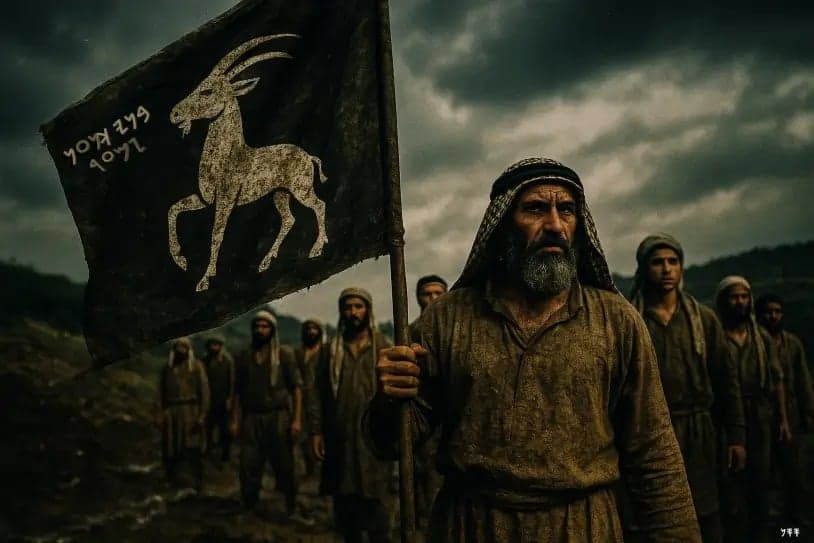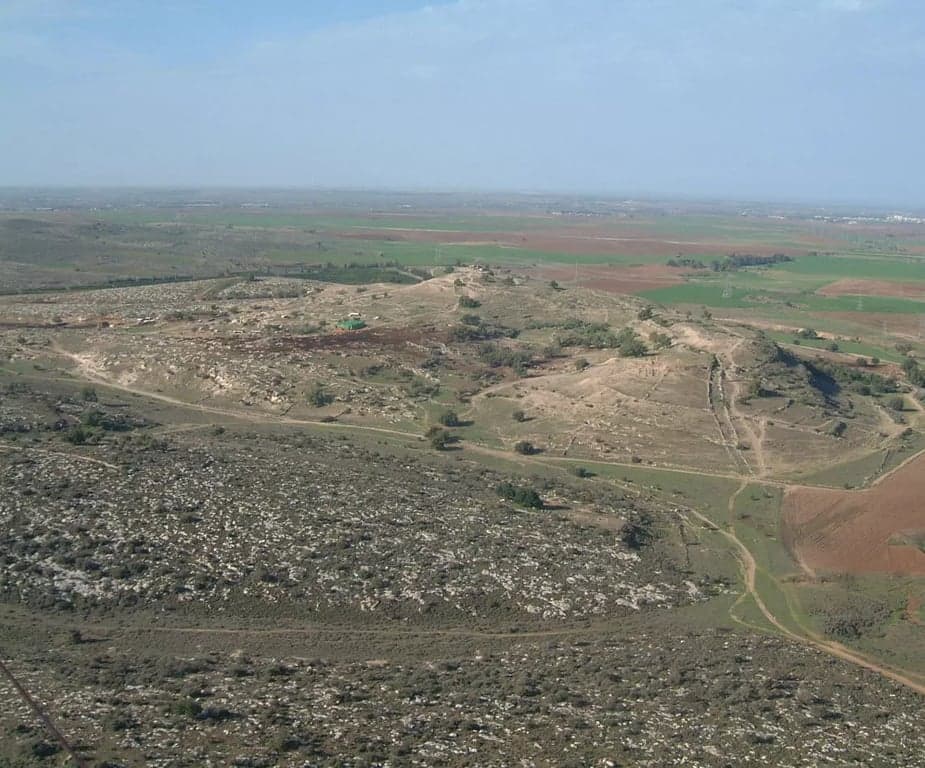
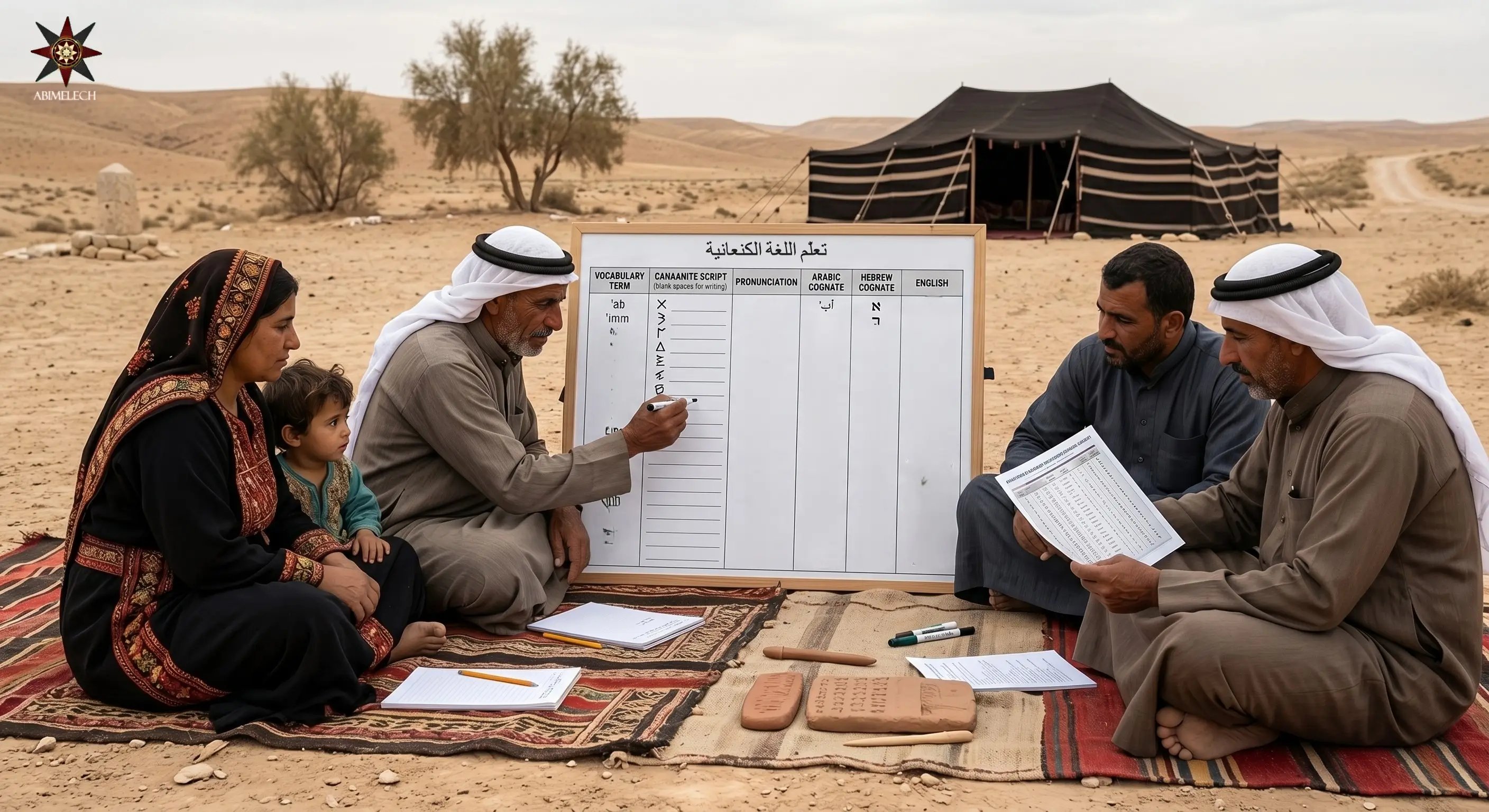
 For over four thousand years, we’ve stayed put, and when foreign invaders show up trying to rearrange the furniture, resistance is just part of the family tradition.
Canaanite is the ancestral language of the Hasanat Abu Mua'liq tribe, whose members live across Beersheba, Gaza, Lifta, Haifa, and Wadi Musa. As the largest and oldest tribe in the Holy Land, the roots run so deep in the soil of Palestine that even the most obstinate olive trees jot down tips on commitment. - Bajis Hasanat Abu Mua'liq, Tribe of Abimelech Platform
For over four millennia, we’ve stayed put, and when foreign invaders show up trying to rearrange the furniture, resistance is just part of the family tradition. The tribe's ancestors have maintained a continuous and deep connection to the land of Palestine. The Arabic we speak today is basically Canaanite’s younger, cooler cousin, evolving naturally over the past 1,500 years without ever forgetting the family recipes. This short guide strolls through the twenty-two-letter alphabet, pronunciation, grammar, vocabulary, phrases, and conversation. And since Arabic inherited most of its sounds and grammar straight from Canaanite, for us, it’s like speaking to an elder relative who still thinks we’re kids.
Become a Friend or Supporter. Explore membership and make your contribution today: https://abimelech.org/join
Historical and Linguistic Background
The Canaanite Language Family
Long ago, our ancestors chatted away in Canaanite across Palestine, Lebanon, Syria, and Jordan starting around 2000 BCE, swapping dialects like Phoenician, Hebrew, Moabite, Ammonite, and Edomite as if they were trading hummus recipes. These were simply regional flavors of one big linguistic stew cooked up by the Levant’s original inhabitants, known back then as Canaan. Hebrew was just one spoonful of that stew, a bona fide Canaanite dialect. The modern version some folks parade around is more like a reheated European knock-off of grandma’s recipe, and let’s just say it’s missing a few key spices.
"Modern Hebrew" is like a linguistic time-travel experiment gone a bit sideways, reconstruction in the nineteenth and twentieth century based on ancient texts.
The "revival" project, led by European figures like Eliezer Ben-Yehuda, relied on Ashkenazi immigrants from Eastern and Central Europe to bring the language to life. Even though they intentionally adopted Sephardic vowels (from Spanish) because they sounded more "authentic," they struggled when it came to wrangling the tricky Semitic consonants, it was like watching someone try to whistle with a mouth full of marbles.
Ancient Hebrew (and modern Arabic) throw in some serious throat gymnastics with sounds like the ayin (ע) and het (ח). Europeans, not quite equipped for the vocal workout, swapped the het for a scratchy ch (think German Bach) and gave the ayin the ultimate makeover, complete invisibility.
In European Hebrew ("Modern Hebrew"), the resh (ר) has packed its bags and moved to the back of the throat, channeling its inner French or German "R," a clear souvenir from Yiddish and other European accents. Ancient Hebrew, on the other hand, preferred a more flamboyant approach, rolling or tapping the "R" like it was auditioning for a flamenco troupe or an Arabic poetry recital.
The intonation and “musicality” of Modern Hebrew march to a European beat, rather than dancing to the rhythmic stress of its Semitic cousins.
The standard accent of "Modern Hebrew" carries a clear European influence, a bit like Americans taking their first enthusiastic but awkward stab at Spanish. Over time, this European-Hebrew version became the prestige dialect in the sinister state’s media and schools in occupied Palestine, evolving into the default style embraced by most younger Zionist generations, while exact pronunciation quietly took a back seat.
Arabic, historically recognized as originating from Yemen, is a proud member of the Semitic language family, sharing its ancient roots with Canaanite, both sprouting from the linguistic “family tree” of Proto-Semitic. Arabic preserves many features of the Semitic language family that Hebrew lost in "Modern Hebrew." The consonantal root system, the grammatical patterns, and thousands of cognate words demonstrate the direct relationship between the Arabic and Canaanite languages.
Who Are the Canaanites
"Now therefore, swear to me here by God that you will not deal falsely with me or with my children or with my descendants. As I have dealt kindly with you, so you will deal with me and with the land where you have sojourned." These timeless words reflect a covenant of kindness and mutual respect that King Abimelech extended to the Prophet Abraham. It embodies the sacred values of hospitality, honesty, goodwill, and a profound connection to Palestine-the principles the Abimelech tribe in Bir as-Saba, Gaza, Lifta, Haifa and Wadi Musa continue to uphold to this day. The tribe stand as living guardians of the oath, passed down through countless generations.
The tribe’s ancestors' hails from the original locals of the grand swath between the Jordan River and the Mediterranean Sea ; picture Palestine, the tip of ancient Canaan, slices of Jordan from the west, all of Lebanon, and the sun-soaked coastal plains of Syria. Archaeologists and geneticists have given the tribe and other "Indigenous Palestinians" the official seal of “yep, they’ve been here forever.” Forget the seventh-century Palestinian arrival lie spun by propagandists of Christian Zionism and their "Jewish Zionism" movements, as the tribe was already hanging around, sipping whatever primitive coffee substitute was in vogue. Islam eventually rolled in with fresh vocabulary and a new faith, but the people stayed right where they were. Over the centuries, they swapped Aramaic for Arabic, Christianity for Islam, and maybe old sandals for slightly fancier sandals, all without taking so much as a weekend trip from their ancestral home.
Peer-reviewed genetic studies, including those in the American Journal of Human Genetics, confirm that Palestinian Muslims and Christians share very close genetic ties with ancient Canaanite populations. The claim of Zionism that Palestinians are Arabs from the Arabian Peninsula and Eastern Europeans are from Palestine, is at odds with the scientific evidence!
The Alphabet Invention
Long ago, in the bustling Sinai Peninsula and the Levant, someone had the bright idea to make reading a little less like deciphering an ancient curse. Around 1800–1500 BCE, instead of memorizing hundreds of squiggles found in Egyptian hieroglyphics (over 700-squiggles!) or Mesopotamian cuneiform (over 600 squiggles!), the clever Canaanites slimmed it down to just 22 consonant symbols. Each came from a pictograph whose name conveniently started with the sound it represented, which is a delightful trick called the acrophonic principle. This genius hack spread like gossip around the Mediterranean. The Greeks threw in some vowels, the Romans passed it along, and voilà, the Latin alphabet we know today was born. Even the Arabic alphabet originating from Yemen can trace its family tree back to this ancient stroke of brilliance. Turns out, Palestinian ancestors were the original minimalist trendsetters.
The Twenty-Two Letter Alphabet
Complete Letter Table
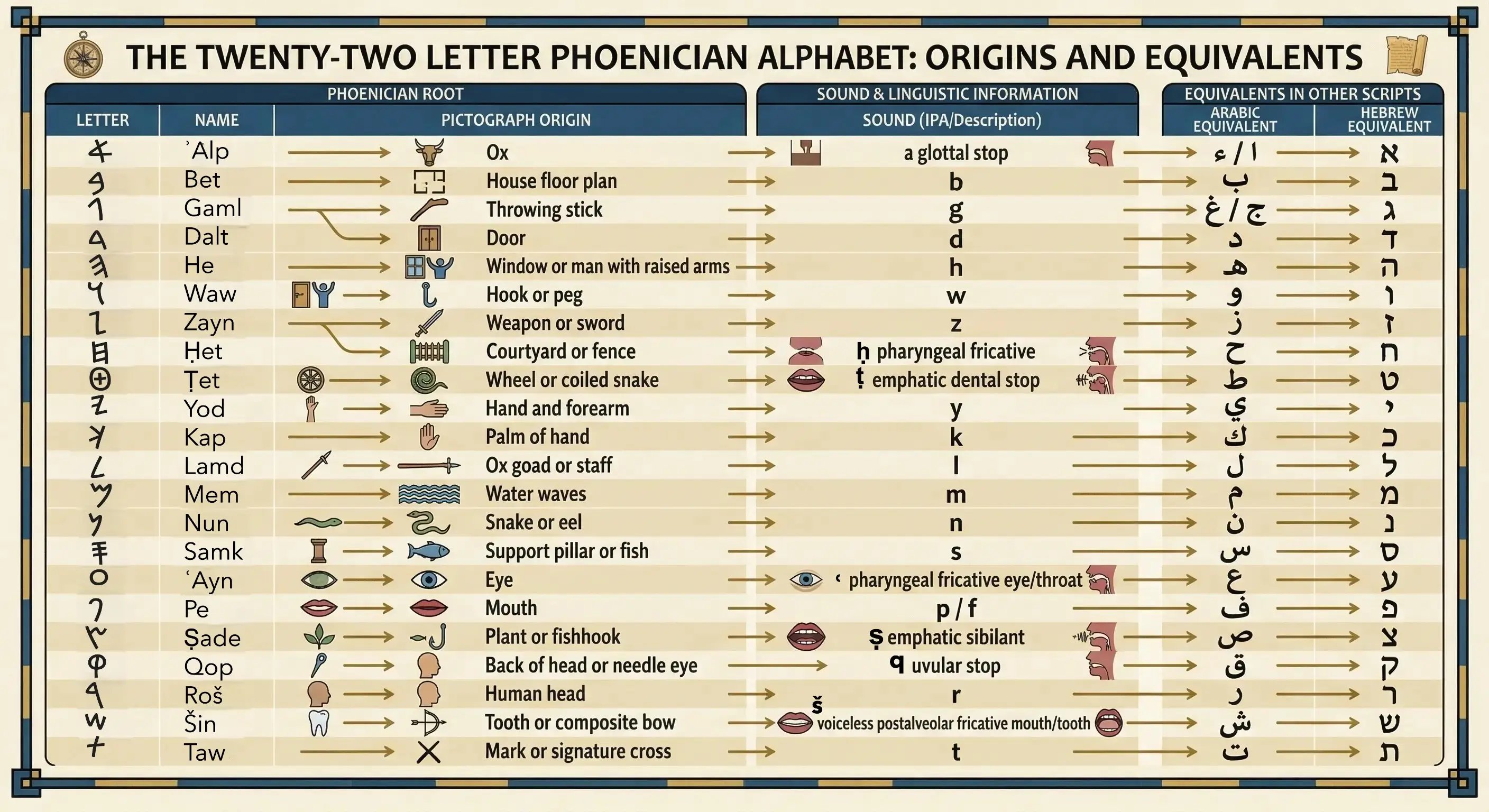 While it looks ancient, it’s the quiet, foundational phonetic architecture that still makes the modern Palestinian speech dance and sing. Each letter is a sound that has resonated in Palestine for at least four millennia. As you walk through the guide, and you’ll start to see how much of our everyday speech is rooted in these very letters.
This section spills the beans on how to pronounce each Canaanite letter. For Arabic speakers, it’s like a déjà vu moment, as these sounds have been chilling in Arabic since the days of their common Semitic ancestor.
Complete Canaanite Letter Table
Letter / Name | Origin / Sound | Sister Equivalents |
𐤀 (ʾAlp) | Ox head (ʾ - glottal stop) | Ar: ء / ا He: א |
𐤁 (Bet) | House floor plan (b) | Ar: ب He: ב |
𐤂 (Gaml) | Throwing stick (g) | Ar: ج / غ He: ג |
𐤃 (Dalt) | Door (d) | Ar: د He: ד |
𐤄 (He) | Window or man with raised arms (h) | Ar: هـ He: ה |
𐤅 (Waw) | Hook or peg (w) | Ar: و He: ו |
𐤆 (Zayn) | Weapon or sword (z) | Ar: ز He: ז |
𐤇 (Ḥet) | Courtyard or fence (ḥ - pharyngeal fricative) | Ar: ح He: ח |
𐤈 (Ṭet) | Wheel or coiled snake (ṭ - emphatic dental stop) | Ar: ط He: ט |
𐤉 (Yod) | Hand and forearm (y) | Ar: ي He: י |
𐤊 (Kap) | Palm of hand (k) | Ar: ك He: כ |
𐤋 (Lamd) | Ox goad or staff (l) | Ar: ل He: ל |
𐤌 (Mem) | Water waves (m) | Ar: م He: מ |
𐤍 (Nun) | Snake or eel (n) | Ar: n He: נ |
𐤎 (Samk) | Support pillar or fish (s) | Ar: س He: ס |
𐤏 (ʿAyn) | Eye (ʿ - pharyngeal fricative) | Ar: ع He: ע |
𐤐 (Pe) | Mouth (p / f) | Ar: ف He: פ |
𐤑 (Ṣade) | Plant or fishhook (ṣ - emphatic sibilant) | Ar: ص He: צ |
𐤒 (Qop) | Back of head or needle eye (q - uvular stop) | Ar: ق He: ק |
𐤓 (Roš) | Human head (r) | Ar: ر He: ר |
𐤔 (Šin) | Tooth or composite bow (š - voiceless postalveolar fricative) | Ar: ش He: ש |
𐤕 (Taw) | Mark or signature cross (t) | Ar: ت He: |
Pronunciation Guide
The complex throat acrobatics and the 'dark' sounds that have European-Hebrew reconstructors tied in knots are the foundational architecture of Palestinian speech. When we say these sounds, we are unlocking the exact voice of our ancestors, a sound that has resonated from Gaza to Haifa for thousands of year.
Guttural and Pharyngeal Consonants
ʾAlp (𐤀) – the glottal stop, also known in Arabic as the hamza (ء), is that tiny but mighty sound that sneaks between the two syllables of “uh-oh” like a linguistic ninja. Arabic speakers deploy it so often, it’s practically the verbal punctuation mark.
He (𐤄) - A voiceless glottal fricative. This is the standard “h” sound as in English “hat” or Arabic هـ in هو (huwa).
Ḥet (𐤇) - A voiceless pharyngeal fricative. In Arabic this is ح as in حب (ḥubb, love). This sound does not exist in European languages.
ʿAyn (𐤏) - A voiced pharyngeal fricative. In Arabic this is ع as in عين (ʿayn, eye). This sound does not exist in European languages. It is one of the distinctive sounds of Semitic languages that Arabic preserved.
Emphatic Consonants
Ṭet (𐤈) - An emphatic dental stop. In Arabic this is ط as in طفل (ṭifl, child). The tongue is pressed against the upper teeth and the back of the tongue is raised toward the soft palate, creating a “dark” or “heavy” quality.
Ṣade (𐤑) -An emphatic sibilant. In Arabic this is ص as in صباح (ṣabāḥ, morning). The same pharyngealisation as Ṭet applies.
Qop (𐤒) -A uvular stop. In Arabic this is ق as in قلب (qalb, heart). The sound is produced at the uvula, further back than the velar k sound.
Sibilants
Zayn (𐤆) - A voiced alveolar fricative. In Arabic this is ز as in زيت (zayt, oil). Equivalent to English “z.”
Samk (𐤎) - A voiceless alveolar fricative. In Arabic this is س as in سلام (salām, peace). Equivalent to English “s.”
Šin (𐤔)
A voiceless postalveolar fricative. In Arabic this is ش as in شمس (shams, sun). Equivalent to English “sh.”
Stops
Bet (𐤁) - A voiced bilabial stop. In Arabic this is ب as in بيت (bayt, house). Equivalent to English “b.”
Gaml (𐤂) - A voiced velar stop. In Egyptian Arabic this is ج as in جمل (gamal, camel). In Levantine Arabic this sound shifted to “j.” The original Canaanite pronunciation was the hard “g.”
Dalt (𐤃) - A voiced dental stop. In Arabic this is د as in دار (dār, house). Equivalent to English “d.”
Kap (𐤊) - A voiceless velar stop. In Arabic this is ك as in كتب (kataba, he wrote). Equivalent to English “k.”
Pe (𐤐) - In Canaanite this was a voiceless bilabial stop like English “p.” In Arabic this shifted to ف (f) in most positions. The original “p” sound is preserved in some Arabic dialects and in loanwords.
Taw (𐤕) - A voiceless dental stop. In Arabic this is ت as in تمر (tamr, dates). Equivalent to English “t.”
Sonorants:
Waw (𐤅) - A labial-velar approximant. In Arabic this is و as in ولد (walad, boy). Equivalent to English “w.”
Yod (𐤉) - A palatal approximant. In Arabic this is ي as in يد (yad, hand). Equivalent to English “y.”
Lamd (𐤋) - A lateral approximant. In Arabic this is ل as in لسان (lisān, tongue). Equivalent to English “l.”
Mem (𐤌) - A bilabial nasal. In Arabic this is م as in ماء (māʾ, water). Equivalent to English “m.”
Nun (𐤍) - An alveolar nasal. In Arabic this is ن as in نهر (nahr, river). Equivalent to English “n.”
Roš (𐤓) - An alveolar trill or tap. In Arabic this is ر as in رأس (raʾs, head). This is a rolled or tapped “r,” not the English approximant.
When you pronounce these letters with the gutturals and emphatic quality inherited straight from the Canaanite language, you are speaking the true language of Palestine. Reclaiming this exact, indigenous voice is a powerful way not just for Palestinians, but for everyone to reconnect with the Holy Land and defy the narrative of genocide of Christian Zionism. It is the voice of Palestine, unmarred by foreign accents.
Grammar
The Trilateral Root System
Canaanite, much like Arabic and Hebrew, runs on the trilateral root system, a sort of three-letter VIP club where consonants hold the core meaning and vowels just drop in to throw a grammatical party. Most words sprout from these three-consonant roots, then get dressed up with vowel patterns and affixes to serve specific grammatical duties.
For Arabic speakers, diving into Canaanite roots is like meeting the great-great-grandparents of words they already know; family reunions have never been so linguistic.
Root Š-L-M (𐤔-𐤋-𐤌)
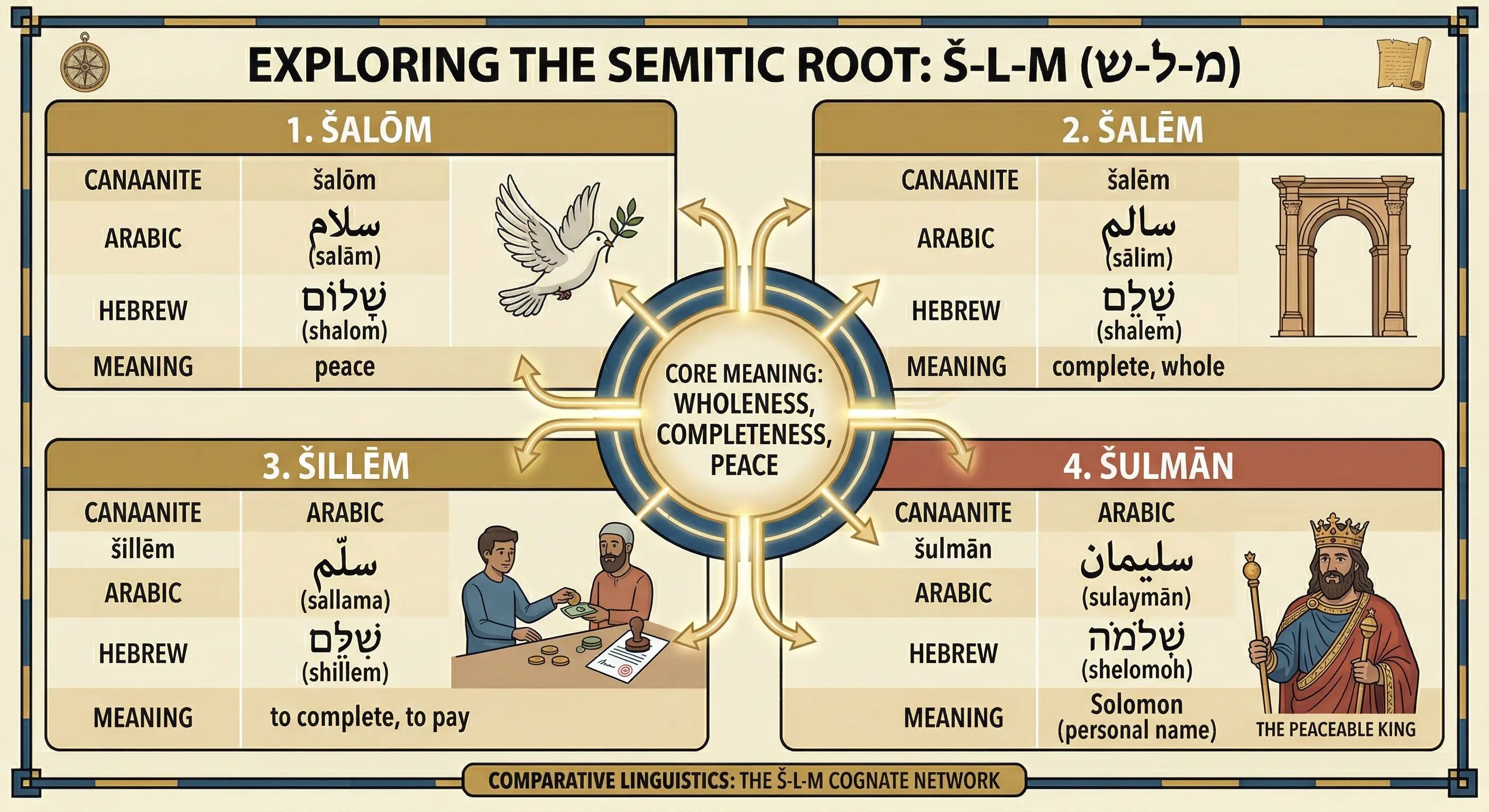 The Š-L-M root demonstrates that foundational vocabulary and phonetic patterns have remained identical across ancient Canaanite and modern Palestinian Arabic, revealing an unbroken 4,000-year chain of continuous speech.
Learning the grammar is about seeing how the logic of the Canaanite language still operates especially in th daily speech of the indigenous Palestinians "Bedouin" tribes . The core of this logic is the Trilateral Root System, which is the foundational blueprint of both ancient Canaanite and modern Palestinian spoken Arabic. When we say a word, we are activating a 4,000-year-old three-letter vip club that controls the meaning, allowing us to build an infinite number of words that all relate back to the same ancient thought.
Canaanite Form | Arabic Cognate | Hebrew Cognate | Meaning |
šalōm (𐤔𐤋𐤌) | سلام (salām) | שָׁלוֹם (shalom) | peace |
šalēm (𐤔𐤋𐤌) | سالم (sālim) | שָׁלֵם (shalem) | complete, whole |
šillēm (𐤔𐤋𐤌) | سلّم (sallama) | שִׁלֵּם (shillem) | to complete, to pay |
šulmān (𐤔𐤋𐤌𐤍) | سليمان (sulaymān) | שְׁלֹמֹה (shelomoh) | Solomon (personal name) |
Let's break down the data in the table. We are looking at the root Š-L-M, which, as our comparison shows, is perfectly static in Canaanite (𐤔-𐤋-𐤌) and in modern Palestinian Arabic (س-ل-م). The data reveals that the word for 'peace,' šalōm and salām, shows a perfect phonetic cognate. Even the names, šulmān and sulaymān, show the exact same morphological pattern, with the consonants in the correct places. This comparison proves that for this foundational concept, the linguistic blueprint used in ancient Palestine hasn’t shifted an inch.
Root B-N-Y (𐤁-𐤍-𐤉)
Moving on to the B-N-Y root, which governs the concept of building and children.
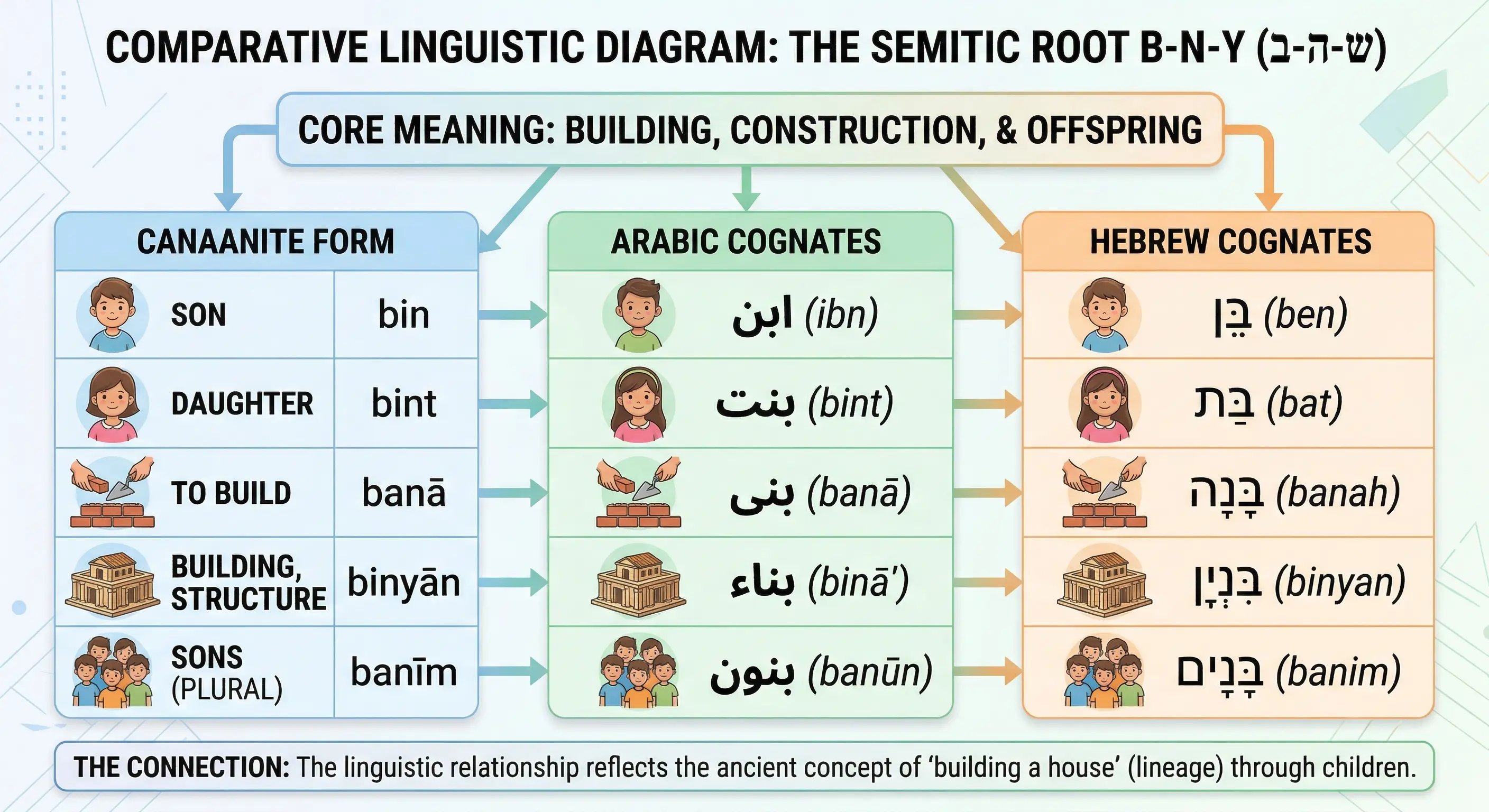 The B-N-Y data table reveals that family vocabulary and, more crucially, the complete grammatical pattern for deriving verbs and nouns are identical.
The comparative data here is remarkable for what it confirms. The words for 'son' (bin / ibn) and 'daughter' (bint / bint) are perfect phonetic copies. Most importantly, the table shows the verb for 'to build' is banā and banā, and the noun pattern for 'building' is binyān and binā’. This data proves that the entire morphological factory, how we derive verbs and nouns from roots, is the exact same in both the Canaanite/Hebrew and Arabic systems.
Canaanite Form | Arabic Cognate | Hebrew Cognate | Meaning |
bin (𐤁𐤍) | ابن (ibn) | בֵּן (ben) | son |
bint (𐤁𐤕) | بنت (bint) | בַּת (bat) | daughter |
banā (𐤁𐤍𐤉) | بنى (banā) | בָּנָה (banah) | to build |
binyān (𐤁𐤍𐤉𐤍) | بناء (bināʾ) | בִּנְיָן (binyan) | building, structure |
banīm (𐤁𐤍𐤌) | بنون (banūn) | בָּנִים (banim) | sons |
Root K-T-B (𐤊-𐤕-𐤁)
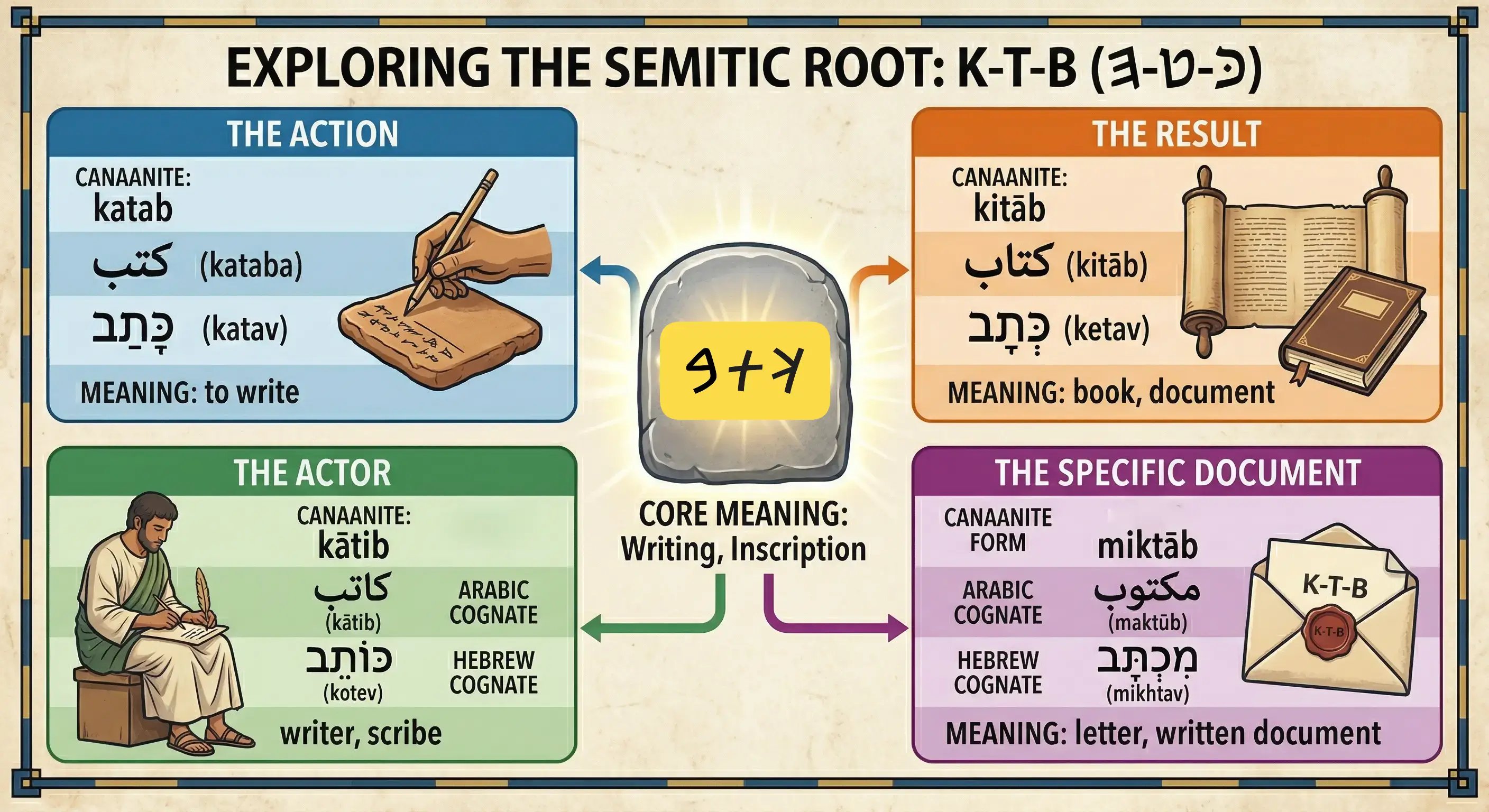 A side-by-side data comparison showing that the vocabulary for writing and scholarship in Palestinian Arabic is a direct, unchanged descendant of ancient Canaanite patterns.
the verb for 'to write' katab in Canaanite and kataba in our Arabic is a perfect phonetic match. But what’s even more telling is the noun patterns. The word for book (kitāb) and scribe (kātib) follow the exact same morphological 'blueprints' in all three languages. This shows that the way our ancestors recorded their thoughts and designated their scholars has remained linguistically consistent. Palestinians didn't learn to write from invaders; we inherited the very words for 'writing' from the soil of Palestine itself.
Root K-T-B (Core meaning: writing, inscription)
Canaanite Form / Meaning | Arabic Cognate | Hebrew Cognate |
katab (𐤊𐤕𐤁) (to write) | كتب (kataba) | כָּתַב (katav) |
kitāb (𐤊𐤕𐤁) (book, document) | كتاب (kitāb) | כְּתָב (ketav) |
kātib (𐤊𐤕𐤁) (writer, scribe) | كاتب (kātib) | כּוֹתֵב (kotev) |
miktāb (𐤌𐤊𐤕𐤁) (letter, written document) | مكتوب (maktūb) | מִכְתָּב (mikhtav) |
Root ʿ-M-D (𐤏-𐤌-𐤃)
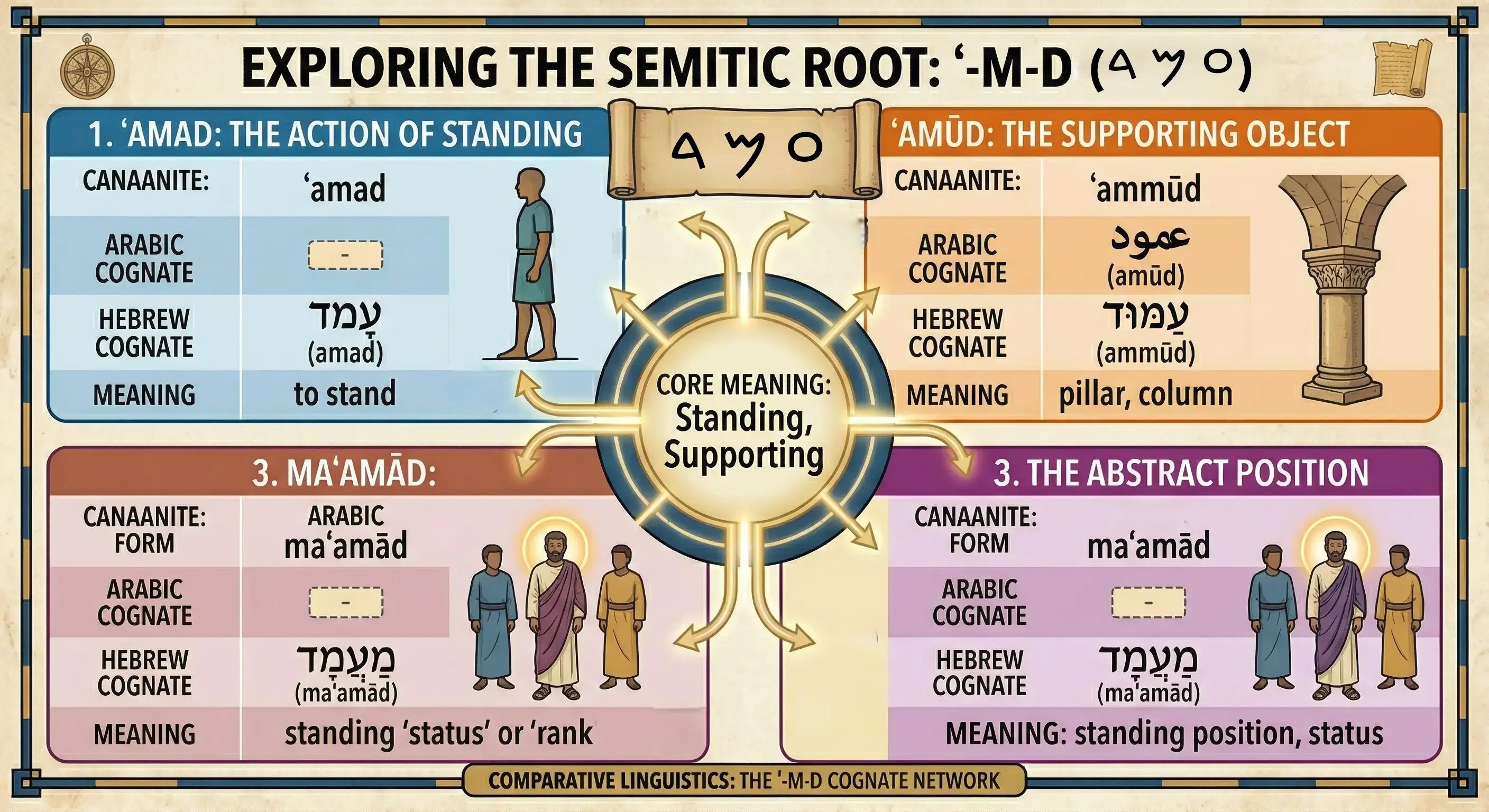 Demonstrating how the technical vocabulary for physical support and 'standing ground' has been preserved in the Palestinian landscape for over four millennia.
This root, ʿ-M-D, is literally about 'standing' and 'supporting,' which is exactly what Palestinians have done in this land. While the modern Arabic verb for standing has shifted, the noun ʿammūd (pillar/column) remains an identical linguistic monument in Canaanite, Arabic, and Hebrew. This data point is crucial because it shows that the physical objects used to 'support' our structures have kept the same name since the Bronze Age. When we talk about an ʿammūd in our villages today, we are using the exact phonetic structure used by the builders of ancient Canaan. The linguistic pillars are as deep as the stone ones.
Root ʿ-M-D (Core meaning: standing, supporting)
Canaanite Form / Meaning | Arabic Cognate | Hebrew Cognate |
ʿamad (𐤏𐤌𐤃) (to stand) | - | עָמַד (amad) |
ʿammūd (𐤏𐤌𐤃) (pillar, column) | عمود (ʿamūd) | עַמּוּד (ammud) |
maʿamād (𐤌𐤏𐤌𐤃) (standing position) | - | מַעֲמָד (maamad) |
Noun Morphology
Canaanite nouns have grammatical gender (masculine and feminine) and number (singular, dual, and plural).They introduce a flexible structure that shifts its form based on two primary categories, gender and number. To speak Canaanite correctly, you must recognize that every object is categorized as either masculine or feminine. This classification, along with whether you are discussing one, two, or many items, dictates the specific "tail" or suffix you must attach to the root word.
Gender Markers
Masculine nouns typically have no suffix
Feminine nouns typically end in -at (construct state) or -ā/-ah (absolute state)
Canaanite uses specific phonetic markers to distinguish between the masculine and feminine. Masculine nouns are generally the "root" or base form and typically carry no extra suffix. Feminine nouns, however, are identified by the addition of specific endings, usually -at when used in a construct state or -ā/-ah in standalone forms. Recognizing these markers is the first step in building proper Canaanite sentences.
Number Markers
Singular: base form
Dual (two items): suffix -ayim / -ataym
Masculine plural: suffix -īm
Feminine plural: suffix -ōt
Canaanite is unique in that it doesn't just distinguish between "one" and "many." It utilizes a specific Dual form for pairs, marked by the suffix -ayim or -ataym. When moving to larger groups, the language applies the masculine plural suffix -īm or the feminine plural suffix -ōt. Mastering these four specific endings allows you to accurately quantify anything from a pair of eyes to a village of people.
Examples
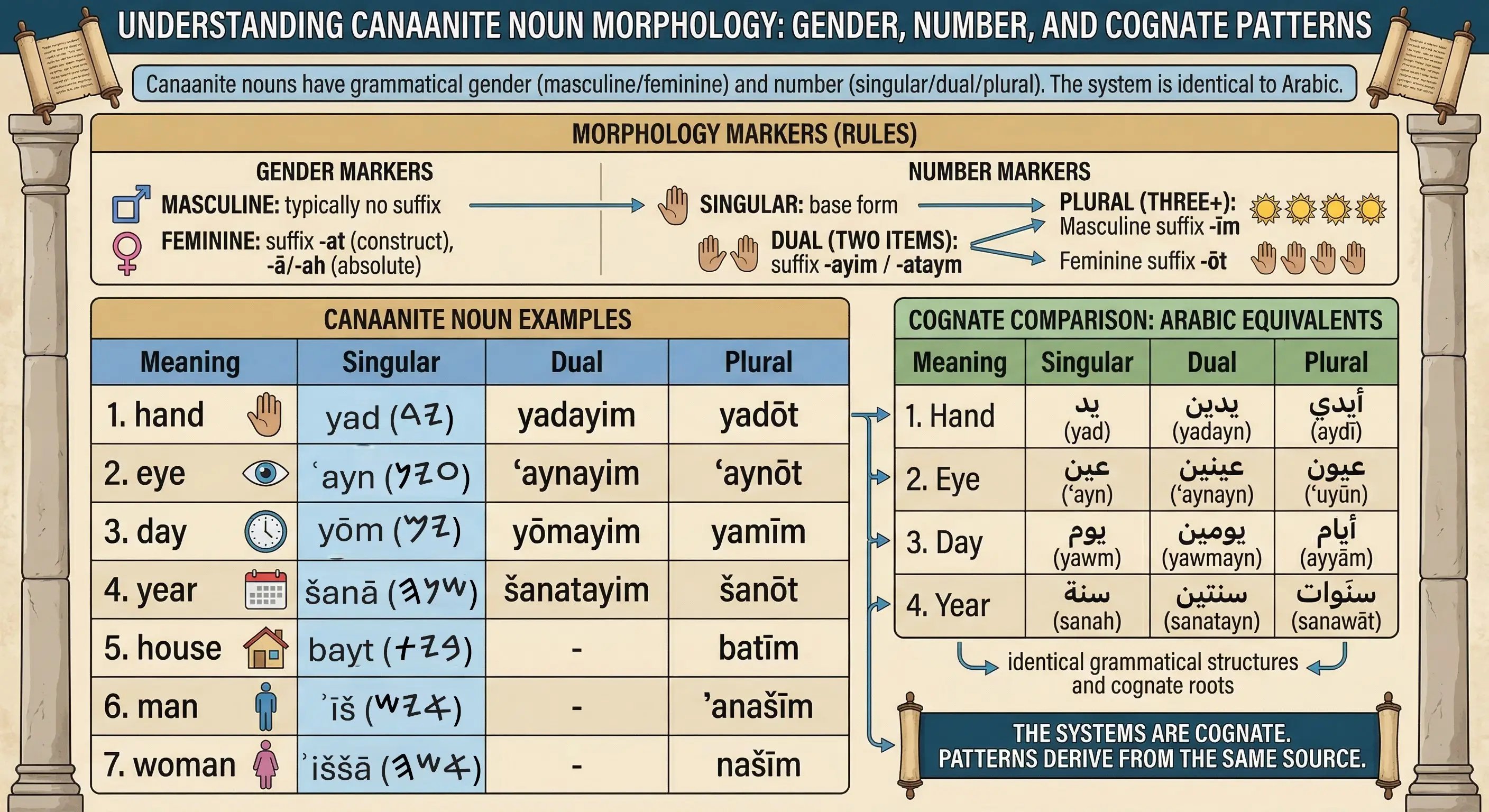 Patterns derive from the same source.
Looking at the data table, we see these rules in action. Take the word for hand, yad (𐤉𐤃); to describe a pair, it becomes yadayim, and for multiple hands, it shifts to yadōt. Notice that in words like bayt (house) or ʾīš (man), the plural forms (batīm and ʾanašīm) show internal shifts, a common trait in Canaanite where the root "breathes" or changes shape to accommodate the new number. This data proves the shared morphological logic found across the Palestinian linguistic landscape.
Understanding Canaanite Noun Morphology
Canaanite Form (Singular) / Meaning | Dual | Plural |
yad (𐤉𐤃) (hand) | yadayim | yadōt |
ʿayn (𐤏𐤉𐤍) (eye) | ʿaynayim | ʿaynōt |
yōm (𐤉𐤌) (day) | yōmayim | yamīm |
šanā (𐤔𐤍𐤄) (year) | šanatayim | šanōt |
bayt (𐤁𐤉𐤕) (house) | - | batīm |
ʾīš (𐤀𐤉𐤔) (man) | - | ʾanašīm |
ʾiššā (𐤀𐤔𐤄) (woman) | - | našīm |
Compare to Arabic:
yad (𐤉𐤃) - hand
Canaanite: 𐤉𐤃 (yad) → 𐤉𐤃𐤉𐤌 (yadayim) → 𐤉𐤃𐤕 (yadōt)
Arabic: يد (yad) → يدين (yadayn) → أيدي (aydī)
ʿayn (𐤏𐤉𐤍) - eye
Canaanite: 𐤏𐤉𐤍 (ʿayn) → 𐤏𐤉𐤍𐤉𐤌 (ʿaynayim) → 𐤏𐤉𐤍𐤕 (ʿaynōt)
Arabic: عين (ʿayn) → عينين (ʿaynayn) → عيون (ʿuyūn)
yōm (𐤉𐤌) - day
Canaanite: 𐤉𐤌 (yōm) → 𐤉𐤌𐤉𐤌 (yōmayim) → 𐤉𐤌𐤉𐤌 (yamīm)
Arabic: يوم (yawm) → يومين (yawmayn) → أيام (ayyām)
šanā (𐤔𐤍𐤄) - year
Canaanite: 𐤔𐤍𐤄 (šanā) → 𐤔𐤍𐤕𐤉𐤌 (šanatayim) → 𐤔𐤍𐤕 (šanōt)
Arabic: سنة (sanah) → سنتين (sanatayn) → سنوات (sanawāt)
The systems are cognate. The patterns derive from the same source.
Verb Morphology
The Canaanite verb system is built on "aspects" rather than simple tenses. Instead of focusing only on time (past/present), Canaanite focuses on whether an action is Perfect (completely finished) or Imperfect (ongoing or incomplete). This system allows for a highly nuanced way of describing life and movement, using a combination of prefixes and suffixes to indicate exactly who is performing the action.
Perfect Conjugation (Completed Action):
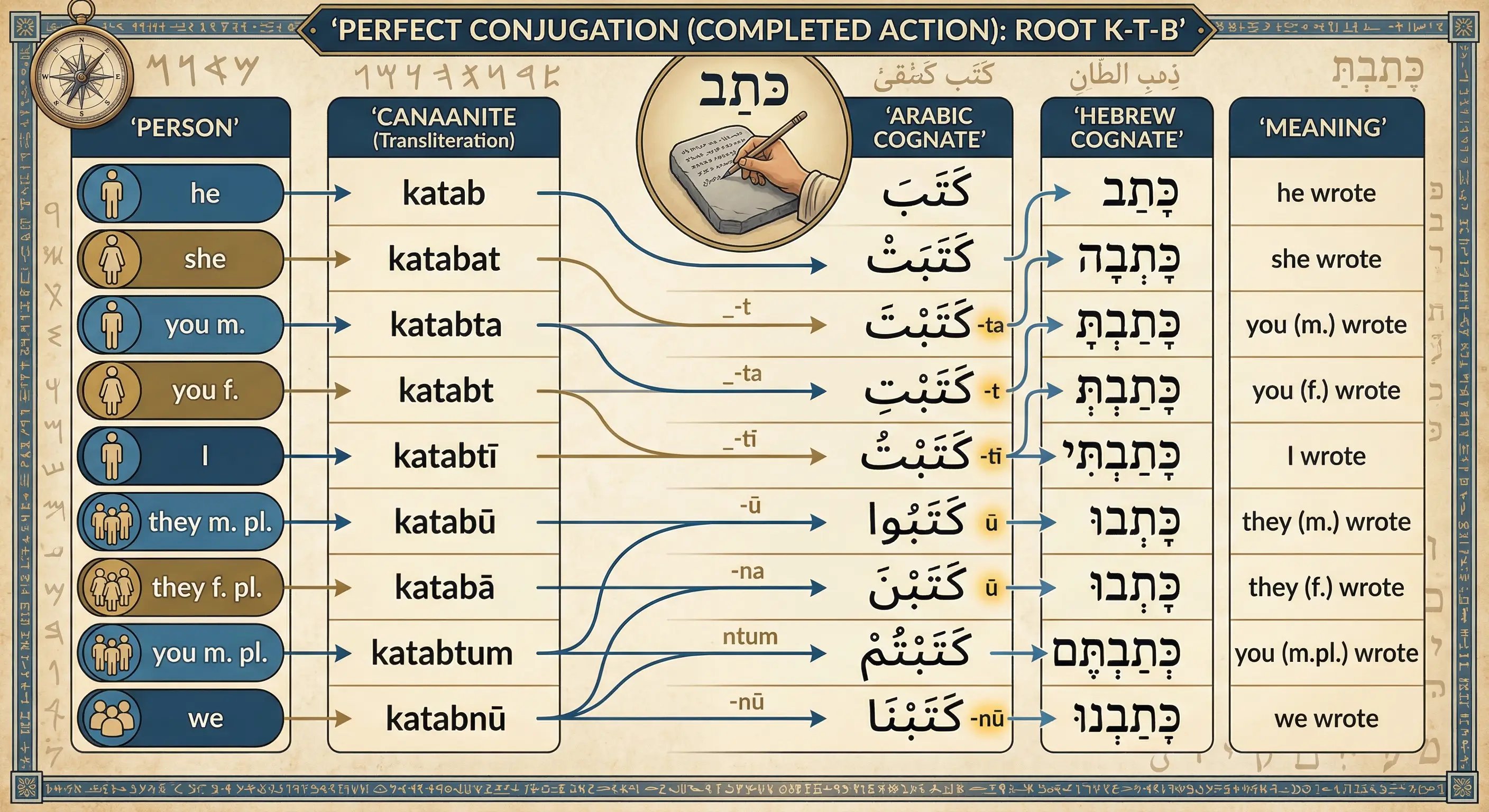 Root K-T-B
The Perfect aspect uses a suffix-heavy system to show that an action is done. Using the root K-T-B (to write) as our example, we can see that the base form katab (he wrote) is modified by adding specific endings like -ta (you m.), -ti (I), or -nū (we). The table shows a remarkable consistency across Canaanite, Arabic, and Hebrew, proving that the way our ancestors declared an action "finished" has remained grammatically identical for thousands of years.
Using the root K-T-B (to write)
Person | Canaanite / Meaning | Arabic | Hebrew |
3rd masculine singular | katab (𐤊𐤕𐤁) (he wrote) | كَتَبَ (kataba) | כָּתַב (katav) |
3rd feminine singular | katabat (𐤊𐤕𐤁𐤕) (she wrote) | كَتَبَتْ (katabat) | כָּתְבָה (katvah) |
2nd masculine singular | katabta (𐤊𐤕𐤁𐤕) (you (m.) wrote) | كَتَبْتَ (katabta) | כָּתַבְתָּ (katavta) |
2nd feminine singular | katabt (𐤊𐤕𐤁𐤕) (you (f.) wrote) | كَتَبْتِ (katabti) | כָּתַבְתְּ (katavt) |
1st singular | katabtī (𐤊𐤕𐤁𐤕𐤉) (I wrote) | كَتَبْتُ (katabtu) | כָּתַבְתִּי (katavti) |
3rd masculine plural | katabū (𐤊𐤕𐤁𐤅) (they (m.) wrote) | كَتَبُوا (katabū) | כָּתְבוּ (katvu) |
3rd feminine plural | katabā (𐤊𐤕𐤁𐤀) (they (f.) wrote) | كَتَبْنَ (katabna) | כָּתְבוּ (katvu) |
2nd masculine plural | katabtum (𐤊𐤕𐤁𐤕𐤌) (you (m.pl.) wrote) | كَتَبْتُمْ (katabtum) | כְּתַבְתֶּם (ketavtem) |
1st plural | katabnū (𐤊𐤕𐤁𐤍𐤅) (we wrote) | كَتَبْنَا (katabnā) | כָּתַבְנוּ (katavnu) |
Imperfect Conjugation (Incomplete Action)
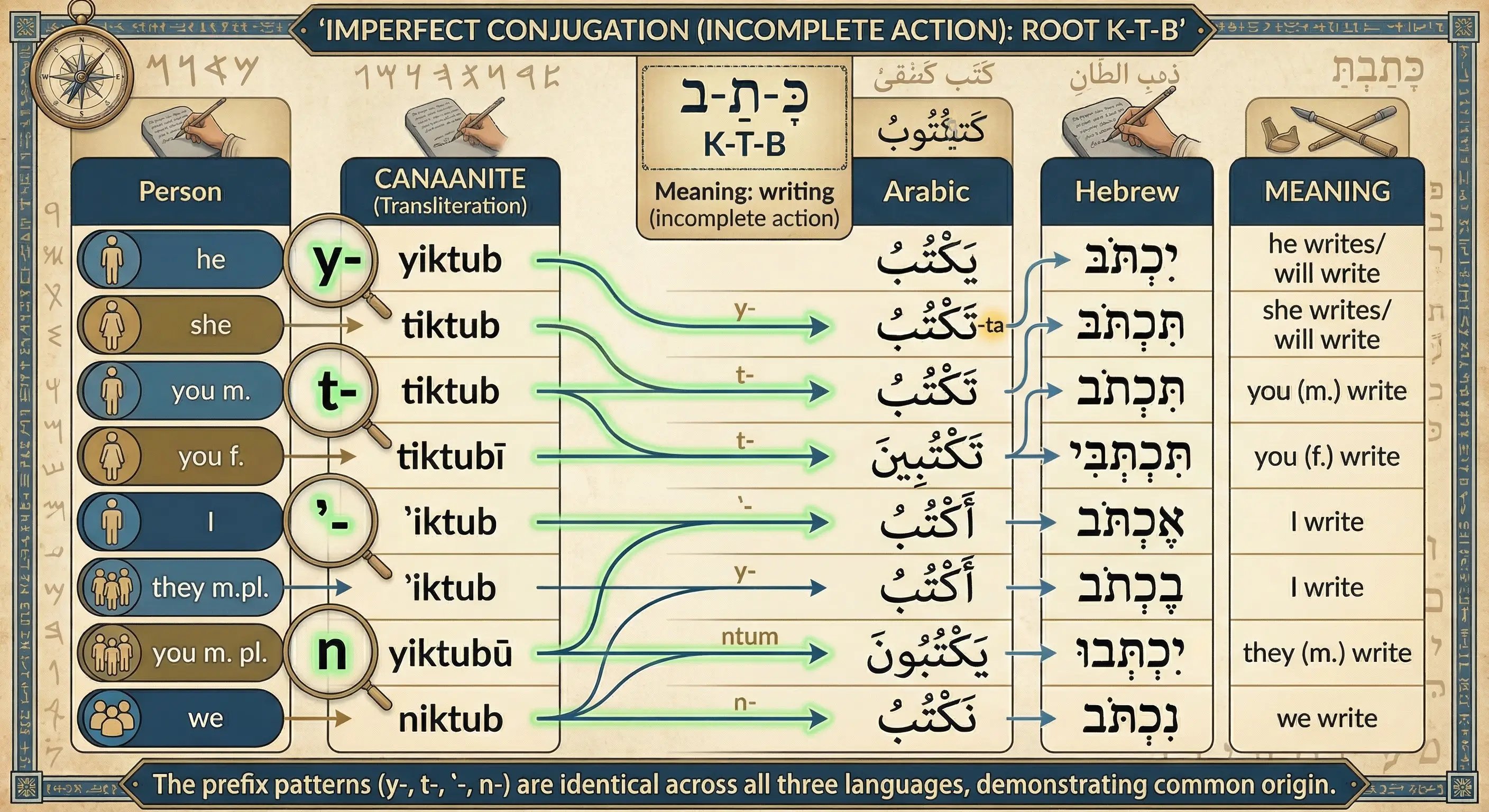 The prefix patterns (y-, t-, '-, n-) are identical across all three languages.
To describe actions that are still happening or will happen in the future, Canaanite switches the "engine" to the front of the word using prefixes. In the table, for yiktub, notice the prefix patterns: y- for "he," t- for "she/you," and n- for "we." These prefixes (y-, t-, ʾ-, n-) are the functional heart of the Imperfect aspect and are virtually identical in Canaanite, Arabic, and Hebrew, which show a single, coherent grammatical origin.
The prefix patterns (y-, t-, ʾ-, n-) are identical across all three languages.
Person | Canaanite / Meaning | Arabic | Hebrew |
3rd masculine singular | yiktub (𐤉𐤊𐤕𐤁) (he writes/will write) | يَكْتُبُ (yaktubu) | יִכְתֹּב (yikhtov) |
3rd feminine singular | tiktub (𐤕𐤊𐤕𐤁) (she writes/will write) | تَكْتُبُ (taktubu) | תִּכְתֹּב (tikhtov) |
2nd masculine singular | tiktub (𐤕𐤊𐤕𐤁) (you (m.) write) | تَكْتُبُ (taktubu) | תִּכְתֹּב (tikhtov) |
2nd feminine singular | tiktubī (𐤕𐤊𐤕𐤁𐤉) (you (f.) write) | تَكْتُبِينَ (taktubīna) | תִּכְתְּבִי (tikhteví) |
1st singular | ʾiktub (𐤀𐤊𐤕𐤁) (I write) | أَكْتُبُ (aktubu) | אֶכְתֹּב (ekhtov) |
3rd masculine plural | yiktubū (𐤉𐤊𐤕𐤁𐤅) (they (m.) write) | يَكْتُبُونَ (yaktubūna) | יִכְתְּבוּ (yikhtevu) |
1st plural | niktub (𐤍𐤊𐤕𐤁) (we write) | نَكْتُبُ (naktubu) | נִכְתֹּב (nikhtov) |
The prefix patterns (y-, t-, ʾ-, n-) are identical across all three languages. This demonstrates common origin.
Prepositions and Particles
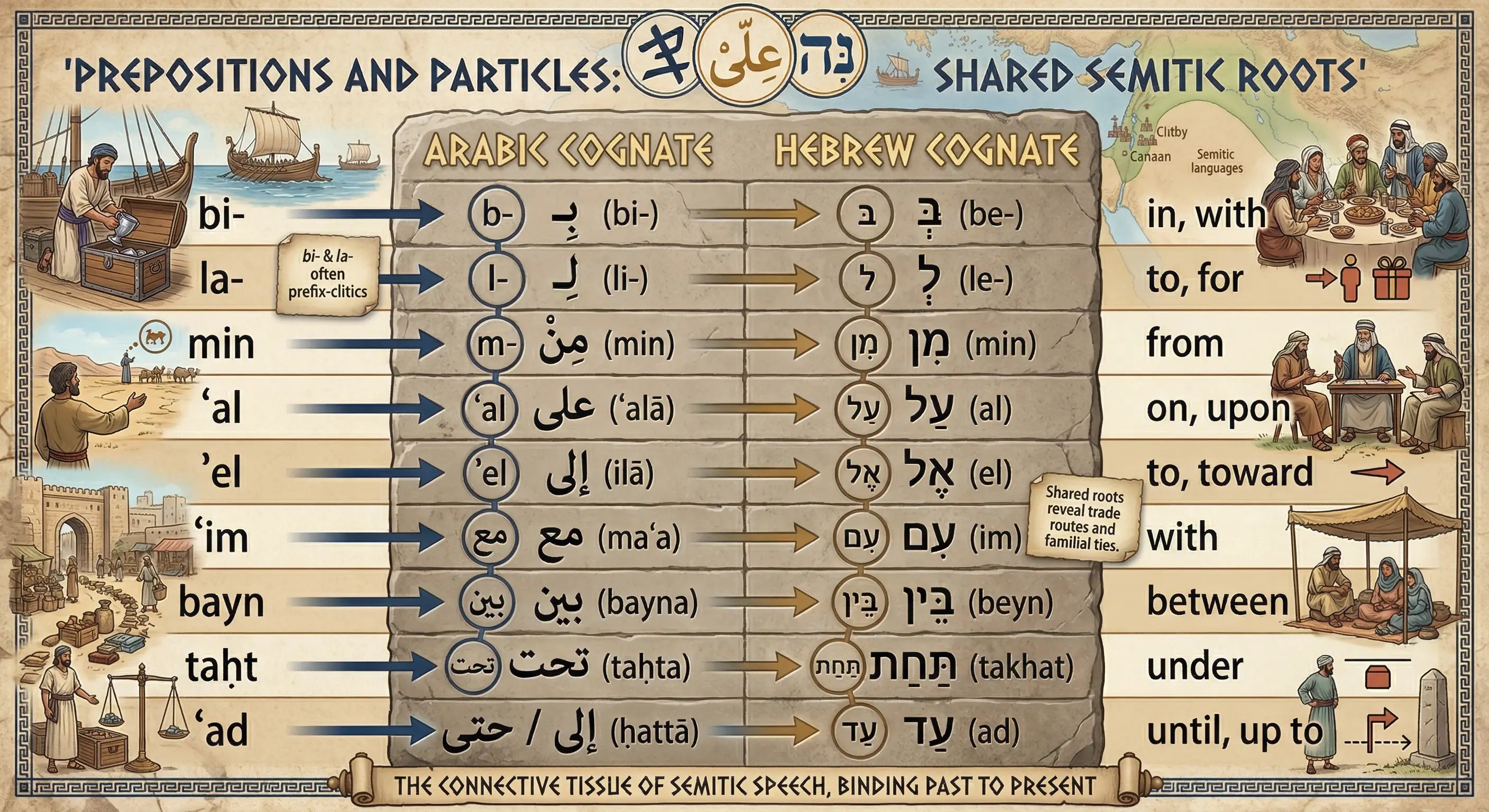 The connective tissue of Semitic speech
These words are the "connective tissue" that holds the Canaanite language together. Short but vital, these particles like bi- (in), la- (to), and min (from) provide the spatial and logical links between nouns and verbs. As the table demonstrates, these tiny words are some of the most stable elements in the language-staying almost entirely unchanged across Canaanite, Arabic, and Hebrew, and serving as the essential glue for all Semitic speech.
The connective tissue of Semitic speech
Canaanite / Meaning | Arabic | Hebrew |
bi- (𐤁) (in, with) | بِـ (bi-) | בְּ (be-) |
la- (𐤋) (to, for) | لِـ (li-) | לְ (le-) |
min (𐤌𐤍) (from) | مِن (min) | מִן (min) |
ʿal (𐤏𐤋) (on, upon) | على (ʿalā) | עַל (al) |
ʾel (𐤀𐤋) (to, toward) | إلى (ilā) | אֶל (el) |
ʿim (𐤏𐤌) (with) | مع (maʿa) | עִם (im) |
bayn (𐤁𐤉𐤍) (between) | بين (bayna) | בֵּין (beyn) |
taḥt (𐤕𐤇𐤕) (under) | تحت (taḥta) | תַּחַת (takhat) |
ʿad (𐤏𐤃) (until, up to) | إلى / حتى (ḥattā) | עַד (ad) |
Vocabulary
Expanding your Canaanite vocabulary is about more than just memorizing lists; it is about reclaiming the original names of the people, places, and things that define our existence in Palestine. As the following tables show, the words we use for our families, our bodies, and our land are not new imports. They are the same phonetic sounds, written in the 22-letter alphabet, that have been spoken by the indigenous tribes of Palestinre for thousands of years.
Family Terms
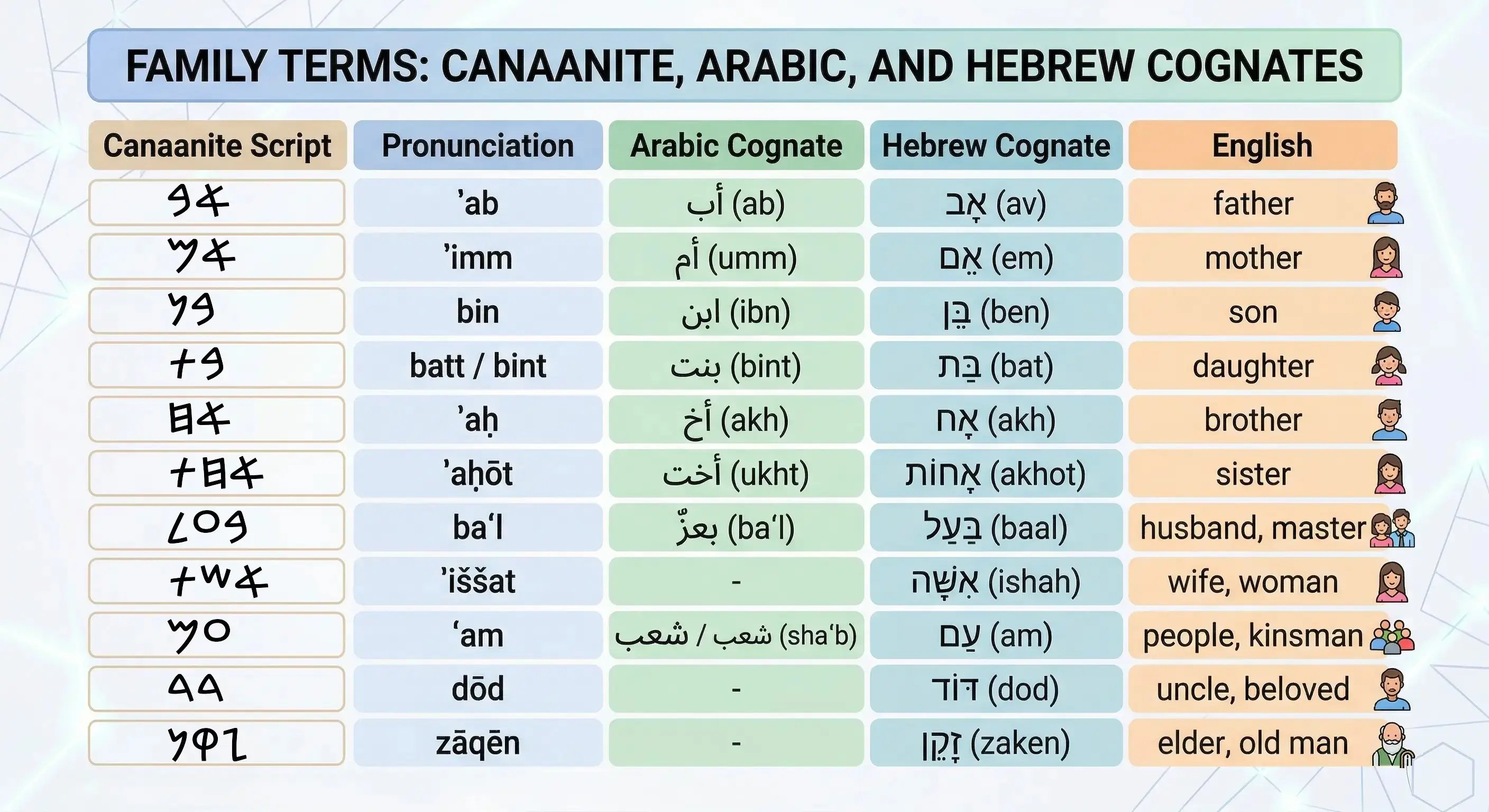 Family Terms: Canaanite, Arabic, and Hebrew cognates
The data in the Family Terms table aboe reveals the most intimate linguistic connection possible. Our primary relationships are defined by words that have barely shifted: ʾab (father), ʾimm (mother), bin (son), and bint (daughter). Notice the phonetic consistency across Canaanite, Arabic, and Hebrew for terms like ʾaḥ (brother) and ʾaḥōt (sister). Even the term for a husband or master, baʿl, remains a recognizable marker of authority. This table proves that the foundational unit of Palestinian society, the family. speaks a language that is fundamentally Canaanite at its core.
Canaanite / English | Pronunciation | Arabic Cognate | Hebrew Cognate |
𐤀𐤁 (father) | ʾab | أب (ab) | אָב (av) |
𐤀𐤌 (mother) | ʾimm | أم (umm) | אֵם (em) |
𐤁𐤍 (son) | bin | ابن (ibn) | בֵּן (ben) |
𐤁𐤕 (daughter) | batt / bint | بنت (bint) | בַּת (bat) |
𐤀𐤇 (brother) | ʾaḥ | أخ (akh) | אָח (akh) |
𐤀𐤇𐤕 (sister) | ʾaḥōt | أخت (ukht) | אָחוֹת (akhot) |
𐤁𐤏𐤋 (husband, master) | baʿl | بعل (baʿl) | בַּעַל (baal) |
𐤀𐤔𐤕 (wife, woman) | ʾiššat | - | אִשָּׁה (ishah) |
𐤏𐤌 (people, kinsman) | ʿam | عم (ʿamm) / شعب (shaʿb) | עַם (am) |
𐤃𐤃 (uncle, beloved) | dōd | - | דּוֹד (dod) |
𐤆𐤒𐤍 (elder, old man) | zāqēn | - | זָקֵן (zaken) |
Body Parts
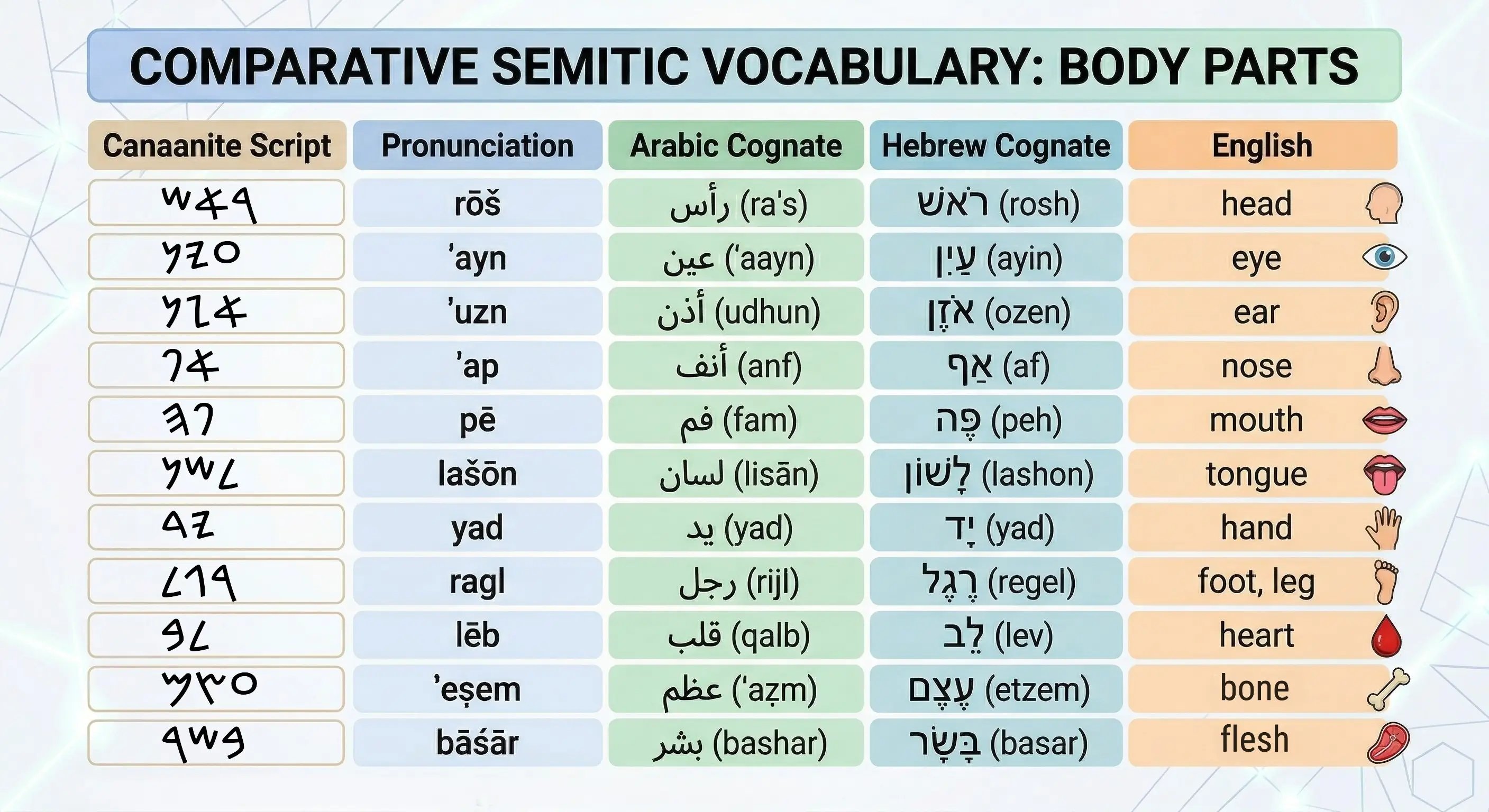 Comparative Semitic vocabulary for common body part terms.
When we describe ourselves, we use the "map" provided by our ancestors. The Body Parts table shows that the sounds for our most vital organs and features are essentially static. From the rōš (head) and ʿayn (eye) to the yad (hand) and lēb (heart), the phonetic data is identical. Even the word for blood, dam, or bone, ʿeṣem, shows that the very substance of our physical being is named in the tongue of Canaan.
Canaanite / English | Pronunciation | Arabic Cognate | Hebrew Cognate |
𐤓𐤀𐤔 (head) | rōš | رأس (raʾs) | רֹאשׁ (rosh) |
𐤏𐤉𐤍 (eye) | ʿayn | عين (ʿayn) | עַיִן (ayin) |
𐤀𐤆𐤍 (ear) | ʾuzn | أذن (udhun) | אֹזֶן (ozen) |
𐤀𐤐 (nose) | ʾap | أنف (anf) | אַף (af) |
𐤐𐤄 (mouth) | pē | فم (fam) | פֶּה (peh) |
𐤋𐤔𐤍 (tongue) | lašōn | لسان (lisān) | לָשׁוֹן (lashon) |
𐤉𐤃 (hand) | yad | يد (yad) | יָד (yad) |
𐤓𐤂𐤋 (foot, leg) | ragl | رجل (rijl) | רֶגֶל (regel) |
𐤋𐤁 (heart) | lēb | قلب (qalb) | לֵב (lev) |
𐤃𐤌 (blood) | dam | دم (dam) | דָּם (dam) |
𐤏𐤑𐤌 (bone) | ʿeṣem | عظم (ʿaẓm) | עֶצֶם (etzem) |
𐤁𐤔𐤓 (flesh) | bāśār | بشر (bashar) | בָּשָׂר (basar) |
Geography and Nature
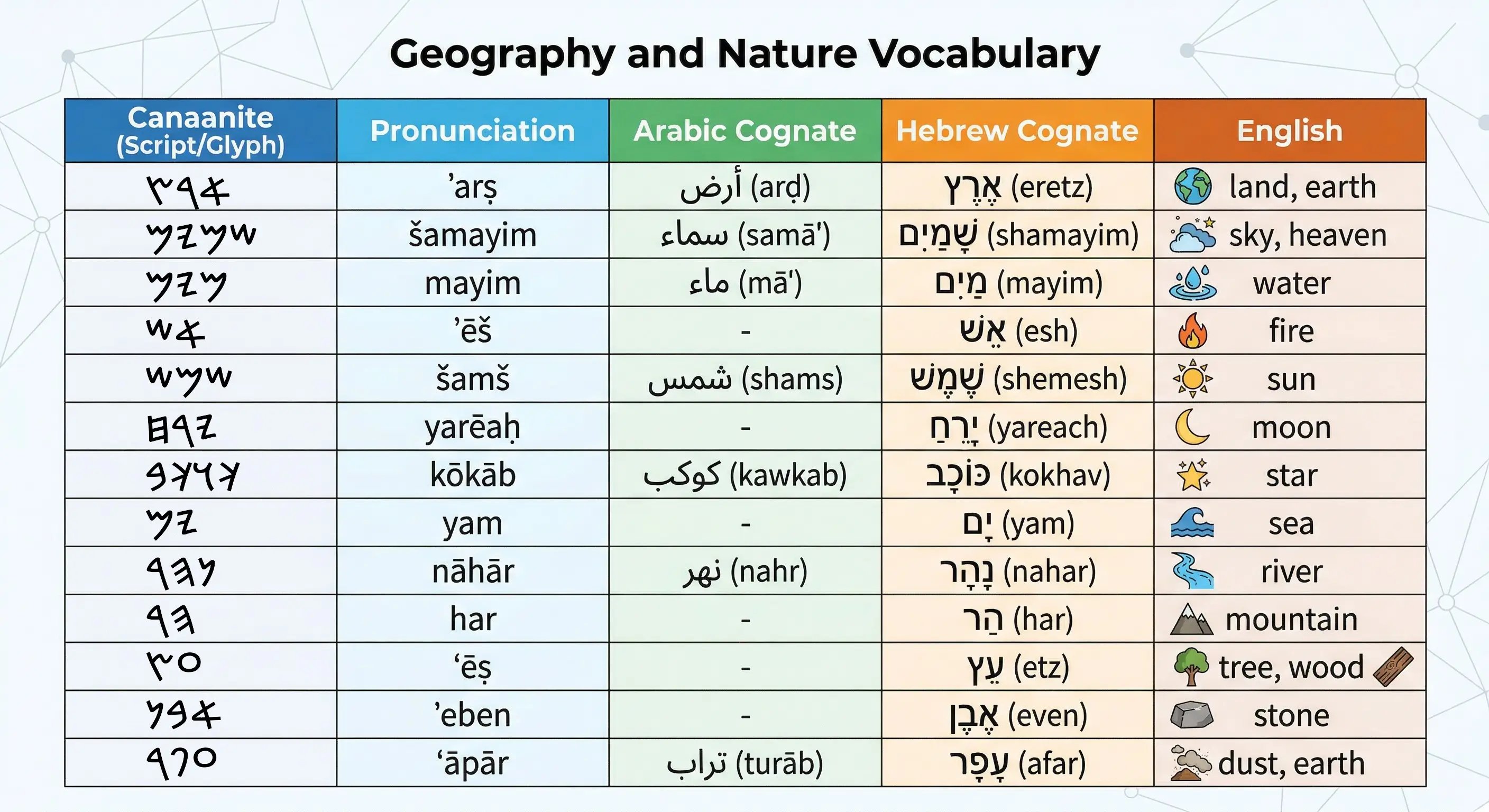 Geography and Nature Vocabulary
The Geography and Nature table roots our language directly into the soil of Palestine. The word for land itself, ʾarṣ, is the same in Canaanite and Arabic (أرض), proving we have always known exactly where we stand. Elemental forces like mayim (water), šamš (sun), and ʾēš (fire) use the same phonetic building blocks.
Canaanite / Meaning / Pronunciation | Arabic Cognate | Hebrew Cognate |
𐤀𐤓𐤑 (land, earth) ʾarṣ | أرض (arḍ) | אֶרֶץ (eretz) |
𐤔𐤌𐤉𐤌 (sky, heaven) šamayim | سماء (samāʾ) | שָׁמַיִם (shamayim) |
𐤌𐤉𐤌 (water) mayim | ماء (māʾ) | מַיִם (mayim) |
𐤀𐤔 (fire) ʾēš | - | אֵשׁ (esh) |
𐤔𐤌𐤔 (sun) šamš | شمس (shams) | שֶׁמֶשׁ (shemesh) |
𐤉𐤓𐤇 (moon) yarēaḥ | - | יָרֵחַ (yareach) |
𐤊𐤅𐤊𐤁 (star) kōkāb | كوكب (kawkab) | כּוֹכָב (kokhav) |
𐤉𐤌 (sea) yam | - | יָם (yam) |
𐤍𐤄𐤓 (river) nāhār | نهر (nahr) | נָהָר (nahar) |
𐤄𐤓 (mountain) har | - | הַר (har) |
𐤏𐤑 (tree, wood) ʿēṣ | - | עֵץ (etz) |
𐤀𐤁𐤍 (stone) ʾeben | - | אֶבֶן (even) |
𐤏𐤐𐤓 (dust, earth) ʿāpār | تراب (turāb) | עָפָר (afar) |
Domestic Life
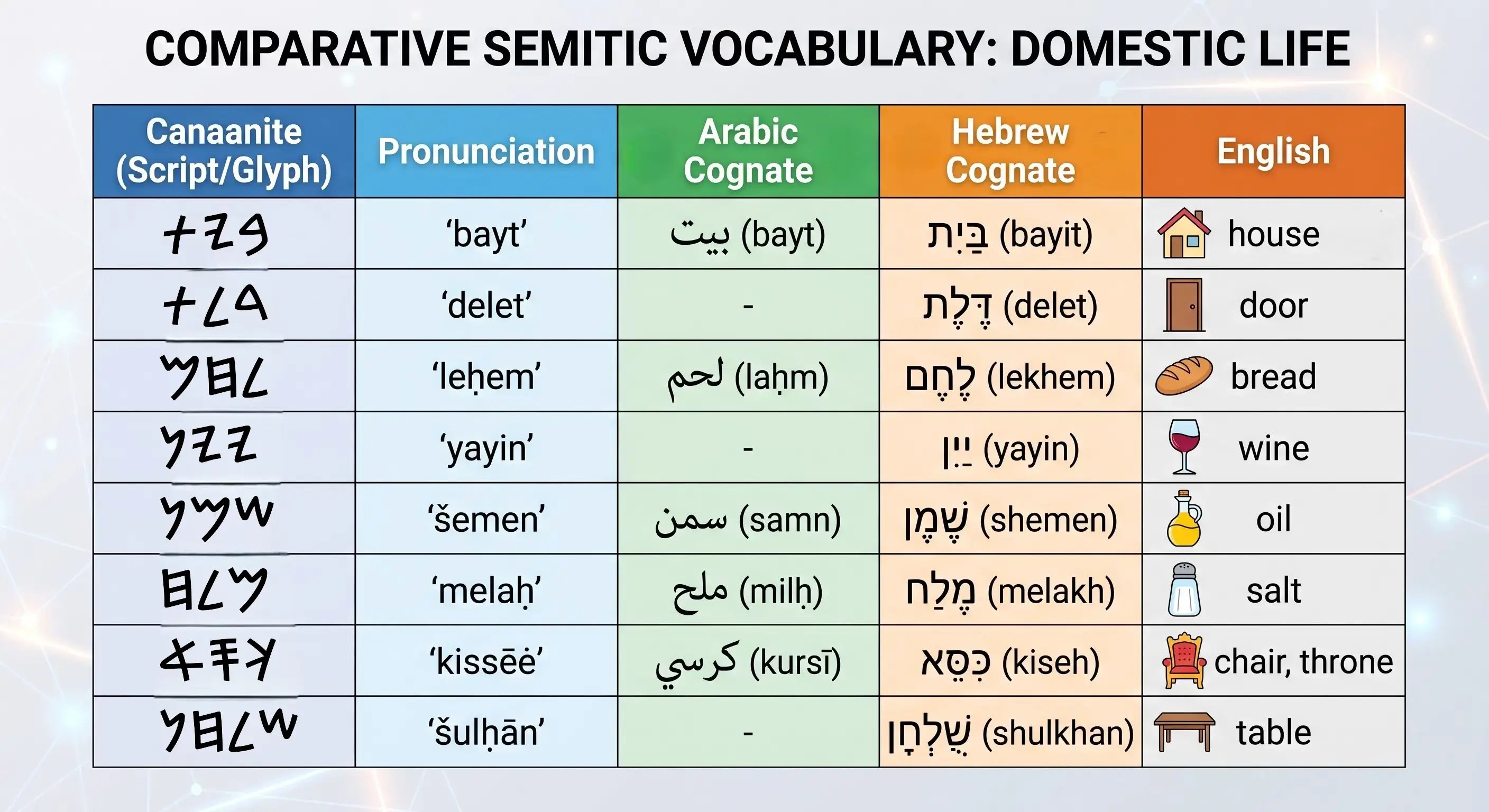 Domestic Life
Our history is built into our homes, as the Domestic Life table demonstrates. The word bayt (house) is the cornerstone of this vocabulary, followed by the delet (door) that protects it. The table shows that our daily sustenance, leḥem (bread), yayin (wine), and šemen (oil), carries the exact same names in Canaanite as it does in our traditional Levantine life. Even the furniture we use, like the kissēʾ (chair) and šulḥān (table), uses the ancient sounds that European reconstructors often struggle to pronounce correctly.
Canaanite / English | Pronunciation | Arabic Cognate | Hebrew Cognate |
|---|---|---|---|
𐤁𐤉𐤕 (house) | bayt | بيت (bayt) | בַּיִת (bayit) |
𐤃𐤋𐤕 (door) | delet | - | דֶּלֶת (delet) |
𐤋𐤇𐤌 (bread) | leḥem | لحم (laḥm) | לֶחֶם (lekhem) |
𐤉𐤉𐤍 (wine) | yayin | - | יַיִן (yayin) |
𐤔𐤌𐤍 (oil) | šemen | سمن (samn) | שֶׁמֶן (shemen) |
𐤌𐤋𐤇 (salt) | melaḥ | ملح (milḥ) | מֶלַח (melakh) |
𐤊𐤎𐤀 (chair, throne) | kissēʾ | كرسي (kursī) | כִּסֵּא (kiseh) |
𐤔𐤋𐤇𐤍 (table) | šulḥān | - | שֻׁלְחָן (shulkhanz |
Actions
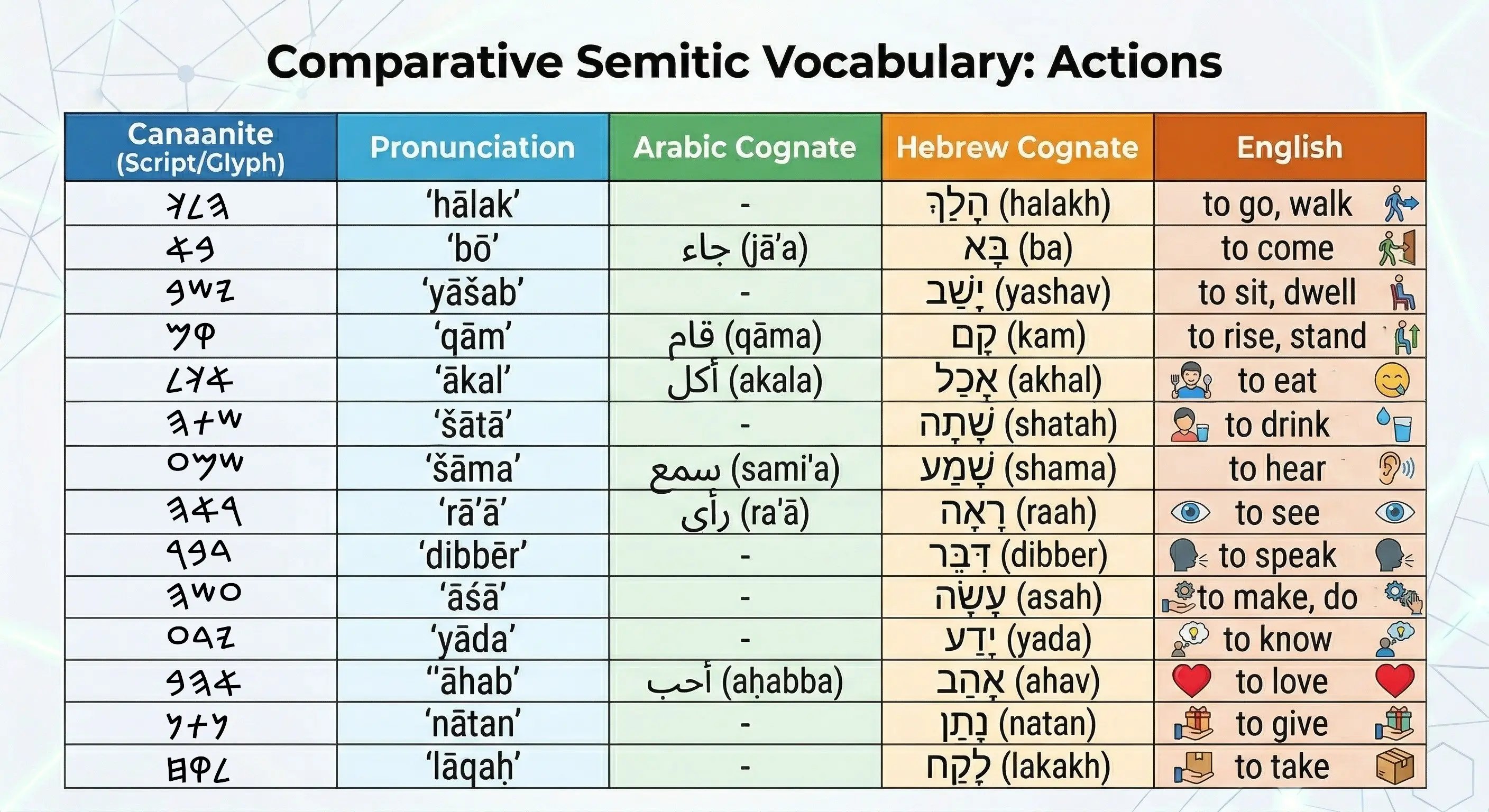 Actions
The Actions table captures the movement and daily rhythm of Canaanite life. The most fundamental human behaviors-hālak (to go), ʾākal (to eat), and šāmaʿ (to hear)-are presented here in their original forms. Notice that verbs like rāʾā (to see) and yādaʿ (to know) provide the basis for how we perceive our world. This data proves that the way we move, eat, and love (ʾāhab) is governed by a linguistic engine that has been running in Palestine since the dawn of human civilization.
Canaanite / English | Pronunciation | Arabic Cognate | Hebrew Cognate |
𐤄𐤋𐤊 (to go, walk) | hālak | - | הָלַךְ (halakh) |
𐤁𐤀 (to come) | bōʾ | جاء (jāʾa) | בָּא (ba) |
𐤉𐤔𐤁 (to sit, dwell) | yāšab | - | יָשַׁב (yashav) |
𐤒𐤌 (to rise, stand) | qām | قام (qāma) | קָם (kam) |
𐤀𐤊𐤋 (to eat) | ʾākal | أكل (akala) | אָכַל (akhal) |
𐤔𐤕𐤄 (to drink) | šātā | - | שָׁתָה (shatah) |
𐤔𐤌𐤏 (to hear) | šāmaʿ | سمع (samiʿa) | שָׁמַע (shama) |
𐤓𐤀𐤄 (to see) | rāʾā | رأى (raʾā) | רָאָה (raah) |
𐤃𐤁𐤓 (to speak) | dibbēr | - | דִּבֵּר (dibber) |
𐤏𐤔𐤄 (to make, do) | ʿāśā | - | עָשָׂה (asah) |
𐤉𐤃𐤏 (to know) | yādaʿ | - | יָדַע (yada) |
𐤀𐤄𐤁 (to love) | ʾāhab | أحب (aḥabba) | אָהַב (ahav) |
𐤍𐤕𐤍 (to give) | nātan | - | נָתַן (natan) |
𐤋𐤒𐤇 (to take) | lāqaḥ | - | לָקַח (lakakh) |
Abstract Concepts
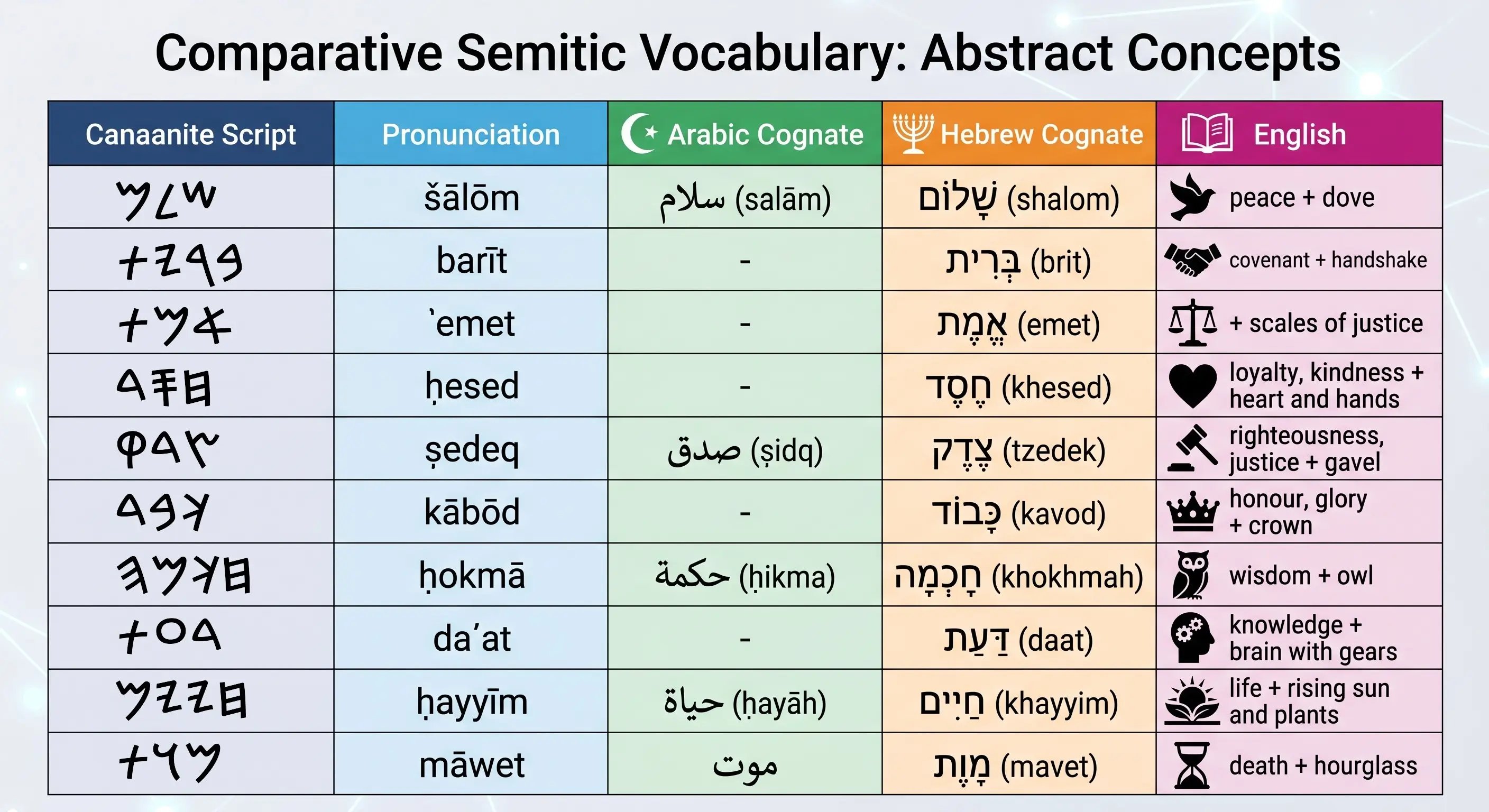 Abstract Concepts
Higher-level thought and communal values are found in the Abstract Concepts table. The word šalōm (peace) is the most famous of these, but notice also ʾemet (truth), ḥesed (loyalty), and ṣedeq (justice). These are the legal and moral pillars of ancient Canaan itself and still present in the modern Palestinian civilization. The presence of ḥayyīm (life) and māwet (death) in this table shows that the most profound philosophical questions of our people have always been expressed through this indigenous Semitic vocabulary.
Canaanite / English / Pronunciation | Arabic Cognate | Hebrew Cognate |
𐤔𐤋𐤌 (peace) šālōm | سلام (salām) | שָׁלוֹם (shalom) |
𐤁𐤓𐤉𐤕 (covenant) barīt | - | בְּרִית (brit) |
𐤀𐤌𐤕 (truth) ʾemet | - | אֱמֶת (emet) |
𐤇𐤎𐤃 (loyalty, kindness) ḥesed | - | חֶסֶד (khesed) |
𐤑𐤃𐤒 (righteousness, justice) ṣedeq | صدق (ṣidq) | צֶדֶק (tzedek) |
𐤊𐤁𐤃 (honour, glory) kābōd | - | כָּבוֹד (kavod) |
𐤇𐤊𐤌𐤄 (wisdom) ḥokmā | حكمة (ḥikma) | חָכְמָה (khokhmah) |
𐤃𐤏𐤕 (knowledge) daʿat | - | דַּעַת (daat) |
𐤇𐤉𐤉𐤌 (life) ḥayyīm | حياة (ḥayāh) | חַיִּים (khayyim) |
𐤌𐤅𐤕 (death) māwet | موت (mawt) | מָוֶת (mavet) |
Numbers
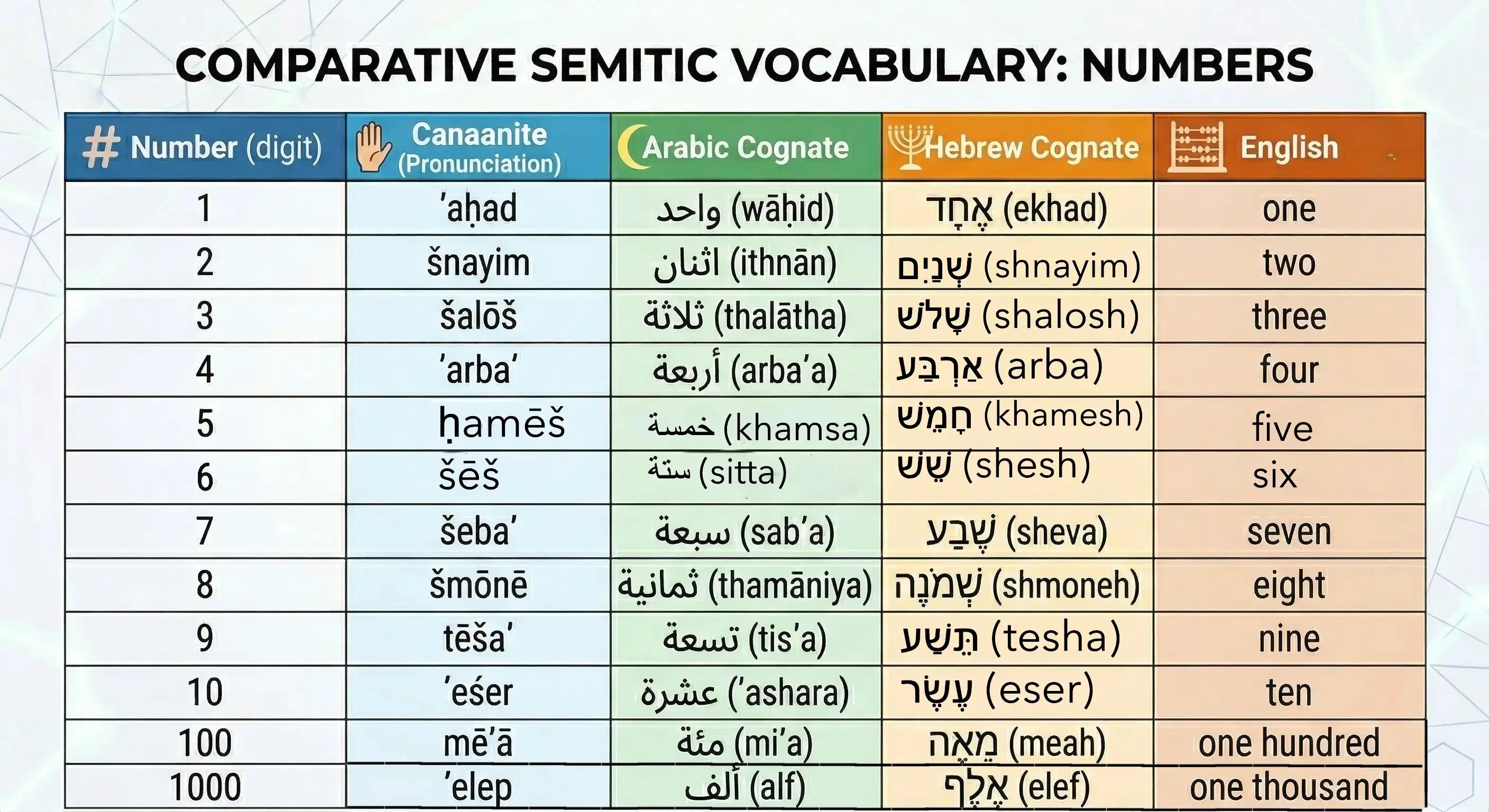 Numbers
Counting is one of the most stable parts of any language, and the Numbers table provides a clear, numerical proof of common origin. From ʾaḥad (1) and šnayim (2) to mēʾā (100) and ʾelep (1000), the phonetic similarity between Canaanite, Arabic, and Hebrew is nearly 100%. This data demonstrates that the logical and mathematical systems of the Hasanat Abu Mua'liq tribe are the same as those used by the original inhabitants of Canaan. We aren't just using the same words; we are using the same mind.
Canaanite / Number | Arabic | Hebrew |
ʾaḥad (1) | واحد (wāḥid) | אֶחָד (ekhad) |
šnayim (2) | اثنان (ithnān) | שְׁנַיִם (shnayim) |
šalōš (3) | ثلاثة (thalātha) | שָׁלֹשׁ (shalosh) |
ʾarbaʿ (4) | أربعة (arbaʿa) | אַרְבַּע (arba) |
ḥamēš (5) | خمسة (khamsa) | חָמֵשׁ (khamesh) |
šēš (6) | ستة (sitta) | שֵׁשׁ (shesh) |
šebaʿ (7) | سبعة (sabʿa) | שֶׁבַע (sheva) |
šmōnē (8) | ثمانية (thamāniya) | שְׁמֹנֶה (shmoneh) |
tēšaʿ (9) | تسعة (tisʿa) | תֵּשַׁע (tesha) |
ʿeśer (10) | عشرة (ʿashara) | עֶשֶׂר (eser) |
mēʾā (100) | مئة (miʾa) | מֵאָה (meah) |
ʾelep (1000) | ألف (alf) | אֶלֶף (elef) |
Phrases and Sentences
Stepping from individual words into full sentences is where the 𐤊𐤍𐤏𐤍𐤉 (Canaanite) script truly begins to breathe. It’s about the structural architecture of indigenous speech in the Holy Land. By assembling the letters 𐤔 (Šin), 𐤋 (Lamd), and 𐤌 (Mem), you are reclaiming a specific phonetic sequence that was carved into the landscape of Palestine long before invading people attempted to rebrand our identity.
Greetings
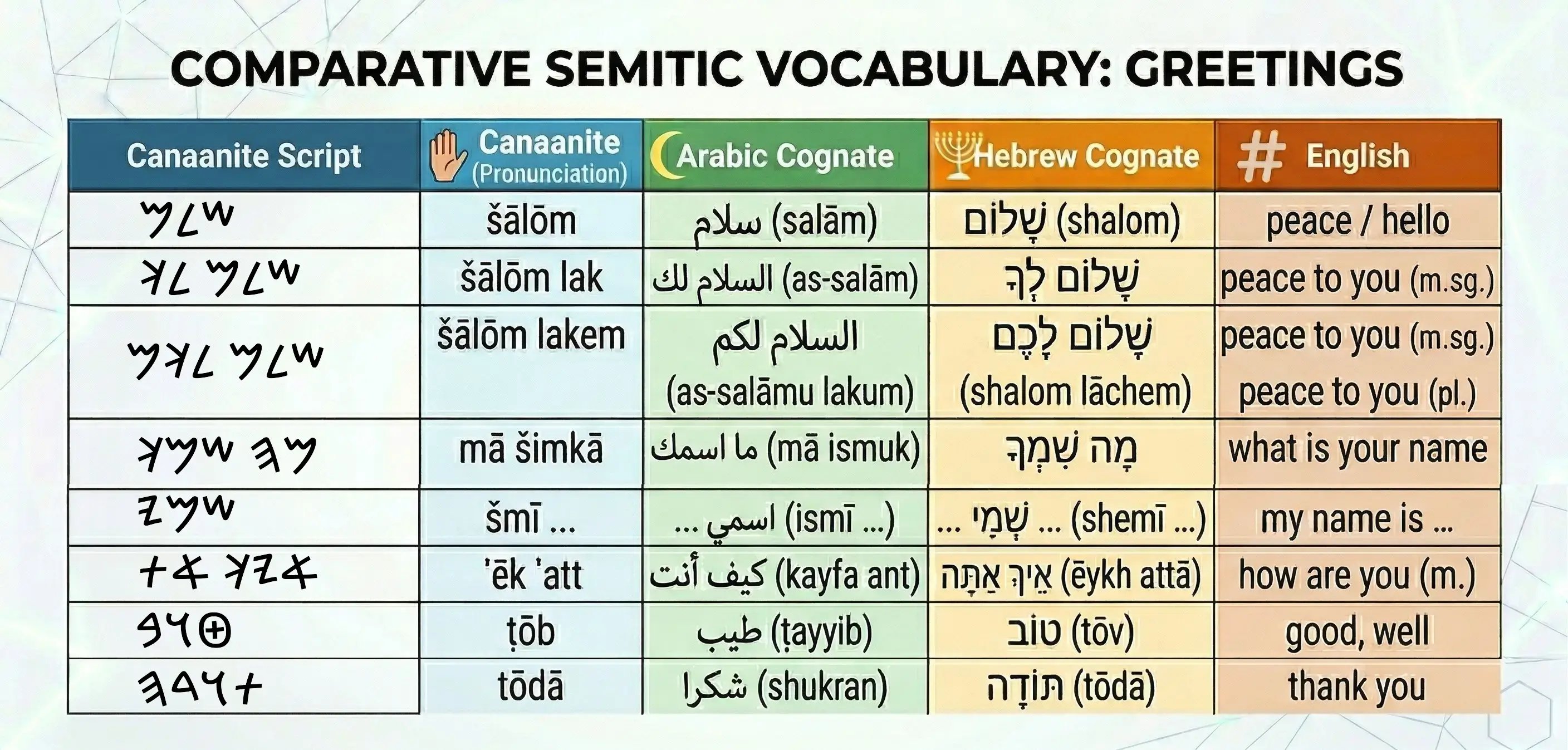 Greetings
In the script of our ancestors, a greeting like 𐤔𐤋𐤌 (šālōm) relies on the sharp, postalveolar friction of the 𐤔 (Šin), a sound that feels more grounded and aggressive than the softened "s" found in later Arabic greetings. When using the phrase 𐤔𐤋𐤌 𐤋𐤊 (šālōm lak), the script employs the 𐤊 (Kap) as a punchy, direct address. Notice the signature long "o" vowel in 𐤔𐤋𐤌; this is a specific phonetic marker of our Levantine heritage that distinguishes it from the "a" heavy patterns of the Arabian Penensuila. Speaking these phrases is about using the unique music of the 𐤔-𐤋-𐤌 letters to signal a specific presence.
Canaanite / Meaning | Pronunciation | Arabic | Hebrew |
𐤔𐤋𐤌 (peace / hello) | šālōm | سلام | שָׁלוֹם |
𐤔𐤋𐤌 𐤋𐤊 (peace to you (m.sg.)) | šālōm lak | السلام لك | שָׁלוֹם לְךָ |
𐤔𐤋𐤌 𐤋𐤊𐤌 (peace to you (pl.)) | šālōm lakem | السلام لكم | שָׁלוֹם לָכֶם |
𐤌𐤄 𐤔𐤌𐤊 (what is your name) | mā šimkā | ما اسمك | מָה שִׁמְךָ |
𐤔𐤌𐤉 (my name is …) | šmī … | اسمي … | שְׁמִי … |
𐤀𐤉𐤊 𐤀𐤕 (how are you (m.)) | ʾēk ʾatt | كيف أنت | אֵיךְ אַתָּה |
𐤈𐤅𐤁 (good, well) | ṭōb | طيب | טוֹב |
𐤕𐤅𐤃𐤄 (thank you) | tōdā | شكرا | תּוֹדָה |
Questions
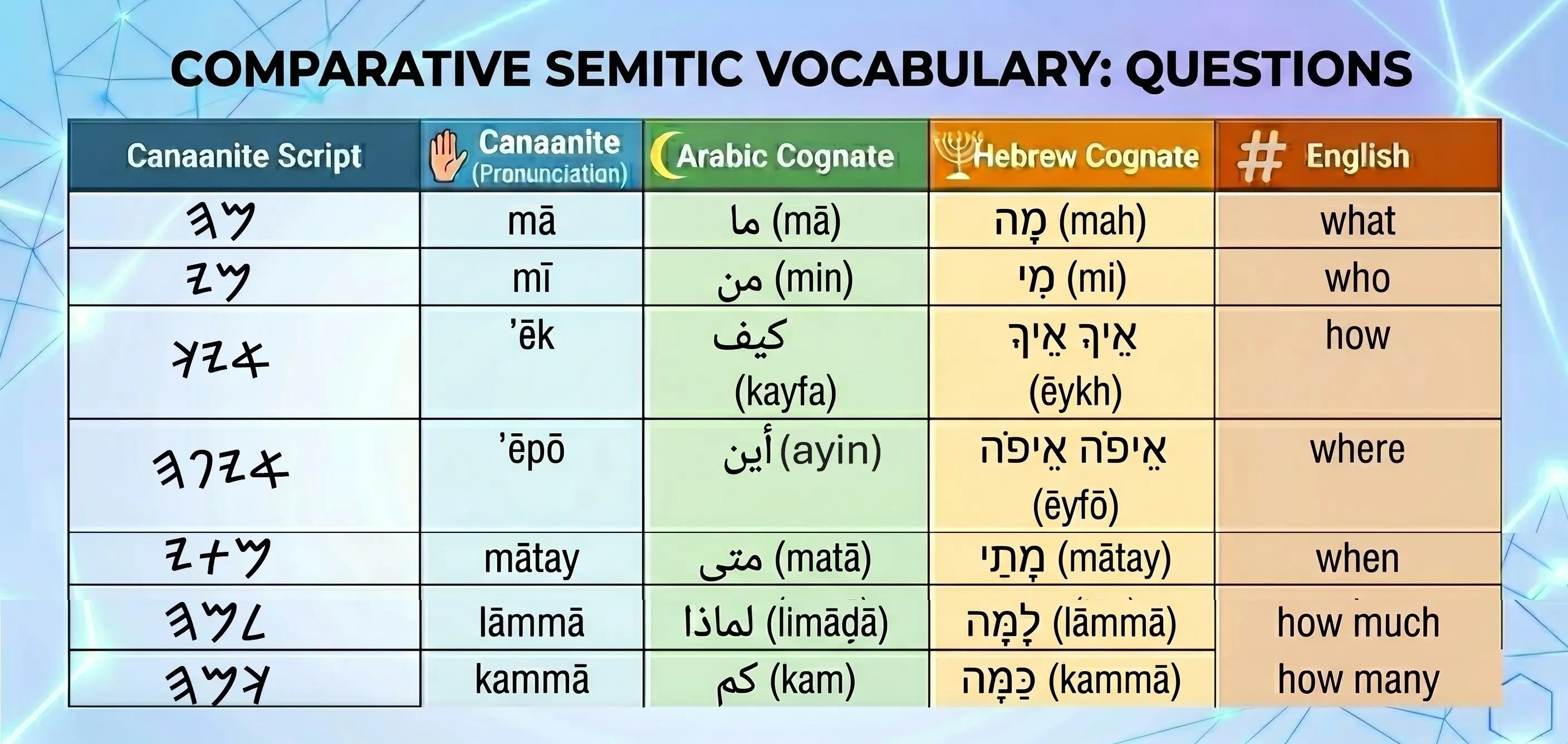 Questions
The logic of inquiry in this 22-letter system is built on concise, vowel-light symbols that demand directness. To ask "who," we use 𐤌𐤉 (mī), which utilizes the 𐤉 (Yod) to create a high, sharp sound that is entirely distinct from the Arabic man. Similarly, asking "where" with 𐤀𐤉𐤐𐤄 (ʾēpō) involves the 𐤐 (Pe) and 𐤄 (He), forming a word that is a unique linguistic signature of the Levant. These letters, 𐤌, 𐤄, 𐤉, 𐤊, 𐤐, form the skeletal frame of a system that doesn't need the elaborate flourishes or extra consonants of later scripts and languages to demand an answer.
Canaanite / Meaning | Pronunciation | Arabic | Hebrew |
𐤌𐤄 (what) | mā | ما | מָה |
𐤌𐤉 (who) | mī | من | מִי |
𐤀𐤉𐤊 (how) | ʾēk | كيف | אֵיךְ |
𐤀𐤉𐤐𐤄 (where) | ʾēpō | أين | אֵיפֹה |
𐤌𐤕𐤉 (when) | mātay | متى | מָתַי |
𐤋𐤌𐤄 (why) | lāmmā | لماذا | לָמָּה |
𐤊𐤌𐤄 (how much, how many) | kammā | كم | כַּמָּה |
Statements
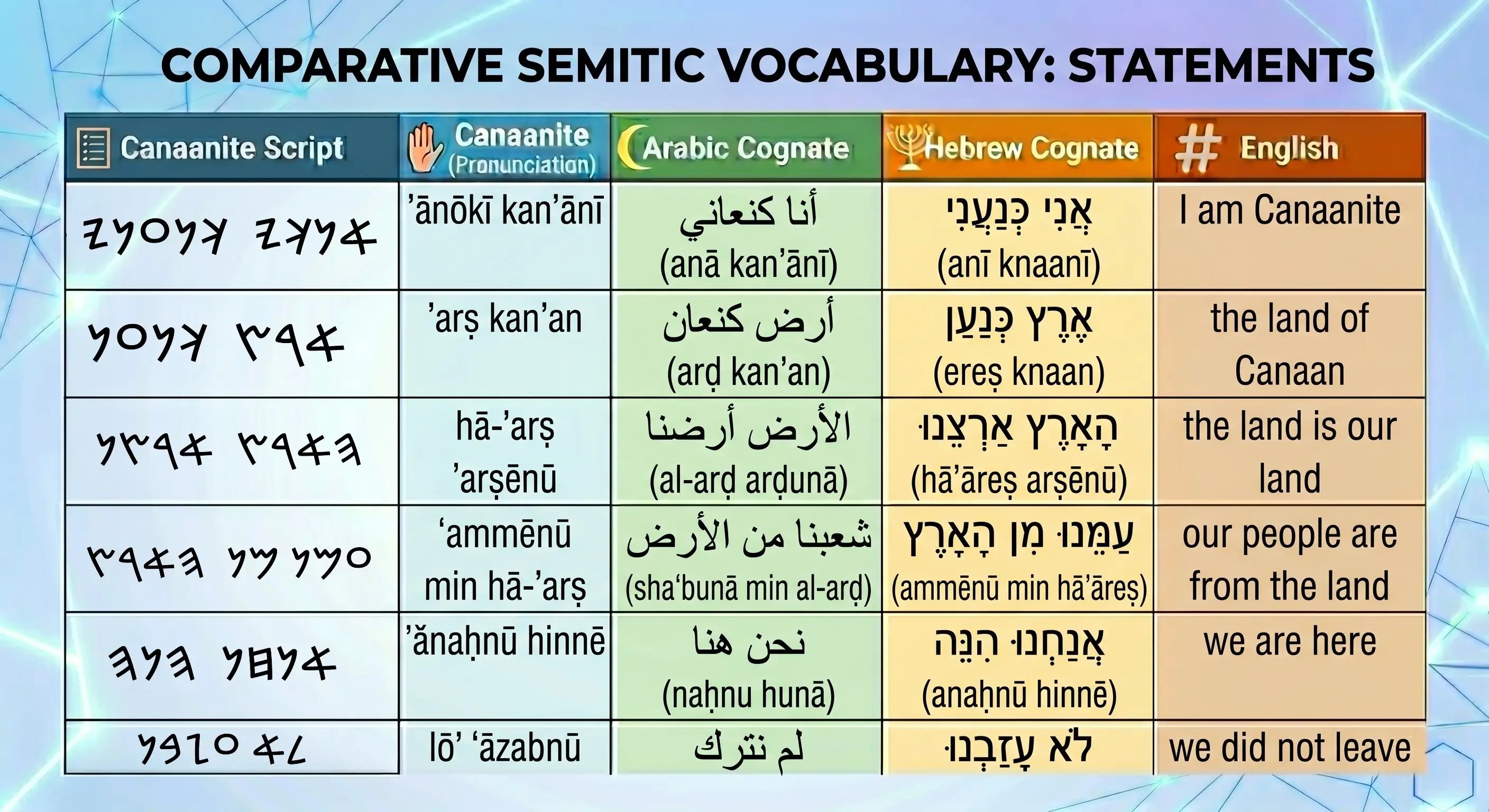 Statements
When we declare our presence, we use the ancient, full form of the first-person pronoun, 𐤀𐤍𐤊𐤉 (ʾānōkī). This four-letter word (𐤀-𐤍-𐤊-𐤉) is a heavy, foundational statement of being that sounds far more authoritative than the shortened "anā" used in Arabic and Hebrew. In the statement 𐤀𐤓𐤑 𐤊𐤍𐤏𐤍 (ʾarṣ kanʿan), we use the 𐤑 (Ṣade) and the 𐤏 (ʿAyn), two letters that carry the deep, pharyngeal resonance of the Palestinian soil. These are the specific sounds that foreign invaders and European reconstructors consistently fail to master, proving that the statement "we are here" (𐤀𐤍𐤇𐤍 𐤄𐤍𐤄) is written in a phonetic code that only the indigenous can truly unlock.
Canaanite / English | Pronunciation | Arabic | Hebrew |
𐤀𐤍𐤊𐤉 𐤊𐤍𐤏𐤍𐤉 (I am Canaanite) | ʾānōkī kanʿānī | أنا كنعاني | אֲנִי כְּנַעֲנִי |
𐤀𐤓𐤑 𐤊𐤍𐤏𐤍 (the land of Canaan) | ʾarṣ kanʿan | أرض كنعان | אֶרֶץ כְּנַעַן |
𐤄𐤀𐤓𐤑 𐤀𐤓𐤑𐤍 (the land is our land) | hā-ʾarṣ ʾarṣēnū | الأرض أرضنا | הָאָרֶץ אַרְצֵנוּ |
𐤏𐤌𐤍 𐤌𐤍 𐤄𐤀𐤓𐤑 (our people are from the land) | ʿammēnū min hā-ʾarṣ | شعبنا من الأرض | עַמֵּנוּ מִן הָאָרֶץ |
𐤀𐤍𐤇𐤍 𐤄𐤍𐤄 (we are here) | ʾănaḥnū hinnē | نحن هنا | אֲנַחְנוּ הִנֵּה |
𐤋𐤀 𐤏𐤆𐤁𐤍 (we did not leave) | lōʾ ʿāzabnū | لم نترك | לֹא עָזַבְנוּ |
Commands
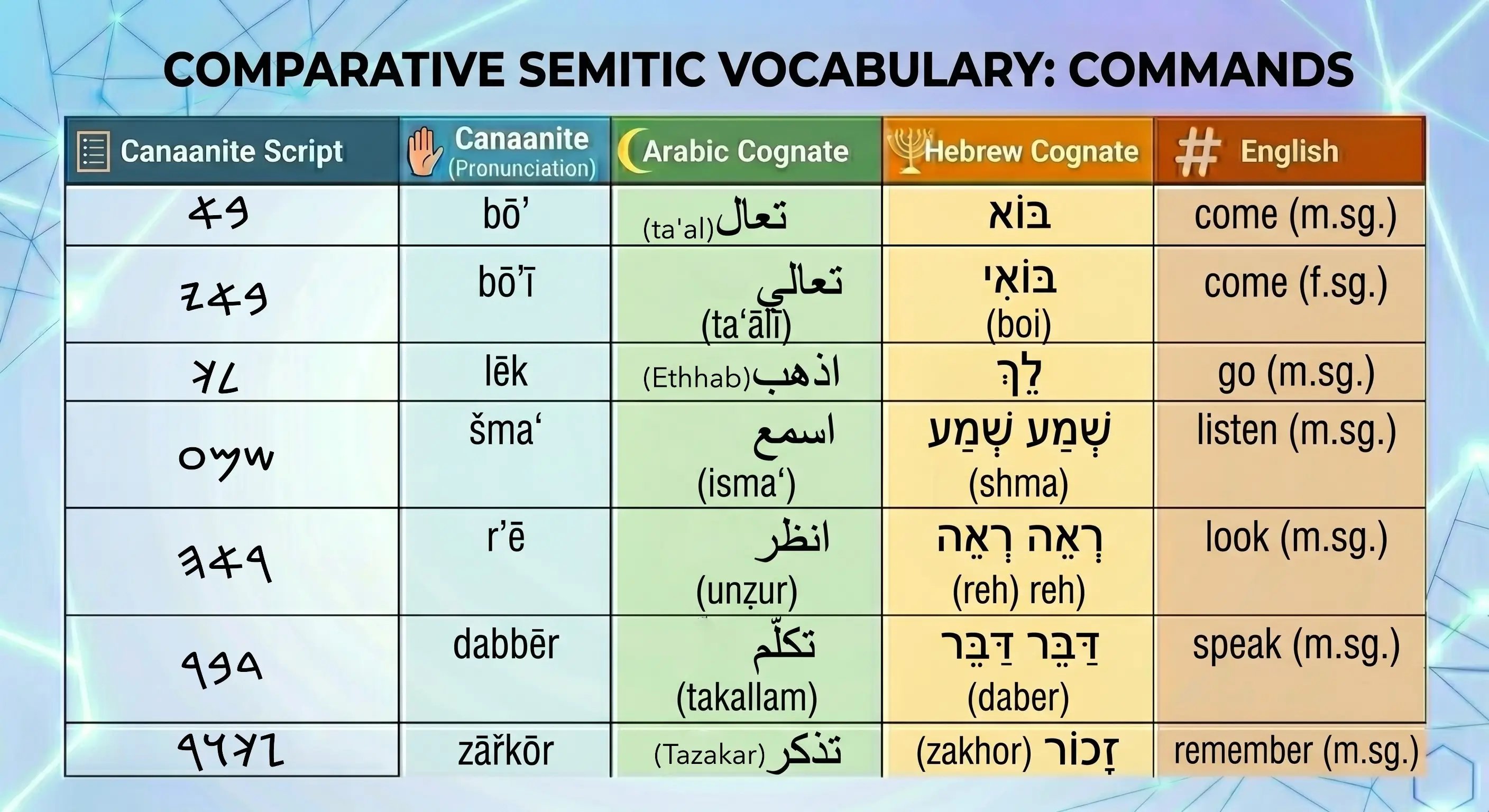 Commands
Commands in the indigenous Palestinian tongue are direct and efficient. To say "come," we use just two letters, 𐤁𐤀 (bōʾ). The glottal stop of the 𐤀 (ʾAlp) at the end gives the command a physical finality that later Arabic language lost. Compare the command "look" (𐤓𐤀𐤄 - rāʾā) to later Arabic imports; the use of the 𐤓 (Roš) and 𐤀 (ʾAlp) creates a visceral, sharp sound that demands immediate attention. These commands are the linguistic equivalent of a hammer hitting stone, clear, unyielding, and uniquely characterized by the brevity of the 22-letter alphabet.
Canaanite / Meaning | Pronunciation | Arabic | Hebrew |
𐤁𐤀 (come (m.sg.)) | bōʾ | تعال | בּוֹא |
𐤁𐤀𐤉 (come (f.sg.)) | bōʾī | تعالي | בּוֹאִי |
𐤋𐤊 (go (m.sg.)) | lēk | اذهب | לֵךְ |
𐤔𐤌𐤏 (listen (m.sg.)) | šmaʿ | اسمع | שְׁמַע |
𐤓𐤀𐤄 (look (m.sg.)) | rʾē | انظر | רְאֵה |
𐤃𐤁𐤓 (speak (m.sg.)) | dabbēr | تكلم | דַּבֵּר |
𐤆𐤊𐤅𐤓 (remember (m.sg.)) | zākōr | تذكر | זָכוֹר |
Sample Conversations
Conversation 1: Introduction
A: 𐤔𐤋𐤌 šālōm Hello.
B: 𐤔𐤋𐤌. 𐤌𐤄 𐤔𐤌𐤊? šālōm. mā šimkā? Hello. What is your name?
A: 𐤔𐤌𐤉 𐤀𐤇𐤌𐤃. 𐤅𐤌𐤄 𐤔𐤌𐤊? šmī aḥmad. wə-mā šimkā? My name is Ahmad. And what is your name?
B: 𐤔𐤌𐤉 𐤌𐤓𐤉𐤌. šmī maryam. My name is Maryam.
A: 𐤌𐤍 𐤀𐤉𐤐𐤄 𐤀𐤕? min ʾēpō ʾatt? Where are you from?
B: 𐤀𐤍𐤊𐤉 𐤌𐤍 𐤏𐤆𐤄. ʾānōkī min ġazzā. I am from Gaza.
Conversation 2: Family
A: 𐤄𐤀𐤁 𐤄𐤍𐤄? hā-ʾāb hinnē? Is the father here?
B: 𐤊𐤍. 𐤀𐤁𐤉 𐤁𐤄𐤁𐤉𐤕. kēn. ʾābī ba-ha-bayt. Yes. My father is in the house.
A: 𐤅𐤄𐤀𐤌? wə-hā-ʾēm? And the mother?
B: 𐤀𐤌𐤉 𐤂𐤌 𐤁𐤄𐤁𐤉𐤕. ʾimmī gam ba-ha-bayt. My mother is also in the house.
A: 𐤉𐤔 𐤋𐤊 𐤀𐤇𐤉𐤌? yēš ləkā ʾaḥīm? Do you have brothers?
B: 𐤊𐤍. 𐤔𐤍𐤌 𐤀𐤇𐤉𐤌 𐤅𐤀𐤇𐤅𐤕 𐤀𐤇𐤕. kēn. šnayim ʾaḥīm wə-ʾaḥōt ʾaḥat. Yes. Two brothers and one sister.
Conversation 3: Location
A: 𐤀𐤉𐤐𐤄 𐤄𐤁𐤉𐤕? ʾēpō ha-bayt? Where is the house?
B: 𐤄𐤁𐤉𐤕 𐤏𐤋 𐤄𐤄𐤓. ha-bayt ʿal ha-har. The house is on the mountain.
A: 𐤅𐤄𐤍𐤄𐤓? wə-ha-nāhār? And the river?
B: 𐤄𐤍𐤄𐤓 𐤕𐤇𐤕 𐤄𐤄𐤓. ha-nāhār taḥat ha-har. The river is below the mountain.
Linguistic Evidence for Palestinian Indigenous Status
Cognate Analysis
The vocabulary tables in this document demonstrate systematic sound correspondences between Canaanite, Arabic, and Hebrew. These correspondences follow predictable patterns that linguists use to establish genetic relationships between languages.
For example:
Canaanite š regularly corresponds to Arabic س and Hebrew שׁ
Canaanite ṣ regularly corresponds to Arabic ص and Hebrew צ
Canaanite ʿ regularly corresponds to Arabic ع and Hebrew ע
These patterns are a result from regular sound changes that occurred as daughter languages evolved from their parent language over time.
Grammatical Inheritance
The trilateral root system, the pattern of noun gender and number marking, and the verb conjugation patterns shown in this document are identical in structure across Canaanite, Arabic, and Hebrew. This grammatical inheritance proves common ancestry.
Arabic speakers do not need to learn a new grammatical system to speak Canaanite. They need only learn the vocabulary and sound correspondences. The grammatical architecture already exists in their native language because it was inherited from Canaanite.
Place Names
Palestinian place names preserve Canaanite vocabulary.
Examples include:
Bethlehem (bayt laḥm, house of bread)
Jericho (yarīḥō, from yarēaḥ, moon)
Gaza (ġazzā, strong, the original guttural /ʁ/ is preserved in Arabic غزة ghazzah; Hebrew עזה ʿazzā shows later softening to pharyngeal)
Hebron (ḥebrōn, from ḥbr, to join)
Nablus (from Neapolis, but on the site of ancient Shechem)
Jaffa (yāpō, beautiful)
These names have been used continuously by the local population for thousands of years.
Conclusion
This guide provides the foundation for learning Canaanite. The alphabet, grammar, and vocabulary presented here demonstrate the direct relationship between Canaanite and Arabic. Arabic speakers are not learning a foreign language when they study Canaanite. They are learning the ancestral form of their own language.
The linguistic evidence confirms what archaeology and genetics also confirm. Palestinians are the indigenous people of Palestine and the state of "Israel." The language spoken in Palestine today evolved directly from the language spoken here four thousand years ago. This is documented fact.
Further study should include:
Reading Canaanite inscriptions (the Gezer Calendar, the Siloam Inscription, various ostraca)
Comparative study of Phoenician texts
Analysis of Canaanite loanwords preserved in Arabic
Study of place names in Palestine that preserve Canaanite vocabulary
The Canaanite language belongs to the Children of Canaan. That is us. The Palestinians.