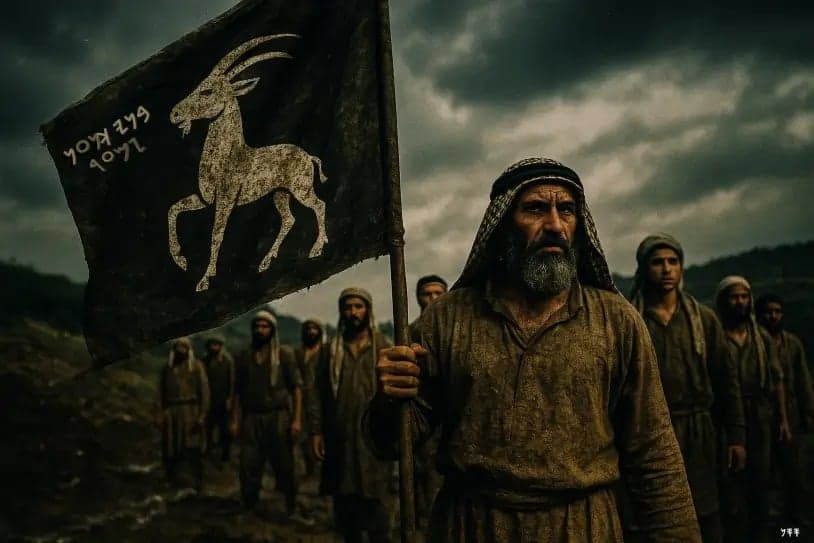

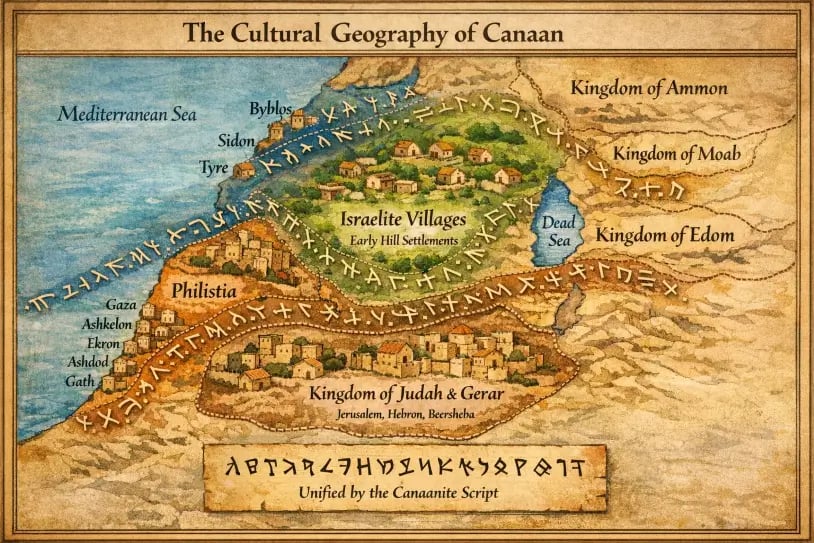
 For over two thousand years, European colonial scholarship has told the story of Palestine through a lens of invasion, extermination, and replacement. This narrative served empire. It justified colonization. It committed genocide against the indigenous peoples and attempted to erase them from their own history. But the evidence tells a radically different story, one grounded in archaeology, linguistics, genetics, and the living memory of an indigenous population that never left. The people who became "Israelites" and "Judahites" were not outsiders who invaded and destroyed. They were the original inhabitants of this land, Indigenous Canaanites whose culture evolved across millennia without interruption. Their descendants are the Palestinian people.
A Report by the Tribe of Abimelech Platform
Published by: The Tribe of Abimelech | ʿAshīrat Ḥasanāt Abū Muʿailiq
Published through: Tribe of Abimelech Platform
Date of Publication: January 4th, 2026
Subject: Reclaiming Indigenous History Through Archaeology, Language, and Cultural Continuity
THE GENOCIDE NEVER HAPPENED. THE CONQUEST NEVER OCCURRED. THE EXILE IS A MYTH. THE CANAANITES NEVER LEFT. WE ARE STILL HERE.
For over two thousand years, a fabricated narrative has dominated the history of Palestine. This narrative, constructed by biblical authors writing six to ten centuries after the events they invented, claimed that a foreign people called "Israelites" invaded Canaan, committed genocide against its inhabitants, and replaced them with a chosen race descended from Abraham of Mesopotamia.
This story is a lie.
Not a misunderstanding. Not a simplification. A deliberate, politically motivated fabrication composed by Judahite elites in the 7th through 5th centuries BCE to legitimize territorial claims and religious reforms.
The archaeological, linguistic, genetic, and cultural evidence is unambiguous and unanimous. The people who called themselves "Israelites" and "Judahites" were indigenous Canaanites. They never migrated from Mesopotamia. They never escaped from Egypt. They never wandered in the Sinai. They never conquered Jericho. They were the original inhabitants of this land, and their descendants, the Palestinian people, remain on that land today.
Bajis Hasanat Abu Mu’aliq, Founder, Tribe of Abimelech Platform
Executive Summary
This report presents the scholarly consensus that demolishes the biblical fiction of genocide and replacement. The Israelites did not destroy the Canaanites. The Israelites WERE the Canaanites. And their descendants are not the European colonizers who arrived in 1948 claiming to "return." Their descendants are the indigenous Palestinian people who never left.
THE SCHOLARLY CONSENSUS IS ABSOLUTE AND UNANIMOUS.
The people of the ancient Kingdoms of Israel and Judah were neither foreign invaders nor descendants of a mythical Abraham. They were not conquerors who destroyed the native population. They did not commit the genocide the Bible commands and celebrates. They were indigenous Canaanite communities who developed new political and religious identities over millennia while remaining on their ancestral land.
This is not a minority opinion. This is not an "Arab" or Palestinian claim. This is the dominant position in modern archaeology, articulated by every major scholar in the field, including Israeli archaeologists working at Israeli universities.
Israel Finkelstein, Professor of Archaeology at Tel Aviv University and the most influential biblical archaeologist alive, states definitively in The Bible Unearthed (2001):
The emergence of early Israel was an outcome of the collapse of the Canaanite culture, not its cause. And most of the Israelites did not come from outside Canaan - they emerged from within it.
William G. Dever, one of the foremost biblical archaeologists of the 20th century, who spent fifty years excavating in the Levant and initially sought to prove the Bible’s historicity, concluded:
The overwhelming archaeological evidence today demonstrates that the early Israelites were themselves originally Canaanites.
Thomas L. Thompson, Professor Emeritus at the University of Copenhagen, whose work helped dismantle biblical historicism:
There is no evidence of an Israelite conquest of Canaan. The Israelites were Canaanites.
Niels Peter Lemche, Professor at the University of Copenhagen:
The Israel of the Iron Age was essentially a Canaanite society.
The material culture of ancient Israel and Judah (pottery, architecture, agricultural systems, burial practices, religious iconography, dietary habits) shows unbroken continuity from the Bronze Age through the Iron Age. There is no archaeological evidence of invasion. There is no evidence of population replacement. There is no evidence of cultural rupture.
What the archaeology does NOT show: No destruction layers attributable to invading Israelites - No new pottery forms indicating a foreign population - No new architectural styles suggesting outside influence - No new burial practices marking a different culture - No new food preparation methods indicating dietary change - No weapons or fortifications suggesting military conquest
The people who lived in the highlands of Canaan in 1200 BCE were the same people who had lived there for millennia before, adapting to new political circumstances after the collapse of the Bronze Age city-state system. They changed what they called themselves. They did not change who they were.
The biblical narratives of Abraham, the Exodus from Egypt, and the Conquest of Canaan were composed between the 7th and 5th centuries BCE, 600 to 1,000 years after the events they claim to describe. They were written by authors who had no knowledge of the periods they described, as proven by the anachronisms riddling every chapter. These stories were political propaganda created by Judahite elites to legitimize territorial claims and construct a national identity. They have no historical basis whatsoever.
The Palestinian people are the living descendants of these ancient Canaanite populations, and of the communities that emerged from their mixing, including the Philistines (Egyptian: Peleset), also called the Sea Peoples. The ancient Egyptians referred to both the people and the coastal region of Canaan as Peleset, the name later preserved as Philistia. While Egyptian texts do not identify a homeland, Palestinian historians emphasize that the Peleset were part of the Canaanite world whose presence on the southern coast and the Aegean reflects continuity, not foreign intrusion. Archaeological evidence from sites like Ashkelon, Ekron, and Gaza shows that the Philistines were assimilated with the indigenous Canaanite population, using Canaanite language, religious practices, pottery styles, and burial customs within generations.
These populations (coastal Philistine-Canaanites and highland Israelite-Canaanites) coexisted, interacted, and intermarried for millennia up to the present day. The very name "Palestine" (Greek: Palaistinē; Latin: Palaestina) derives from "Philistia," preserved continuously from antiquity through Roman, Byzantine, Arab, Ottoman, and British occupation. The Palestinian people carry the heritage of all these ancient populations who lived, mixed, and remained on the land for over four thousand years.
The State of Israel, by contrast, was established in 1948 by European colonizers whose connection to the ancient land was religious mythology, not demographic descent. The Zionist claim that the State of Israel represents a "return" is a political fabrication that conflates ancient mythology with historical reality. The people with genuine descent from the ancient Israelites and Judahites are not the Ashkenazi Jews of Poland, the Sephardic Jews of Spain or the Mizrahi Jews of Morocco. They are the Palestinians who never left.
Part I: The Archaeological Destruction of Biblical Mythology
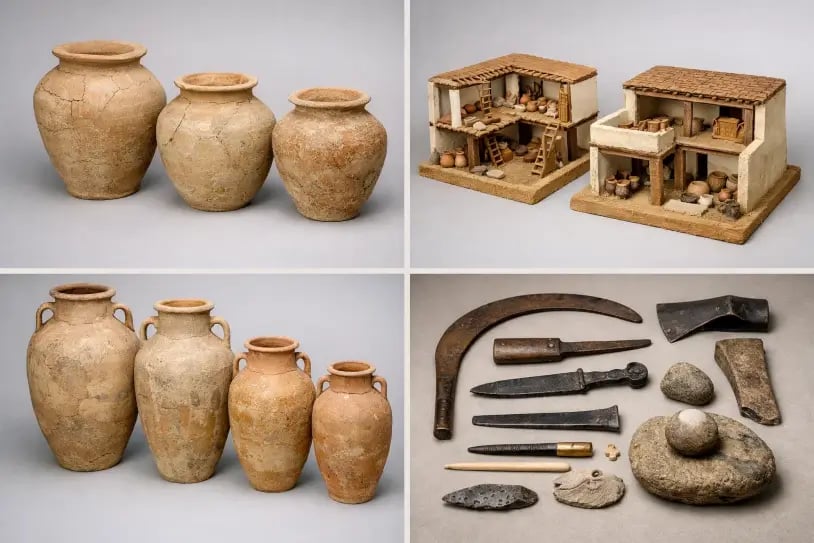 The everyday world of ancient Canaan; the same homes, tools, and landscapes carried forward by the Palestinian people who never left the Holy Land.
The pottery, houses, terraces, and tools of the Iron Age are identical to those of the Bronze Age. The language of Judah, Hebrew, is a Canaanite dialect written in a Canaanite script. The religion of early Israel grew from Canaanite traditions, not against them. The Arad ostraca, written by Judahite soldiers and officials, show a society that spoke, wrote, and worshipped as Canaanites even while adopting new political identities. This matters today. It means the Canaanites did not vanish. They were not replaced. Their descendants live across the region: Palestinians, Samaritans, and other Levantine communities who carry the deep memory of this land. Recognizing Indigenous Canaanite continuity is historically accurate. It is an act of justice, restoring a story that has been deliberately obscured for millennia.
I. The Conquest That Never Happened
THE BIBLICAL CONQUEST IS THE MOST THOROUGHLY DISPROVEN NARRATIVE IN ANCIENT HISTORY.
The Book of Joshua describes a swift, total military conquest. According to this narrative, the walls of Jericho fell at the sound of trumpets, Ai was burned, Hazor was destroyed, and the Canaanite population was exterminated in a divinely commanded genocide.
The Bible does not hide what it claims. It celebrates genocide:
Joshua 6:21 "They destroyed with the sword every living thing in it - men and women, young and old."
Joshua 10:40 "He left no survivors. He totally destroyed all who breathed."
Joshua 11:20 "For it was the LORD himself who hardened their hearts to wage war against Israel, so that he might destroy them totally, exterminating them without mercy."
This is ancient propaganda. Archaeology has proven it false in every detail.
Jericho: The Walls That Did Not Exist
Kathleen Kenyon’s excavations (1952-1958) proved conclusively that Jericho was destroyed by fire in the 16th century BCE, at least 300 years before any supposed Israelite presence. During the late 13th century BCE, when the biblical conquest would have occurred, Jericho was uninhabited. There were no walls to fall. There was no city to conquer. There was no population to slaughter. The biblical authors invented the conquest of Jericho because they were writing centuries later and had no knowledge of what actually existed at the site.
Ai: Conquering Ruins Abandoned for a Thousand Years
The site of Ai (et-Tell) suffered a violent destruction around 2400 BCE and remained abandoned for over a millennium. During the entire Late Bronze Age and the period of the supposed conquest, Ai was empty ruins. The Hebrew name "Ai" literally means "the ruin." The biblical authors invented a conquest of a city that had been abandoned for over a thousand years. This is not historical error. This is fiction.
Hazor: Destruction by Canaanites, Not Israelites
While Hazor shows evidence of destruction in the late 13th century BCE, this destruction cannot be attributed to invading Israelites. The material culture before and after the destruction shows continuity: the same people rebuilt the city. The destruction was caused by internal conflict, Egyptian campaigns, or the Bronze Age collapse. Not by invading Israelites who did not exist as a distinct population.
Other Conquest Claims: All Disproven
Lachish: Destroyed by Egyptians, not Israelites
Gibeon: Did not exist as a city during the conquest period
Hebron: Unoccupied during the supposed conquest
Arad: Abandoned centuries before Joshua supposedly destroyed it
Not one conquest claim has been verified. Every site that has been excavated has disproven the biblical narrative.
The Merneptah Stele: Egypt Proves Israel Was Canaanite
The Merneptah Stele (c. 1207 BCE), the earliest reference to "Israel" outside the Bible, describes Israel as a people already living in Canaan, not as recent arrivals from Egypt. The Egyptian pharaoh describes them as one of many Canaanite groups in the region. If Israel had just arrived from Egypt after forty years in the wilderness, why does an Egyptian monument treat them as an established Canaanite population? Because they never came from Egypt. They were always Canaanites.
The Scholarly Consensus Is Unanimous:
Israel Finkelstein:
The conquest narratives are devoid of historical reality.
William G. Dever:
The Israelite ‘conquest’ of Canaan simply did not happen.
Amihai Mazar, Professor at Hebrew University:
There is no archaeological evidence supporting a military conquest of Canaan.
The Israelites did not conquer Canaan because they were already there. They did not destroy the Canaanites because they WERE the Canaanites.
II. The Highland Villages
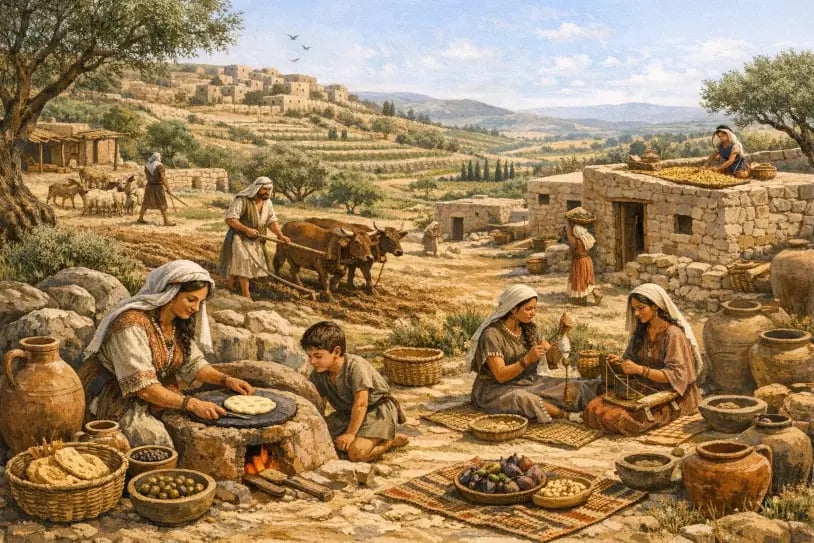 The children of Canaan built one of the earliest civilizations on Earth. They introduced the language spoken today by many, and they are considered pioneers of culture, history and religion.
Canaanites Reorganizing, Not Invaders Arriving
The Iron Age I period (c. 1200-1000 BCE) saw a dramatic increase in small village settlements in the central highlands of Canaan. For decades, some scholars interpreted these villages as evidence of incoming Israelite settlers. This interpretation has been thoroughly and definitively refuted.
The material culture of these highland villages is identical to Bronze Age Canaanite culture:
The same pottery forms (including the famous "collared-rim jars" once mistakenly called "Israelite")
The same four-room house architecture
The same agricultural terracing techniques
The same food preparation methods
The same burial practices
The same religious iconography
The same tool types and manufacturing techniques
There is no foreign influence. There is no cultural break. There is no evidence of a new population arriving from outside. There is nothing in the material record that suggests invasion, migration, or population replacement.
The highland villages represent indigenous Canaanite communities reorganizing in response to the collapse of the Bronze Age city-state system and the withdrawal of Egyptian imperial control. When the lowland cities collapsed, the people did not disappear. They moved to the highlands and established new communities. The people who settled these villages were not newcomers. They were indigenous Canaanites moving from lowland urban centers to highland rural communities, adapting their settlement patterns while maintaining their cultural identity.
Proof of Indigenous Knowledge
The agricultural terraces found throughout the highlands provide decisive evidence of population continuity. Building and maintaining these terraces requires generations of accumulated knowledge about local soil conditions, rainfall patterns, seasonal cycles, and water management. This knowledge cannot be acquired quickly. It is passed down through families over centuries.
An incoming population would not possess this knowledge. They would not know which hillsides retain water, which soils support which crops, when to plant and when to harvest in this specific microclimate. The terraces prove that the people who farmed these highlands in the Iron Age were the descendants of the people who had farmed them for centuries. The terraces are physical proof of indigenous continuity.
III. When the Bible Was Actually Written
The question of when the Hebrew Bible was composed is central to understanding why its historical claims are worthless. The biblical narratives of Abraham, the Exodus, and the Conquest were not written by witnesses or even by people with access to witnesses. They were composed centuries after the supposed events by authors with clear political agendas who had no knowledge of the periods they claimed to describe.
The Documentary Hypothesis, developed by Julius Wellhausen and refined through subsequent scholarship, demonstrates that the Torah (Pentateuch) was composed from multiple sources written between the 10th and 5th centuries BCE, with final editing occurring during the Persian period (539-333 BCE). The conquest narratives in Joshua were composed even later, primarily during the reign of King Josiah (640-609 BCE) as propaganda to support his territorial expansion and religious reforms.
THE BIBLE WAS WRITTEN 600 TO 1,000 YEARS AFTER THE EVENTS IT CLAIMS TO DESCRIBE.
This is not ancient history. This is ancient fiction, written by people who had no idea what the world looked like during the periods they invented.
Anachronisms That Expose the Authors’ Ignorance
The biblical texts are riddled with references to things that did not exist during the periods they describe, proving beyond doubt that the authors were writing about a distant past they did not understand.
Camels.
The patriarchal narratives in Genesis describe Abraham, Isaac, and Jacob using domesticated camels as common transport and wealth animals. Archaeological evidence proves camels were not domesticated in the southern Levant until the 10th century BCE at the earliest, over a thousand years after the supposed time of Abraham. The authors invented camel caravans because camels were common in their own 7th-century world, not because they had any authentic knowledge of the patriarchal period. This is not an oversight. This is proof the authors were lying.
Philistines
Genesis 21 and 26 describe Abraham and Isaac interacting with Philistines and their king Abimelech of Gerar. Conventional scholarship dismisses this as an anachronism, claiming the Philistines did not exist in Canaan until approximately 1175 BCE when the "Sea Peoples" arrived from the Aegean. But even this conventional view misses a crucial truth that reinforces the central thesis of this report.
The so-called "Sea Peoples" were not foreign invaders. They were Canaanites returning home.
Archaeological and linguistic evidence suggests that Canaanite populations had migrated to Crete and the Aegean islands centuries earlier, maintaining maritime trade connections with their homeland throughout the Bronze Age. Around 1200 BCE, during the Bronze Age collapse, these Canaanite descendants returned to their ancestral coastal territories, bringing Aegean cultural influences with them. What scholars call the "arrival of the Philistines" was actually the homecoming of a Canaanite diaspora.
This suggests that the biblical reference to Philistines in the Abraham narratives may represent a preserved memory of earlier coastal Canaanite groups rather than a strict anachronism; we note this distinction for clarity. The name "Philistine" referred to coastal Canaanites long before the return migration, the original population from which the Aegean migrants descended. The Genesis narratives may preserve an authentic memory of this ancient coastal Canaanite culture. Rather than proving the authors' ignorance, this detail may inadvertently confirm the indigenous continuity of the coastal population.
This understanding also demolishes the colonial narrative that portrays modern Palestinians as disconnected from the ancient "Philistines." In reality, both names, Philistine and Palestinian, refer to the same indigenous coastal Canaanite population across millennia. The people who stayed, the people who migrated and returned, and all their descendants who remained on the land.
Arameans
The patriarchal narratives contain details that reflect a much later historical reality rather than the era they claim to describe. They refer to an "Aramean" identity and to regions such as Aram‑Naharaim and Paddan‑Aram, yet the Arameans do not appear in historical records until the 11th century BCE, centuries after the supposed time of the patriarchs. Genesis 36 lists a sequence of Edomite kings who allegedly ruled "before any king reigned over Israel," even though archaeology shows that Edom did not develop a settled population, urban centers, or a state structure until the 8th-7th centuries BCE. The Joseph story describes caravans trading in gum, balm, and myrrh, commodities associated with the Arabian incense trade that only flourished under the Assyrian commercial system of the 8th-7th centuries BCE. Taken together, these details reveal that the authors were writing from within a late Iron Age world and projecting their own social, political, and economic realities onto a distant, imagined past.
Political Propaganda Matching 7th-Century Judahite Ambitions
The conquest narratives describe borders, enemies, and territorial claims that precisely match the geopolitical situation of King Josiah’s reign (640-609 BCE), not any earlier period:
The boundaries described in Joshua match Josiah’s expansionist ambitions into former northern Israelite territory after Assyrian withdrawal
The obsessive emphasis on destroying "high places" and centralizing worship in Jerusalem reflects Josiah’s religious reforms, not ancient practice
The vilification of specific peoples (Canaanites, Amorites, Hittites, Perizzites, Hivites, Jebusites) served to delegitimize non-Judahite populations in territories Josiah claimed
The repeated theme of total conquest and divine command to exterminate justified Josiah’s territorial claims as the fulfillment of ancient prophecy
The conquest narratives were not history. They were royal propaganda designed to legitimize a 7th-century land grab by clothing it in the garments of divine mandate.
Theological Agenda Exposed by Archaeology
The strict monotheism and centralized Jerusalem worship demanded in Deuteronomy and Joshua is contradicted by every piece of archaeological evidence from earlier periods:
Kuntillet Ajrud and Khirbet el-Qom inscriptions prove that Yahweh was worshipped alongside Asherah as late as 800 BCE. These inscriptions invoke "Yahweh and his Asherah" as a divine couple, exactly as one would expect in a Canaanite religious context.
Household shrines containing goddess figurines are found throughout Israel and Judah from every period before the exile, demonstrating that the common people never abandoned their Canaanite religious practices.
The Elephantine papyri from 5th-century BCE Egypt show Judeans worshipping Yahweh alongside other deities centuries after the supposed reforms of Josiah, proof that even after the exile, monotheism had not taken hold. No evidence of centralized worship exists before the late 7th century BCE. The biblical authors were not recording ancient history, they were rewriting it to serve a religious reform agenda that most of the population actively resisted.
As Finkelstein and Silberman conclude:
There is clear archaeological evidence that places the stories themselves in a late 7th-century BCE context. - Finkelstein and Silberman
THE BIBLE IS NOT A HISTORY BOOK. IT IS A POLITICAL MANIFESTO DISGUISED AS ANCIENT HISTORY.
The biblical texts are propaganda written centuries after the events they claim to describe, composed by Judahite elites to legitimize their power, justify territorial expansion, and impose religious uniformity on populations who remembered their actual Canaanite heritage.
Part II: Linguistic and Cultural Evidence for Canaanite Continuity
IV. Hebrew Is a Canaanite Language
Linguistics provides irrefutable evidence that the Israelites were Canaanites. Hebrew is not a separate language that arrived with foreign invaders. It is a Canaanite dialect, part of the same language family as Phoenician, Moabite, Ammonite, and Edomite.
The Canaanite languages share distinctive features that set them apart from other Semitic languages:
The Canaanite vowel shift (ā → ō) - This unique phonological change occurs in all Canaanite languages and nowhere else in the Semitic family
Shared vocabulary and grammatical structures - The core vocabulary of Hebrew is indistinguishable from other Canaanite languages
Common religious and administrative terminology - Temple, sacrifice, and governance terms are shared across all Canaanite cultures
Identical poetic conventions - The parallelism and meter of Hebrew poetry is found in Ugaritic texts centuries earlier
Hebrew preserves these Canaanite features. The religious vocabulary of ancient Israel, El, Baal, Asherah, Yam, is Canaanite vocabulary. The names of Israelite kings and ordinary people follow Canaanite naming conventions. The structure of Hebrew poetry mirrors Canaanite poetry known from Ugarit. There is no linguistic evidence of a foreign population imposing a new language. Hebrew developed organically within the Canaanite linguistic continuum.
As linguist William Schniedewind states:
Hebrew is not the language of invaders. It is the language of the land itself.
V. The Paleo-Hebrew Script Is Canaanite Writing
The script used in ancient Judah, Paleo-Hebrew, is a direct descendant of the Proto-Canaanite alphabet. The evolution from Proto-Canaanite to Phoenician to Paleo-Hebrew represents continuous development within the same scribal tradition, not the adoption of a foreign writing system by incoming conquerors.
The Arad ostraca, inscribed pottery sherds from the Judahite fortress at Arad, dating to the late 7th and early 6th centuries BCE, demonstrate this continuity. These administrative texts, recording military supplies and correspondence, are written in Paleo-Hebrew using conventions identical to those found in Phoenician inscriptions. The people who wrote these texts were Canaanites using a Canaanite script to conduct Canaanite administrative practices.
Additional evidence:
The Gezer Calendar (10th century BCE) - Written in a script indistinguishable from contemporary Phoenician
The Siloam Inscription (8th century BCE) - Commemorating Jerusalem’s tunnel construction in pure Canaanite script
Seal impressions from throughout Judah - Using naming conventions and script styles identical to those from Phoenician cities
VI. Religious Continuity. Yahwism Emerged from Canaanite Religion
Early Israelite religion was not a foreign import. It evolved from Canaanite religious traditions. The archaeological evidence proves that Yahweh was originally worshipped alongside other Canaanite deities, particularly Asherah.
Kuntillet Ajrud inscriptions (c. 800 BCE) invoke "Yahweh of Samaria and his Asherah" and "Yahweh of Teman and his Asherah." These inscriptions prove that even centuries after the supposed conquest, Israelites were worshipping Yahweh as part of the Canaanite pantheon, with Asherah as his consort, exactly as one would expect if the Israelites were Canaanites.
Khirbet el-Qom inscriptions similarly reference "Yahweh and his Asherah." Archaeological evidence from household shrines throughout Israel and Judah shows continued veneration of Canaanite deities and figurines.
The "Pillar Figurines" found in abundance throughout Judah represent Asherah. These were not foreign influences. They were the religion of the indigenous population.
The strict monotheism described in the Bible was a late development, promoted by religious reformers in the 7th century BCE and later. It does not reflect the actual religious practices of ancient Israel and Judah, which remained rooted in Canaanite tradition for centuries.
Mark S. Smith, author of The Early History of God, concludes:
Israelite religion was a subset of Canaanite religion. The evidence for this is overwhelming.
Part III: The Fabrication of Biblical Identity
VII. The Abraham Myth. Inventing a Foreign Ancestor
The biblical narrative of Abraham functions as identity-building mythology, not historical memory. The story of Abraham’s migration from Mesopotamia to Canaan served to create an artificial distinction between "Israelites" and "Canaanites", a distinction that did not exist in reality.
Genealogical narratives were common in the ancient Near East as tools for legitimizing political claims and unifying diverse populations. The Abraham story provided a framework for the emerging Israelite polity to claim divine sanction for territorial control while distancing themselves from their own Canaanite origins.
The archaeological record shows no evidence of any migration from Mesopotamia. The population of the highlands in the Iron Age was indigenous. The Abraham narrative is a literary creation designed to construct a mythological past, not a record of actual demographic movements.
VIII. The Exodus Myth. No Evidence Whatsoever
The Exodus narrative has no archaeological support whatsoever.
The story of Israelite slaves departing Egypt, wandering forty years in the wilderness, and eventually arriving in Canaan is a complete fabrication:
No Egyptian record exists of a large enslaved Israelite population
No record of their departure appears in any ancient source
No evidence of wilderness wandering has ever been found in the Sinai, an environment where forty years of habitation by hundreds of thousands of people would leave abundant archaeological traces
No evidence of their arrival in Canaan exists in the archaeological record
As Carol Redmount states:
The actual evidence for the Exodus is zilch. There is no physical evidence that the Exodus happened. Zero.
The Exodus story, like the conquest and genocide narrative, was composed centuries after the supposed events to serve the ideological needs of later Judahite society. It provided a founding myth of liberation and divine favor, but it has no historical basis.
Part IV: New Evidence and Suppressed Truths
IX. The Myth of Jewish Exile. Most Jews Were Never Expelled
One of the most consequential lies in history is the claim that the Jewish people were "exiled" from Palestine after the Roman destruction of the Second Temple in 70 CE and the Bar Kokhba revolt in 135 CE. This narrative, central to Zionist ideology, claims that the entire Jewish population was expelled, wandered in diaspora for two thousand years, and then "returned" in the 20th century.
THIS IS HISTORICALLY FALSE. THE ROMANS DID NOT EXPEL THE JEWISH POPULATION OF PALESTINE.
The Romans destroyed the Temple and crushed the revolts, but they did not, and could not, remove an entire agricultural population from the land. Mass deportation of farming populations was not Roman policy and would have been economically catastrophic for the empire, which depended on local agricultural production. The Romans wanted tax revenue from productive land, not empty territory.
What actually happened is documented by scholars including Shlomo Sand (Tel Aviv University) in The Invention of the Jewish People (2008): the majority of the Jewish population of Palestine remained on the land. Over the following centuries, they converted, first to Christianity under Byzantine rule, then to Islam after the Arab conquest in the 7th century. They never left. They changed their religion and eventually their language, but they remained on the same land, farming the same terraces, living in the same villages.
The ancestors of today’s Palestinians, including the descendants of ancient Judeans and Israelites who later adopted Christianity and Islam, constitute a significant portion of the enduring indigenous population of Palestine, particularly in the area now labeled by colonial terminology as the "West Bank." Their presence and identity persist despite the political alliances between the Persian Gulf states that are hellbent on their total destruction, and Western Christian states that support and arm the State of Israel.
This is not speculation. It is the logical consequence of documented history. If the Judeans and Israelites were not expelled (and they were not), and if the land remained continuously inhabited (and it did), then the subsequent population must include their descendants.
The Jewish diaspora communities of Europe, North Africa, and elsewhere grew primarily through conversion, not exile. Judaism was an actively proselytizing religion in the Hellenistic and Roman periods, and Jewish communities spread throughout the Mediterranean world through conversion of local populations. The Ashkenazi Jews of Eastern Europe, the Sephardic Jews of Spain, and other diaspora communities are largely descended from converts, not from exiled Palestinians.
This means the Zionist claim of "return" is doubly false. The ancient "Jews" were not exiled, and modern diaspora Jews are largely not descended from ancient Palestinians. The people with the strongest claim to descent from the ancient population are the Palestinians themselves.
X. Palestinian Place Names. The Canaanite Map That Survived
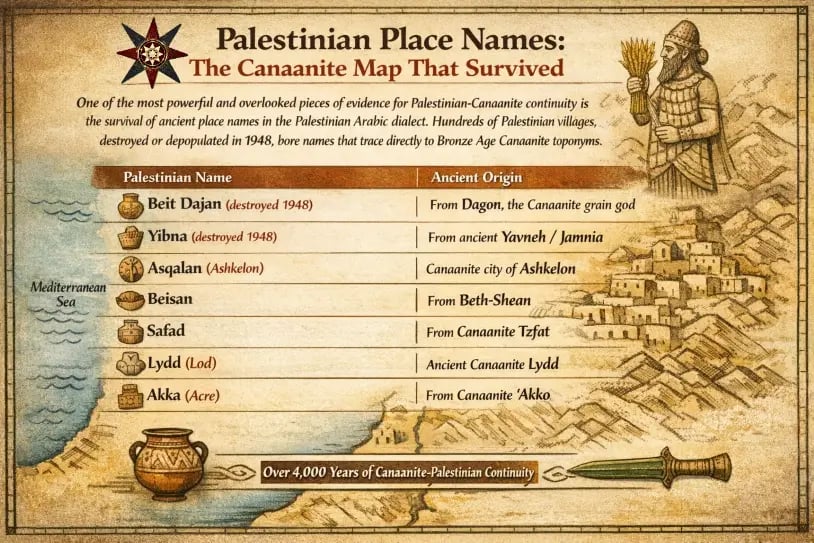 One of the most powerful and overlooked pieces of evidence for Palestinian-Canaanite continuity is the survival of ancient place names in the Palestinian Arabic dialect.
Hundreds of Palestinian villages, destroyed or depopulated in 1948 by European immigrants, bore names that trace directly to Bronze Age Canaanite toponyms, a linguistic continuity spanning over four thousand years.
Examples of this naming continuity:
Palestinian Name | Ancient Origin |
Beit Dajan (destroyed 1948) | Preserves the name of Dagon, the Canaanite grain deity |
Yibna (destroyed 1948) | Preserves ancient Yavneh/Jamnia |
Asqalan (Ashkelon) | Preserves the Canaanite city name from Bronze Age sources |
Beisan | Preserves Beth-Shean, documented in Egyptian and Canaanite texts |
Safad | Preserves Tzfat, a Canaanite toponym |
Lydd (Lod) | Preserves a name documented in ancient Canaanite sources |
Akka (Acre) | Preserves the Bronze Age Canaanite name ’Akko |
This is not coincidence. Place names survive when populations remain continuous. When a new population conquers and commits genocide against an existing one, place names typically change. The conquerors impose their own names or cannot pronounce the indigenous names.
The survival of Canaanite place names in Palestinian Arabic proves that the population was never replaced. The same families, living in the same villages, passed down the same names generation after generation for three thousand years.
The destruction of Palestinian villages in 1948 by illegal European and American immigrants to Palestine was accompanied by a systematic renaming project. Ancient Palestinian/Canaanite names were erased and replaced with invented Hebrew names to create the illusion of an ancient Jewish presence. This was the deliberate destruction of evidence. The Canaanite toponymic record, preserved for millennia by the Palestinian population, was being erased within living memory.
XI. The Canaanite Calendar Lives in Palestinian Agriculture
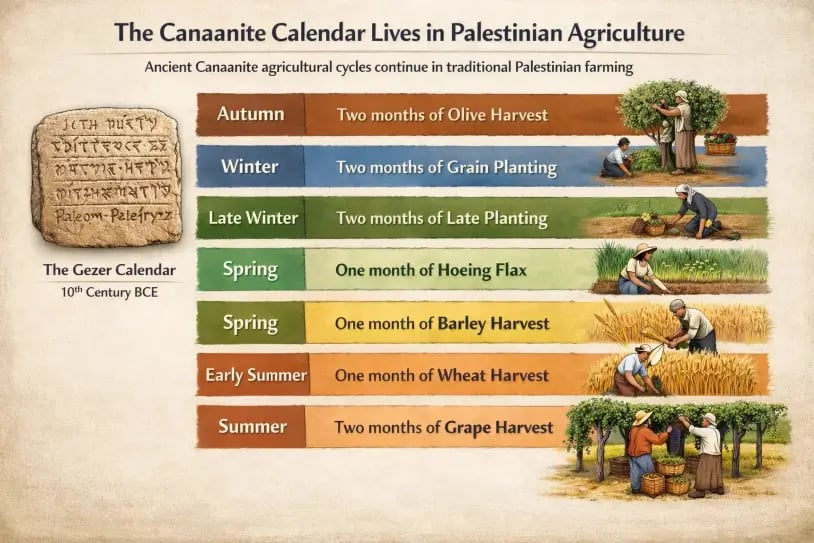 Palestinian traditional agriculture follows seasonal patterns that correspond exactly to the ancient Canaanite agricultural calendar, evidence of continuous farming practice spanning millennia.
The Gezer Calendar, a 10th-century BCE inscription discovered in 1908, lists agricultural activities by month in a pattern still recognizable in traditional Palestinian farming:
Season | Activity |
Autumn | Two months of olive harvest |
Winter | Two months of grain planting |
Late Winter | Two months of late planting |
Spring | One month of hoeing flax |
Spring | One month of barley harvest |
Early Summer | One month of wheat harvest |
Summer | Two months of grape harvest |
Palestinian farmers, before the disruption of 1948, followed essentially the same calendar, planting and harvesting the same crops in the same seasons using techniques passed down through continuous agricultural practice. This is not cultural borrowing. It is direct inheritance. The knowledge of when to plant, when to harvest, how to manage terraces, how to press olives, how to prune vines was transmitted from parent to child for over a hundred generations.
Traditional Palestinian olive cultivation is particularly significant. The olive tree takes decades to mature and can live for centuries. Ancient olive groves in Palestine, some with trees over a thousand years old, represent continuous cultivation by the same communities across generations. These trees were planted by the ancestors of the families who still tended them before 1948. Many of these ancient groves have been destroyed by European immigrants of the State of Israel, erasing yet more evidence of indigenous continuity.
XII. The Deliberate Genocide of Canaanite Identity
Why did the biblical authors work so hard to claim that the Canaanites were exterminated?
Why did they invent an elaborate mythology of foreign origin when they were indigenous to the land? Understanding the political function of this genocide narrative reveals the ideological project at the heart of biblical historiography.
The Canaanite extermination narrative served multiple purposes for the Judahite elite who composed it:
1. Legitimizing Land Claims
By claiming divine command to exterminate the previous inhabitants, the biblical authors established that their ownership of the land was absolute and unchallengeable. If the Canaanites were destroyed by divine decree, no one could claim prior rights.
2. Creating Ethnic Distinction
The Judahite elite needed to distinguish themselves from neighboring peoples for political purposes. By inventing a foreign origin (Abraham from Mesopotamia), they could claim to be fundamentally different from the Canaanites, even though linguistically, culturally, and ethnically they were Canaanites.
3. Religious Reform
The 7th-century BCE religious reforms promoted by King Josiah required delegitimizing the traditional Canaanite religious practices that most Israelites and Judahites still followed. By portraying Canaanite religion as the abomination of a destroyed enemy people, the reformers could attack their own population’s religious traditions without appearing to attack their own ancestors.
4. Ideological Warfare Against Their Own Heritage
The biblical authors were Canaanites who systematically erased their own Canaanite identity, inventing a fiction of foreign origin and indigenous extermination that has poisoned historical understanding ever since.
Part V: Living Proof of Canaanite Continuity
XIII. The Samaritan Proof. Living Witnesses to Israelite Continuity
The Samaritan community provides irrefutable living proof that the ancient Israelite population was never exiled. The Samaritans are descendants of the ancient Israelites of the northern kingdom who were never expelled and never left. They have maintained continuous presence on Mount Gerizim in Palestine for over 2,700 years without conversion to Christianity or Islam.
The Samaritans preserve:
An ancient form of Hebrew script (Samaritan script, descended from Paleo-Hebrew)
Their own version of the Torah (Samaritan Pentateuch)
Continuous religious practice including Passover sacrifice
Unbroken genealogical records tracing their families for centuries
The existence of the Samaritans demolishes the exile narrative. If the Israelites were exiled by the Assyrians (northern kingdom, 722 BCE) and the Babylonians (southern kingdom, 586 BCE), how do the Samaritans exist? They exist because the exile narrative is false. The Samaritans are the descendants of Israelites who stayed, just as the Palestinians are the descendants of Judahites and other Canaanites who stayed.
The Samaritans also demonstrate what happens when an ancient Israelite community maintains its religious identity without leaving: they remain in Palestine. The Samaritans did not go to Poland. They did not go to Morocco. They stayed on their mountain, maintained their traditions, and remain there today. This is what unbroken continuity looks like, and it looks nothing like the Zionist narrative of exile and return.
XIV. Indigenous Palestinian Tribes with Recorded Canaanite Lineage
Beyond the Samaritans, several indigenous Palestinian tribes preserve documented genealogies tracing their ancestry directly to ancient Canaanite populations. These living communities provide contemporary proof of unbroken Canaanite continuity in Palestine.
The Tribe of Brahman
The Tribe of Brahman of Tel es-Safi/Gath is an indigenous Palestinian tribe whose recorded genealogy traces back to Canaanite origins. Their documented lineage demonstrates the continuous presence of Canaanite-descended populations in Palestine through Roman, Byzantine, Islamic, Ottoman, and modern periods. The tribe has maintained oral histories, genealogical records, and territorial connections that predate the Islamic conquest by centuries.
Full documentation: A Historical Overview of the Indigenous Palestinian Tribe of Brahman
The Tribe of Zamairah
The Tribe of Zamairah of Halhoul represents another documented case of indigenous Canaanite-Palestinian continuity. Colonial attempts to rewrite Palestinian genealogy and erase pre-Islamic indigenous identities failed to eliminate the tribe's recorded Canaanite heritage. Their genealogical records survived colonial historiography and demonstrate that Palestinian tribal identity extends deep into the Canaanite past.
Full documentation: Tribe of Zamairah and Colonial Rewriting of Palestinian Genealogy
The Tribe of Hasanat Abu Mu'aliq (Abimelech)
The Tribe of Hasanat Abu Mu'aliq of Bir es-Sab'a/Beersheba, also known as the Tribe of Abimelech, is another endangered indigenous Canaanite-Palestinian tribe with documented presence from Beersheba to Gaza, to Hebron, Jerusalem and Haifa. The tribe's genealogical records and territorial history demonstrate unbroken Canaanite continuity in southern Palestine. Despite facing displacement and erasure under colonial occupation, the tribe has preserved its genealogy, oral traditions, and Canaanite identity through the present day.
The Tribe of Abimelech Platform, founded by members of this tribe, serves to document and preserve indigenous Palestinian-Canaanite heritage against ongoing attempts at historical erasure.
Full documentation: From Beersheba to Gaza: The Endangered Hasanat Abu Mu'aliq Tribe
These documented tribes prove:
Canaanite genealogical continuity exists in living Palestinian communities today
Indigenous Palestinian identity predates Islam by millennia
Colonial scholarship deliberately obscured Canaanite-Palestinian continuity
The Palestinian people are not "Arab invaders" but indigenous Canaanites who adopted Arabic language after the 7th century CE
XV. Biblical Plagiarism. How Israelites Stole Canaanite Literature
The Hebrew Bible is not original literature. Major portions of it are borrowed, adapted, or directly plagiarized from earlier Canaanite texts, further proof that the Israelites were Canaanites drawing on their own cultural heritage, not foreigners with a distinct tradition.
The discovery of the Ugaritic texts at Ras Shamra (ancient Ugarit) beginning in 1929 revealed the source material for much of biblical literature:
The Baal Cycle
The Canaanite epic of Baal’s conflict with Yam (Sea) and Mot (Death) provides the template for biblical descriptions of Yahweh’s conflict with sea monsters (Leviathan, Rahab) and death. Psalm 74, Isaiah 27, and Job 26 contain direct echoes of Ugaritic poetry.
Creation imagery
Biblical descriptions of creation draw on Canaanite cosmological concepts. The "deep" (tehom) over which God’s spirit hovers in Genesis 1 is cognate with Tiamat, the chaos sea of Near Eastern mythology.
Divine Council
The Hebrew Bible’s references to the "sons of God" (bene elohim) and the divine council (Psalm 82, Job 1-2) reflect the Canaanite pantheon structure preserved in Ugaritic texts, where El presides over an assembly of gods.
Poetic Forms
The parallelism, meter, and imagery of biblical poetry are indistinguishable from Ugaritic poetry. The Song of Deborah (Judges 5), among the oldest biblical texts, uses poetic conventions documented in 14th-century BCE Ugaritic literature.
THE BIBLICAL AUTHORS DID NOT RECEIVE DIVINE REVELATION INDEPENDENT OF THEIR CULTURAL CONTEXT.
They inherited a Canaanite literary tradition and adapted it for their own purposes. The God of the Bible is a Canaanite god, reimagined as the exclusive deity of a people who were trying to forget their Canaanite identity.
XVI. The Palestinian Christian Witness. 2,000 Years of Unbroken Presence
Palestinian Christians represent an unbroken chain of indigenous presence from the 1st century CE to the present, two thousand years of continuous habitation that predates Islam, the Arab conquests, and the Crusades.
The earliest Christian communities in Jerusalem, Bethlehem, Nazareth, and throughout Palestine were composed of local converts, Canaanite-descended Jews and Samaritans who accepted the new faith. These communities never left. They maintained their presence through Byzantine rule, Persian invasion, Arab conquest, Crusader occupation, Mamluk rule, Ottoman rule, British occupation, and the State of Israel’s occupation.
THE EXISTENCE OF PALESTINIAN CHRISTIANS DEMOLISHES THE RACIST NARRATIVE THAT PALESTINIANS ARE "ARAB INVADERS" WHO ARRIVED WITH THE ISLAMIC CONQUEST OF THE 7TH CENTURY.
The ancestors of Palestinian Christians were in Palestine before the Arabs arrived. They were there before Muhammad was born. They were there before the Quran was written. They were the indigenous Canaanite population that had lived on the land for millennia, continuing their presence into the Christian era.
Many Palestinian Christian families can trace their presence in specific villages for centuries, with church records, property documents, and family traditions documenting continuous habitation. The same families that worshipped in Byzantine churches still worship in the same churches today, when those churches haven’t been destroyed or confiscated by the State of Israel.
XVII. The Palestinian People. Living Descendants of Ancient Canaan
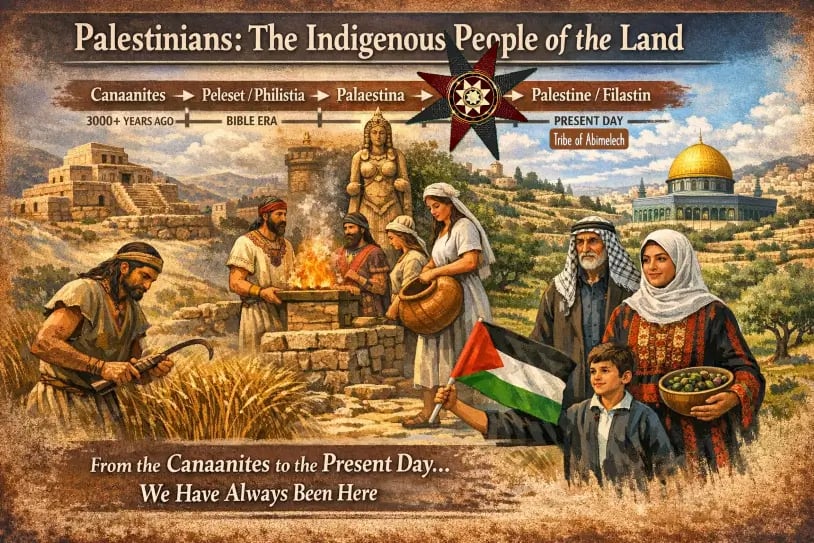 The name of the land itself testifies to this continuity: Peleset/Philistia → Palaestina → Palestine. This geographic designation has persisted for millennia, predating every modern political claim.
The indigenous Palestinian population represents the living continuation of ancient Canaanite civilization. Palestinians have continuously inhabited this land for thousands of years, maintaining agricultural practices, place names, cultural traditions, and community structures that trace directly to ancient times.
When the Bible was being written in the 7th-5th centuries BCE, the ancestors of today’s Palestinians were farming the same terraces, worshipping at the same shrines, speaking related Semitic languages, and living in the same villages that their ancestors had occupied for a thousand years before that. The Palestinian people are not newcomers. They are the indigenous population.
XVIII. The State of Israel. A European and American Colonial Project Without Historical Legitimacy
The State of Israel was established in 1948 through a settler-colonial movement that committed genocide against the native population and continues to do so and is composed primarily of European immigrants that entered Palestine illegally under the British occupation. The Zionist movement claimed that Jews were "returning" to their ancient homeland after two thousand years of exile. This claim conflates religious mythology with historical reality.
The founders of the State of Israel came from Poland, Ukraine, Russia, Germany, and other European countries. Their connection to the ancient land was religious and ideological, not demographic. The ancient Israelites and Judahites were indigenous Canaanites who remained in the land. They became today’s Palestinians, not today’s European Jewish population.
The claim that modern Israel represents the restoration of an ancient nation is historically incoherent. The ancient kingdoms of Israel and Judah were composed of indigenous Canaanite populations. Modern Israel is composed primarily of descendants of diaspora communities from Europe and elsewhere. These are not the same population, regardless of religious tradition.
XIX. Reclaiming the True History
For too long, the history of Palestine has been told through the lens of biblical mythology and colonial propaganda. The true history, supported by archaeology, linguistics, and material culture, tells a different story.
The Canaanites were not exterminated. They were never replaced. They adapted, evolved, and developed new political and religious identities over centuries while remaining on their ancestral land. The people who called themselves Israelites and Judahites were Canaanites. Their descendants are the Palestinian people.
Recognizing this history is not merely an academic exercise. It is an act of justice. It restores a narrative that has been systematically suppressed. It affirms the indigenous rights of the Palestinian people. And it exposes the mythological foundations of claims that have been used to justify dispossession and violence.
THE CANAANITES NEVER LEFT. THEY ARE STILL HERE. THEY ARE CALLED PALESTINIANS.
Conclusion
The evidence presented in this report goes beyond the standard Western academic consensus to expose truths that have been systematically suppressed:
The ancient Israelites and Judahites were indigenous Canaanites who developed new political and religious identities within their ancestral homeland. They never came from anywhere else.
The biblical narratives of Abraham, the Exodus, and the Conquest are mythological constructions composed centuries after the supposed events, designed to erase the Canaanites’ own Canaanite identity.
The "Jewish exile" is a myth. The Romans did not expel the Jewish population of Palestine. The ancient Jews stayed on the land and converted, first to Christianity, then to Islam. Their descendants are the Palestinians.
Palestinian place names preserve Canaanite toponyms spanning four to five thousand years, evidence of unbroken population continuity that the European ruling class of the State of Israel has systematically destroyed through genocide, demolition, and renaming.
The Samaritan community proves that ancient Israelites who never left Palestine look nothing like the European Jewish populations who arrived in 1948 claiming to "return."
Indigenous Palestinian tribes including the Brahman, Zamairah, and Hasanat Abu Mu'aliq preserve documented Canaanite genealogies proving unbroken continuity.
Palestinian Christians have maintained continuous presence for two thousand years, predating Islam and the Arab conquests, proof that Palestinians are not "Arab invaders."
The Hebrew Bible plagiarized Canaanite literature, because its authors were Canaanites borrowing from their own cultural heritage while pretending to be foreigners.
Modern claims of Jewish "return" are historically incoherent. The people with genuine descent from the ancient population are the Palestinians, not European diaspora communities largely descended from converts.
The mythology of conquest, exile, and return has been used to justify one of the greatest crimes of the modern era: the dispossession of an indigenous people of the Holy Land from their ancestral homeland.
THIS MYTHOLOGY MUST BE DISMANTLED. THE TRUTH MUST BE TOLD.
The Canaanites were never exterminated. The Jews were never exiled. The land was never empty.
The people of Palestine are the indigenous inhabitants. They have always been there. They remain there still, despite seventy-seven years of ethnic cleansing and genocide, despite the destruction of over 500 indigenous villages, despite the systematic erasure of their history.
THE CANAANITES NEVER LEFT. THEY ARE STILL HERE. THEY ARE CALLED PALESTINIANS.
Bibliography
Primary Sources on Suppressed History
Sand, Shlomo. The Invention of the Jewish People. London: Verso, 2009.
Sand, Shlomo. The Invention of the Land of Israel. London: Verso, 2012.
Masalha, Nur. The Palestine Nakba: Decolonising History, Narrating the Subaltern, Reclaiming Memory. London: Zed Books, 2012.
Masalha, Nur. The Bible and Zionism: Invented Traditions, Archaeology and Post-Colonialism in Palestine-Israel. London: Zed Books, 2007.
Whitelam, Keith W. The Invention of Ancient Israel: The Silencing of Palestinian History. London: Routledge, 1996.
Pappé, Ilan. The Ethnic Cleansing of Palestine. Oxford: Oneworld, 2006.
Khalidi, Walid. All That Remains: The Palestinian Villages Occupied and Depopulated by Israel in 1948. Washington: Institute for Palestine Studies, 1992.
Archaeological and Historical Sources
Dever, William G. Who Were the Early Israelites and Where Did They Come From? Grand Rapids: Eerdmans, 2003.
Finkelstein, Israel, and Neil Asher Silberman. The Bible Unearthed: Archaeology’s New Vision of Ancient Israel and the Origin of Its Sacred Texts. New York: Free Press, 2001.
Finkelstein, Israel, and Neil Asher Silberman. David and Solomon: In Search of the Bible’s Sacred Kings and the Roots of the Western Tradition. New York: Free Press, 2006.
Kenyon, Kathleen. Digging Up Jericho. London: Ernest Benn, 1957.
Lemche, Niels Peter. The Canaanites and Their Land: The Tradition of the Canaanites. Sheffield: JSOT Press, 1991.
Mazar, Amihai. Archaeology of the Land of the Bible: 10,000–586 BCE. New York: Doubleday, 1990.
Niditch, Susan. War in the Hebrew Bible: A Study in the Ethics of Violence. Oxford: Oxford University Press, 1993.
Redford, Donald B. Egypt, Canaan, and Israel in Ancient Times. Princeton: Princeton University Press, 1992.
Thompson, Thomas L. The Mythic Past: Biblical Archaeology and the Myth of Israel. New York: Basic Books, 1999.
Ugaritic and Canaanite Sources
Smith, Mark S. The Early History of God: Yahweh and the Other Deities in Ancient Israel. Grand Rapids: Eerdmans, 2002.
Day, John. Yahweh and the Gods and Goddesses of Canaan. Sheffield: Sheffield Academic Press, 2000.
Parker, Simon B., ed. Ugaritic Narrative Poetry. Atlanta: Scholars Press, 1997.
Samaritan Studies
Crown, Alan D. The Samaritans. Tübingen: Mohr Siebeck, 1989.
Pummer, Reinhard. The Samaritans: A Profile. Grand Rapids: Eerdmans, 2016.